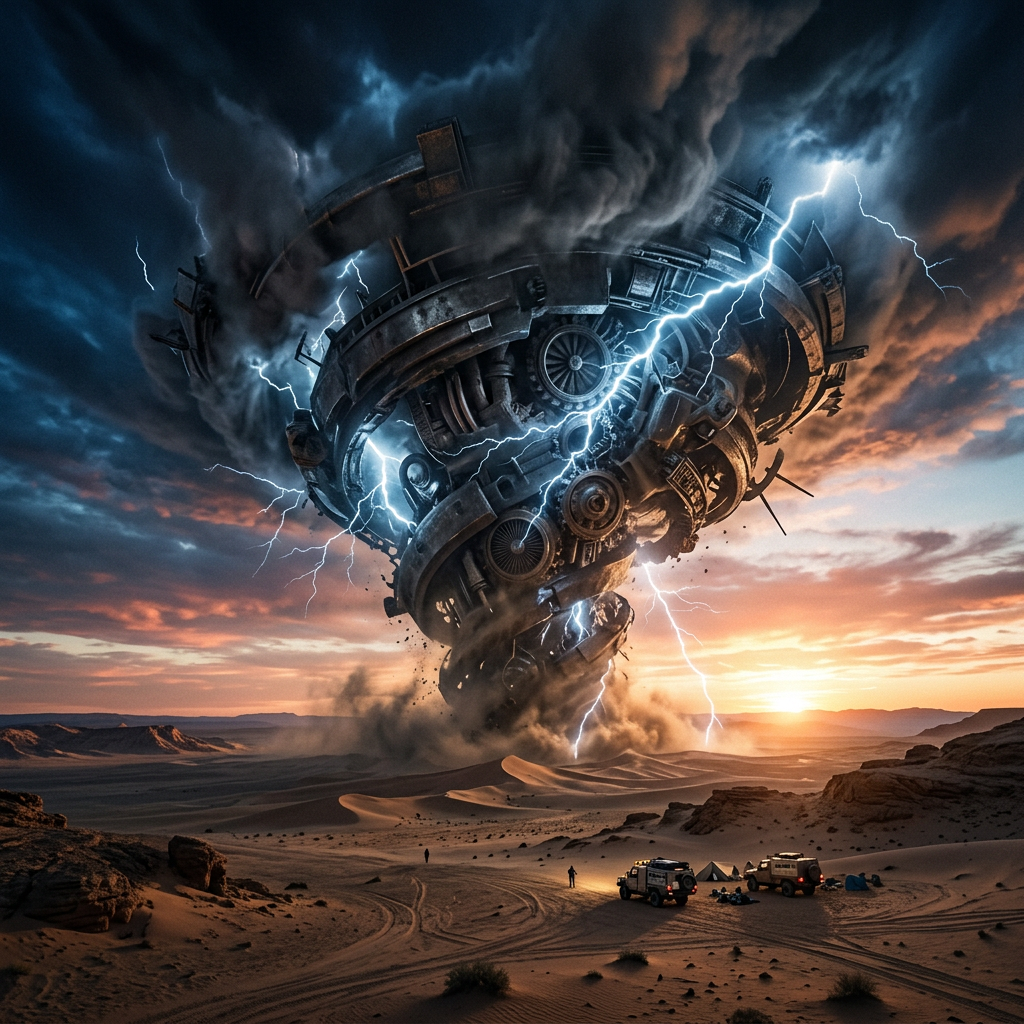
The desert is a place of silence and memory, where the wind carves stories into dunes and the sun bleaches all secrets to bone. But on this day, the silence was shattered. A sound unlike any other—not the crash of a sandstorm, nor the groan of the earth—ripped across the horizon, carrying with it a warning that would forever alter the fate of those who dared to build empires on the whims of fortune. This is the tale of the Iron Tempest, a force of nature so fierce it scattered even the architects of chance.
The Iron Tempest Trumpet Awakens the Desert
The dawn broke with an eerie stillness. The merchants of the great caravan routes were preparing their loads, the dice-rollers in the markets were setting out their boards, and the soothsayers were reading the entrails of goats for signs of prosperity. Then came the Trumpet. It was not made of brass or silver, but of iron—a deep, resonant bellow that vibrated through the sand itself.
> “When the earth becomes a bell and the sky the clapper, only the deaf are wise.”
This was not a call to prayer or a signal of trade. It was a metallic storm, a clattering scream that moved like a living thing. The iron tongue of the tempest licked the dunes, shaking loose the ancient bones hidden beneath. Men covered their ears, but the sound burrowed into their minds, unmaking the very logic by which they lived. The desert, for the first time in centuries, was awake and angry.
Architects of Chance Face the Metallic Storm
Who were these Architects of Chance? They were the masters of probability, the high priests of luck. In the oasis cities of the Sahel, they built fortunes not on gold or salt, but on the spin of a wheel, the fall of a die, the flight of a bird. Their systems were elaborate:
- Divination matrices carved into wooden tablets, used to predict the next great trade wind.
- Gaming houses where salt and ivory changed hands based on the outcome of a cast.
- Insurance guilds that promised to cover losses from sandstorms or bandit raids—if the dice fell your way.
They believed they had tamed the random. They believed the universe was a game they could win. But the Iron Tempest was no player. It was the game itself, turning over the table, scattering the pieces. The storm did not ask for odds; it did not bargain. It simply roared.
Scattering Sands: Empires Built on Luck Unravel
As the trumpet sounded, the first to fall were the Folly Towers—tall, spiraling structures built at the edges of settlements. These were the places where the architects gathered to calculate the “best paths” for the coming year. Each tower was filled with:
- Lucky charms: amulets made from jackal teeth and desert cacti.
- Probability charts: papyrus scrolls covered in complex formulas for dice and bone throws.
- Ritual circles: where men would fast for days to “align their spirit with fortune.”
The storm struck them first. The iron wind peeled the outer walls like rinds from fruit. The scrolls caught fire from the friction of the air. The amulets turned to slag. The architects ran, clutching their heads, screaming that their numbers had failed them. In one day, the capital of the Kingdom of the Cast Die was reduced to a ghost town of scattered bones and bent iron.
Idris of Gao Witnesses the Steel-Tongued Tempest
Among those who saw the storm come was a man named Idris of Gao. He was not an architect of chance; he was a historian, a keeper of old words and older maps. When the trumpet sounded, he did not run to save riches. He ran to the central archive, there to witness something he would later describe as “the death of the random.”
> “The storm did not destroy with fury alone. It rearranged. I saw the same die land on a face it had never shown before. I saw a man’s luck turn to acid in his hands.”
Idris recorded how the steel-tongued tempest seemed to speak. It howled in patterns—rhythmic, almost coded. The architects had thought they could model the universe, but the universe was now modeling them. Idris wrote in his journal that the tempest was not a natural event. It was a rebalancing, a reset of the cosmic dice that had rolled too long in one direction. He saw men who had never lost a gamble suddenly lose their lives. He saw the poor become rich for a moment, only to have the sand swallow them whole.
The Flight of Chance-Architects Before the Roar
In the end, the architects of chance did what they had never done before: they fled. Not to new casinos or new charts, but into the desert itself, hoping the emptiness would swallow the sound. The tempest, however, did not chase them. It had made its point.
- They abandoned their lodestones and their prayer beads to the sand.
- They shed their silk robes and ran barefoot, for luck had become a burden.
- They broke their dice underfoot, not in anger, but in prayer—a silent bargain with the elements.
The roar followed them for three days and three nights, a constant reminder that some forces cannot be calculated. Some storms cannot be hedged against. When the sound finally faded, the desert was quiet once more—but it was a different quiet. The air tasted of iron. The dunes had shifted, burying old paths. And the men who had once called themselves masters of chance wandered without compass, their systems shattered, their faith in randomness broken.
Conclusion
The Iron Tempest did not destroy the desert—it remade it. The architects of chance were scattered, their towers toppled, their formulas rendered meaningless. But like all great storms, it left behind a lesson: that life is not a game to be won, but a current to be ridden. The survivors who returned to the oasis spoke of a new way of thinking, one that honored uncertainty without trying to cage it. They built smaller, listened to the wind, and no longer pretended to hear the music of the spheres. For the Trumpet of Iron had taught them, in its terrible voice, that the only true chance is the one you take without knowing the odds.
Leave a Reply