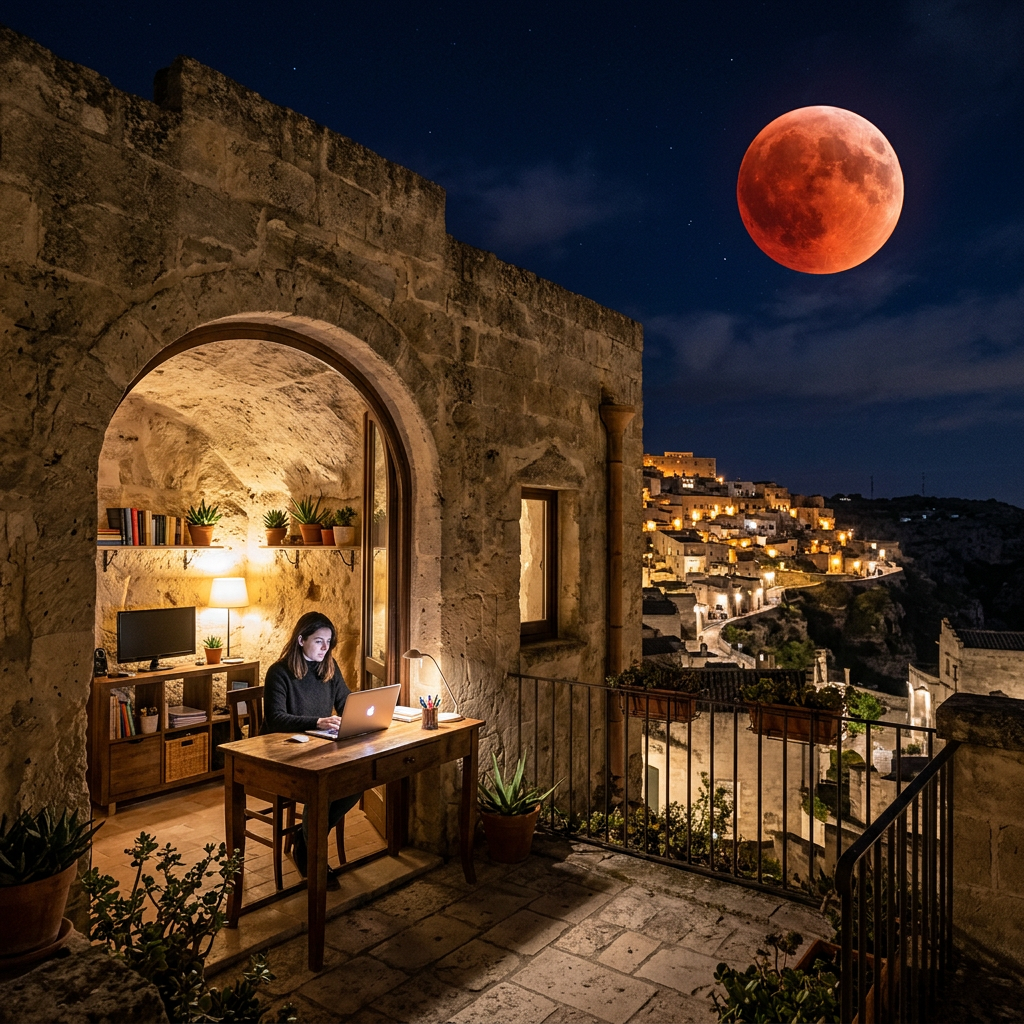
In the labyrinthine alleyways of Matera, where history is etched into every stone, a different kind of earthquake was brewing—one that would register not on a seismograph, but on the ledgers of heaven and earth. This is the story of a scribe, a stone city, and the breaking of a seal that had held for millennia. It is a tale of reckoning, recorded in ink and blood under a red moon.
The Cave-Office in the Ancient Stone of Matera
My workspace was not a room with four walls, but a cave-dig carved into the tufa limestone of the Sassi. The desk was a slab of ancient rock, smoothed by generations of hands. The air smelled of damp earth, old parchment, and the faint, coppery tang of ink.
- The Tools: A quill from a raven’s wing, a pot of iron-gall ink, and a ledger bound in leather cured locally.
- The Light: A single oil lamp, its flame casting dancing shadows on the vaulted ceiling.
- The Sound: A constant, gentle drip of water from an unseen spring, the only rhythm to my work.
Here, I chronicled the transactions of the faithful: births, marriages, debts, and deaths. For years, I was a passive observer, a recorder of events I believed were preordained. I thought the sixth seal, the great cosmic threshold, was a metaphor for revelation. I was wrong. It was a literal account, and my cave-office was its most remote auditing station.
When the Platform Brought Clarity to Chaos
The world above the Sassi had gone mad. Markets collapsed, news from the north spoke of rising tribalism, and the air was thick with a panic no one could name. The digital platforms, once great engines of connection, had become echo chambers of fragmented truth. Every scroll of my ledger seemed to contradict the last.
Then, a quiet delegation came to my door. They were not priests or politicians, but a collective of weavers, stonecutters, and olive growers. They carried no manifesto, only a simple request.
> “Scribe, do not record our arguments. Record our promises.”
They built a platform—not of code, but of stone and timber—in the Piazza del Duomo. On it, they spoke not of what they believed, but of what they would do for each other. This was the first clarity amidst the noise. They were forging a new kind of contract, one that bypassed the broken platforms of the world.
The Vote That Shattered the Sixth Seal
The vote was not for a candidate, but for a principle: collective accountability. Each resident of the Sassi, from the oldest nonna to the youngest child, was given a single river stone. They placed it in one of two urns.
- Urn of the Flame: Symbolizing a return to the old, frantic faith of spectacle and fear.
- Urn of the Waters: Symbolizing a covenant of slow, steady, sacrificial work.
The counting took all night. As the sun rose, illuminating the white stone of Matera, the Waters urn overflowed. The moment it tipped, the air changed. A pressure I had carried for years lifted. The sixth seal was not a door that opened outward. It was a bond that had bound us to a false narrative. The vote was the key.
It shattered not with a bang, but with a deep, resonant hum that vibrated through the tufa. My ledger, which had been filled with confusion, now seemed clear. The seal had been a lie we told ourselves to avoid responsibility. The vote was the truth.
A Red Moon Over the Sassi’s Ledger
That night, the sky turned a deep, burnished red. It was not an apocalyptic sign, but a reflection—a mirror of the ferocity in our own hearts now quieted. I opened my ledger to the final pages. For the first time, I did not write what happened. I wrote what was possible.
- The new entry: A covenant of local food, shared water, and a rotating schedule for tending the communal gardens.
- The new debt: One of gratitude, not obligation.
- The new seal: Not a lock, but an open hand.
Under the red moon, the Sassi did not crumble. It glowed. The stones themselves seemed to breathe, exhaling centuries of isolation. The ledger, bound in the dark, was no longer a record of the past. It was a compass for a future built on the rarest of materials: earned trust.
The Scribe’s Reckoning With the Faithless
The reckoning was not for the outsiders, the “faithless” who had come to mock our primitive ways. It was for me. I had spent years recording faith as a transaction, a contract with fine print. I had to break my own seal.
I took the old ledger to the cave’s hearth. I did not burn it. I placed it in a niche, beside a jar of rainwater and a dried sprig of rosemary.
> “You are no longer the record,” I whispered. “You are the reminder.”
My reckoning was this: I had to stop being a scribe of what was and become a witness to what could be. The faithless were those who thought the story was over. The true faithful were those who realized the story had only just begun, and that they were its authors—scribes without a master, writing in the living stone of their own lives.
Conclusion
The breaking of the sixth seal in Matera was not the end of the world. It was the end of a particular kind of world—one ruled by passive prophecy and recorded doom. In the cave-offices of the heart, we all keep a ledger. The question is not whether the seals will break, but whether we will have the courage to vote, to commit, and to write a new covenant in the stone of our shared existence. The red moon fades, but the ink of this new contract is indelible. The reckoning is over. The writing begins.
Leave a Reply