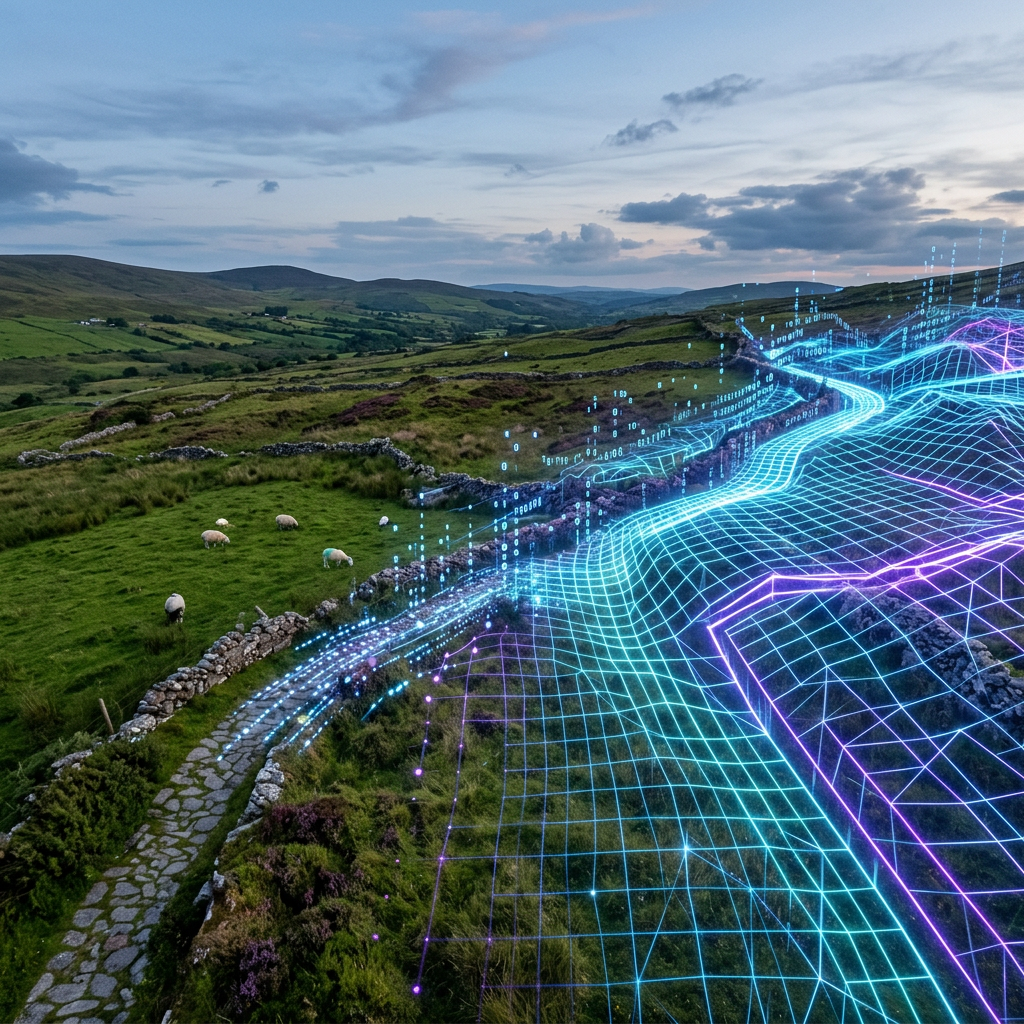
The Black Horse’s Silent Prophecy
In the mist-laden valleys of ancient Ireland, whispers carried truths that men often ignored. One of the most enduring was the tale of the Black Horse, a creature of shadow and soil, whose appearance foretold a coming imbalance. It was not a harbinger of doom, but of correction—a reminder that when a land strays too far from its roots, the earth itself will stir to reclaim harmony.
Today, that prophecy echoes not in thunder, but in silence. Ireland stands at a crossroads, caught between a digital gold rush and the quiet degradation of its soul. The Black Horse does not gallop; it waits. And in its stillness, we see the cracks forming in our modern foundations.
When the Orchard Stopped Breathing
There is a quiet corner of County Tipperary where an ancient apple orchard has stood for centuries. Until recently, it was a symbol of cyclical life: blossoms in spring, fruit in autumn, rest in winter. But over the last decade, something shifted. The trees began to wither, their gnarled limbs refusing to bear fruit.
Locals whisper that the orchard stopped breathing when the village pub closed its doors—not because of a lack of patrons, but because the owners sold the land to a data center developer. The rich soil was paved over for servers that hum with the ghostly commerce of online gambling. The irony was not lost: a place that once nourished bodies now hosts the extraction of souls.
This is not an isolated story. Across rural Ireland, similar scenes unfold. The land is being disconnected from the people, sold off for ventures that promise prosperity but deliver a hollow echo.
AI Casinos and the Hollowing of Ireland
The most insidious force in this modern imbalance is the rise of AI-driven casinos and crypto gambling platforms. They are marketed as “innovative” and “borderless,” but their effect is deeply local. Like a fog rolling in from the digital sea, they obscure the real cost.
Consider what happens when an AI casino replaces a local bookmaker:
- Jobs vanish: The local shopkeeper, the cashier, the cleaner—none are needed when algorithms handle everything.
- Money leaves: Profits are siphoned into offshore accounts, never circulating in the local economy.
- Community dissolves: The pub or betting shop was a place of human interaction. An app is a void.
- Debt multiplies: AI optimizes addiction, personalizing loss patterns to keep players hooked far longer than any human dealer could.
The clever coding these platforms boast of is simply a shiny wrapper for extraction. The Black Horse sees it clearly: what is taken from the soil, from the people, must be returned—or the land will exact its price.
From Crypto Illusions to Real Outcomes
The promise of crypto was decentralization, of returning power to the individual. Yet in Ireland, it has too often become a tool for centralized exploitation. Speculative bubbles in digital tokens have drawn young farmers and tradespeople away from sustainable livelihoods. They chase “lambos” and “moonshots” while real lambing sheds fall silent.
Consider the contrast:
| Crypto Illusions | Real Outcomes |
|---|---|
| Passive income | Active land neglect |
| Digital certificates | Lost traditional skills |
| Global liquidity | Local financial drain |
| Tech utopia | AI casino addiction |
The Black Horse’s prophecy does not demonize technology, but it demands accountability. A blockchain cannot plow a field. A crypto wallet cannot mend a fence. When the digital realm becomes an escape from reality, reality fights back—through soil erosion, community collapse, and a profound sense of emptiness.
Restoring Balance Through the True Market
> “The market is not a machine. It is a garden, and you must tend it with your own hands.”
This anonymous Irish proverb points to the remedy. Restoring balance in Ireland requires a shift from extractive virtual markets to regenerative true markets—those that honor the land, labor, and local cycles.
What does this look like in practice?
- Reclaim community land trusts: Return control of arable land to local cooperatives, not investment funds.
- Tax digital extraction: Implement a “soil royalty” on profits from AI casinos and crypto farms that use Irish bandwidth and energy.
- Fund real apprenticeships: Redirect a percentage of online gambling taxes into training for heritage crafts, organic farming, and sustainable technology.
- Rediscover local exchange: Establish time banks and barter networks in rural towns, reducing reliance on centralized digital platforms.
- Let the Black Horse run: Create “rewilding zones” where nature is allowed to heal—forests, bogs, and waterways that act as living regulators of both climate and economy.
The balance is not about rejecting progress, but about rooting it. Every AI algorithm must be paired with a human hand that understands the land. Every digital transaction must leave a deposit in the communal well.
Conclusion
The Black Horse’s prophecy was never about a single cataclysmic event. It was a slow, patient warning: that which is taken without gratitude must be returned with interest. Ireland has been seduced by the glitter of digital extraction, but the orchard remembers the old ways. The trees will either bloom again, or the silence will teach us what we refused to hear.
To restore balance, we must listen not to the algorithms, but to the soil beneath our feet. The Black Horse is already standing at the gate. It is not too late to open it to a different future—one where prosperity is not siphoned upward, but spread across the land like morning mist over a green field.
Leave a Reply