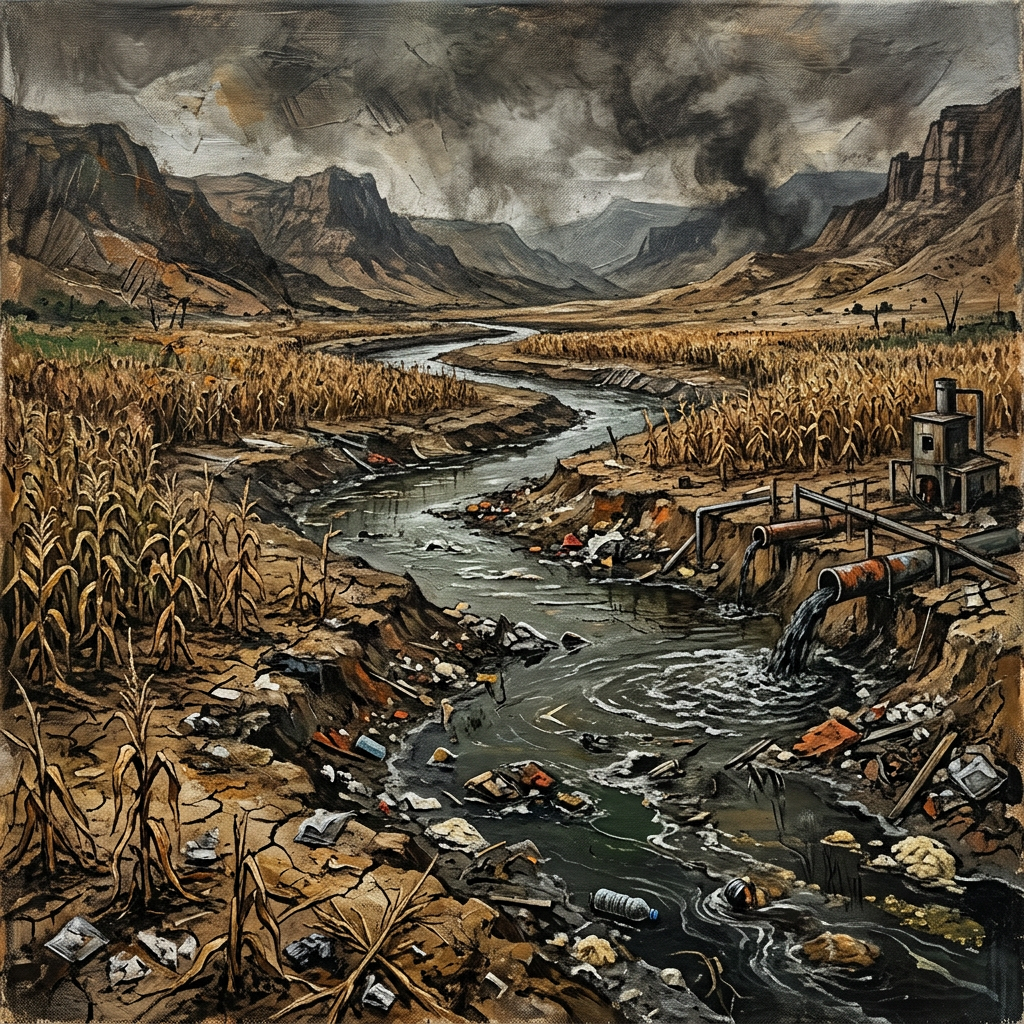
Nestled deep in a valley where morning mist clung to cedar trees, the village of Tsumago had always owed its life to the Black River. Its waters were not black in color, but clear as glass over river stones—the name came from the deep, dark shadows cast by the tree-lined banks. The river was a constant, a reliable pulse that irrigated rice terraces and quenched the thirst of generations. But no one in the village expected that the river’s greatest gift would arrive in the form of something entirely foreign: a star.
This is not a story of a literal star falling from the sky. It is a story about a community brought to its knees by despair, and the single, improbable catalyst that pulled them back from the brink.
The River That Never Lied and the Shadow That Fell
For centuries, the people of Tsumago trusted the Black River. Its flow was a calendar; its clarity, a contract. During the dry months, elders would read the water level and predict the harvest. The river never lied. Then came the blight.
It was not a flood or a drought that broke Tsumago. It was a sickness that traveled through the water—a microscopic wormwood of toxicity. First, the fish died. Then, the rice paddies turned yellow. Children developed fevers that no poultice could cool. The village council, a group of weathered farmers and shopkeepers, watched in horror as their lifeline turned against them.
> “We cleansed every well. We burned incense on the banks. We prayed. But the river went silent.”
> — Old Yamada, village waterkeeper
The shadow that fell over Tsumago was not supernatural; it was the slow, creeping realization that their world was ending, one sickly crop at a time.
When Wormwood Darkened the Waters of Tsumago
Wormwood, in this context, was not the plant, but a name the villagers gave to a strange, oily residue that appeared after a landslide upstream. It seeped into the Black River like a phantom. Tests—what few they could manage in their remote hamlet—showed nothing. But the signs were undeniable:
- Skin rashes appeared on anyone who bathed in the river
- Crops wilted within days of irrigation
- Livestock refused to drink from their usual watering holes
- A metallic taste lingered in every bucket of water drawn
The market that once bustled with traders selling yuba, mushrooms, and river-smoked trout grew silent. Strangers avoided Tsumago. The village became a husk of itself, a case study in slow collapse.
Whispers of a Star That Restores, Not Poison
Desperation drives people to strange hope. It was a wandering monk, sheltering from rain in a shrine near the defiled river, who spoke of the “Star of Renewal.” He described it not as an object, but as a practice—a forgotten method of water healing using crystallized minerals from a sacred spring high in the mountains. The crystals, when suspended in running water under moonlight, formed a lattice that could bind to toxins and pull them from the flow.
The villagers were skeptical. Yet, with nothing left to lose, a team of three—a young herbalist, the monk, and a former stonecutter—climbed for three days to the spring. They found the crystals: six-sided, pale blue, glowing faintly under the night sky. They called it the “Star Stone.”
Back at the Black River, the experiment began. They hung a net of Star Stones over the first downstream pool. The effect was slow but visible:
- The oil slick began to break apart within a week
- The metallic taste in the water diminished after two weeks
- A single frog returned to the pool—the first sign of life
- After a month, the water ran clear and sweet again
> “It was not magic. It was chemistry older than our fear.”
> — Herbalist Kaede
The New Market: Returning Agency to Lost Souls
The healing of the river was a triumph, but it was not the end. The villagers understood a hard truth: the blight was caused by human error—a careless mining operation upstream that had polluted the watershed. The Star Stones had healed the symptom, but the village needed to heal its soul.
What emerged was the New Market, a system built on reciprocity and caution. It was less a bazaar of goods and more a bazaar of trust:
| Principle | Practice |
|---|---|
| Water first, profit second | Every vendor must maintain a clean water source |
| Knowledge shared freely | The Star Stone method is taught, not sold |
| Restorative trade | A portion of every sale funds upstream conservation |
| Community feed | Unsold produce goes to the elderly and sick |
The New Market did not just sell vegetables and crafts. It sold a story: that a village could face ruin and find a path back, not through a miracle, but through a commitment to shared responsibility.
How a Village Healed Beneath a Clearing River
Today, the Black River runs clearer than it has in living memory. The rice paddies are green again. Children splash in the shallows. The New Market is famous across the region, drawing visitors who come not just for the organic daikon or hand-woven baskets, but for the feeling of walking into a place that chose to heal.
Tsumago did not forget its wound. On the riverbank, a simple stone marker reads: “Here, the river died. And we learned to listen.” The Star Stones are still used, now housed in a small shrine at the water’s edge. The monk visits twice a year. The herbalist Kaede runs a workshop.
The village learned that sometimes, a star is not a celestial event. It is a six-sided crystal hanging in a net, a stranger with a map, and a community brave enough to try anything once.
Conclusion: The Light Under the Surface
The story of Tsumago is not unique in its suffering, but it is extraordinary in its response. When the river that never lied began to poison, they did not abandon it. They searched for a star, not in the sky, but in the mountains, in their history, and in each other.
The Black River still flows, dark under the trees. But now, it carries not just water, but a promise: that what has been broken can be remade—not the same as before, but perhaps stronger. The star that healed a village was never magic. It was attention paid to the invisible, and the courage to believe that rivers, like people, deserve a second chance.
Leave a Reply