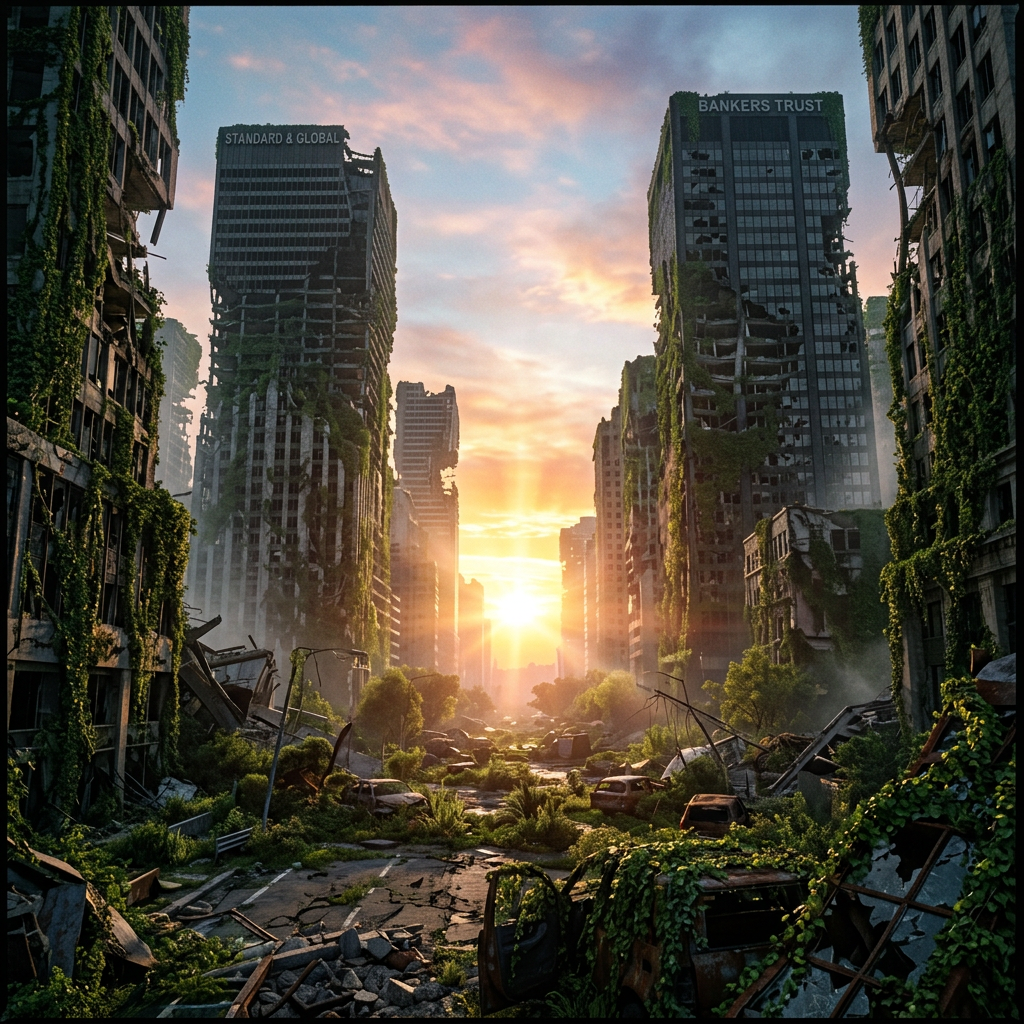
When the Scroll Descended: A New Dawn
The sky didn’t split with fire or thunder. Instead, it tore like old parchment, and from the rift descended a living scroll—a cosmic ledger of all human transactions, promises, and bets. This was not the apocalypse anyone prepared for. There were no horsemen, no plagues of locusts. There was only the slow, horrifying realization that every contract, every IOU, every handshake promise written in sand had suddenly become legally binding under celestial law.
As the scroll unfurled across continents, it cast a long shadow. People watched in awe as their stock portfolios vanished, their insurance policies dissolved, and their digital currencies evaporated into the ether. The world’s financial systems—built on trust, speculation, and fragile agreements—crumbled overnight. But amid the chaos, a strange quiet emerged. The scroll did not destroy; it revealed. It exposed the hollow core of every market that had traded in promises rather than value.
The Great Beast and the Fall of False Markets
Before the scroll’s descent, humanity had built its greatest beast: the global financial machine. This creature fed on derivatives, futures, and leveraged bets—abstract numbers dancing on screens. It had no soul, no memory, and no mercy. When the scroll arrived, it demanded real accounting.
- Stock markets collapsed because they traded on future earnings that would never come.
- Cryptocurrency exchanges froze overnight—their promises of decentralized trust were no match for cosmic record-keeping.
- Insurance giants vanished, as their risk models could not account for the end of probabilistic time.
- Debt markets shattered—every unpaid loan, every speculative mortgage was now permanently etched in the scroll’s unerasable script.
The beast didn’t die. It was named—and in being named, it lost its power. The false markets fell not because of violence, but because they could no longer hide behind complexity and jargon. People saw, for the first time, that these markets had been built on a foundation of shared delusion.
Why This Market Survives the World’s End
In the aftermath, one market did not merely survive—it thrived. This was the Last Market, and its currency was not gold or data, but proven action. Its rules were simple and immutable:
> Every transaction requires physical delivery. Every promise must be fulfilled in the present. No futures, no speculation, no credit.
Three pillars held this market together:
- Immediacy: Goods and services exchanged hand-to-hand, eye-to-eye. If you wanted a loaf of bread, you offered eggs or labor now.
- Verifiability: The scroll did not accept hearsay. Only witnessed, completed trades were recorded. This eliminated fraud and empty promises.
- Reciprocity: No one could accumulate without giving. Hoarding became impossible because value was tied directly to use.
This market survived because it was not a construct of human ambition—it was a return to elemental exchange. It remembered what we had forgotten: that true wealth is not stored in ledgers, but in the hands of those who do.
Light Rising from the Ruins of Betting
The old world was built on betting. We bet on stock prices, on real estate bubbles, on the next quarter’s earnings. We bet on crops, on weather, on human lives through insurance. The Last Market transformed this darkness into light by replacing speculation with participation.
Consider the difference:
- Old world gambler: Buys a share hoping someone else will pay more tomorrow.
- Last market participant: Barters skills today for sustenance, knowledge, or tools.
In the ruins, people discovered a profound truth: there is no need to bet on the future when you can shape the present. Farmers traded harvests directly with bakers. Carpenters built homes in exchange for food. Healers offered their craft for protection. The market became a living network of interdependence, not exploitation.
> The only way to predict the future is to create it—with your own hands, in your own community, in your own time.
The Last Market: Beginning, Not the End
As the scroll continues to record, a strange optimism grows. Children born after the Fall know nothing of “investing” or “portfolios.” They know barter, craft, and mutual aid. The Last Market has become the seedbed of a new civilization—one where value is measured by contribution, not accumulation.
- Communities have formed skill exchanges where knowledge is the most valuable currency.
- Artisans have revived lost trades, creating objects of real, lasting worth.
- Neighbors have learned to trust again, because every transaction is witnessed and recorded with integrity.
The world’s end was not an ending at all. It was the birth of accountability. And in the Last Market, rising from the ashes of a thousand broken systems, humanity has found something it lost centuries ago: the courage to trade not in dreams, but in reality itself.
Leave a Reply