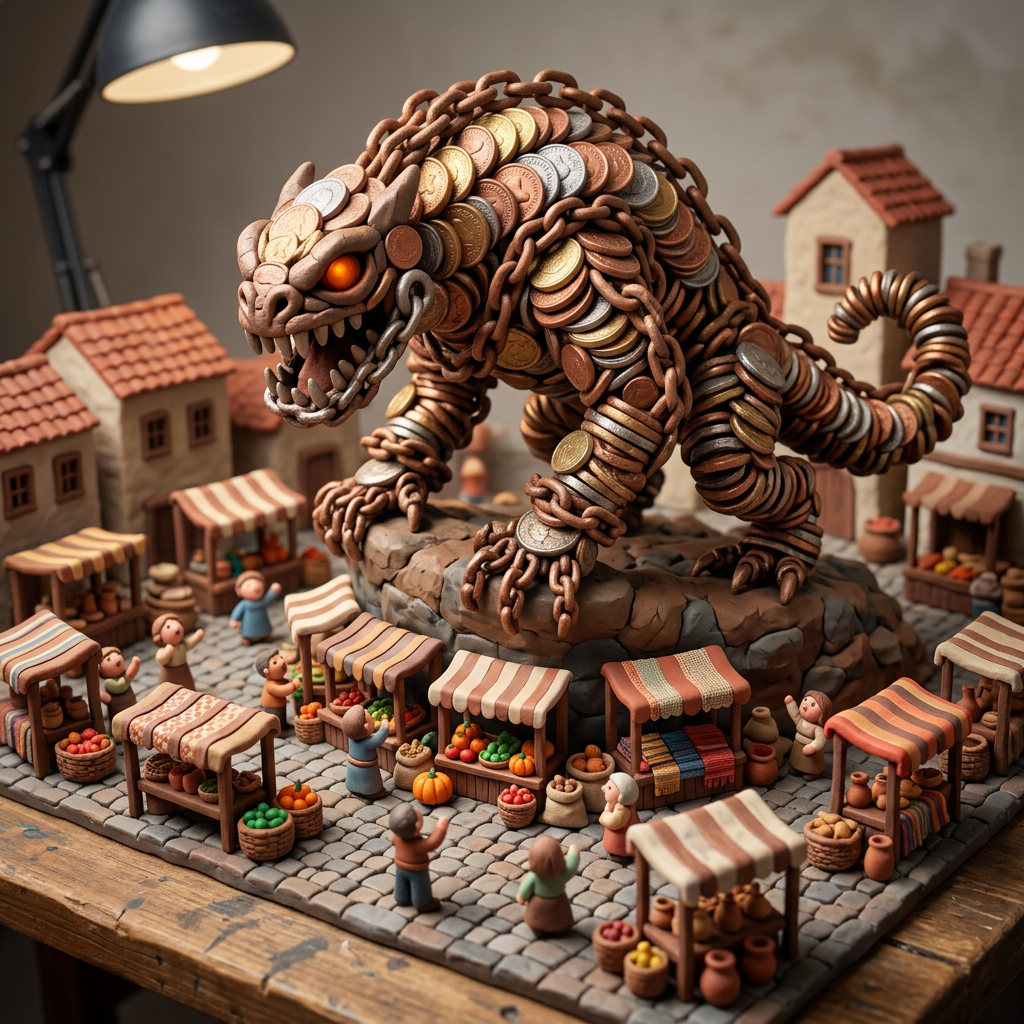
There are tales told in the quiet corners of the world—not of dragons or kings, but of economies that refused to die. When the great Gambling’s Plague swept across nations, it did not discriminate. It consumed casinos, stock markets, and the very fabric of chance. Yet, in the shadow of that collapse, one marketplace endured. It was not built on luck or probability, but on something far older: trust, scarcity, and the unspoken contract between seller and soul.
The Vision of the Eighth Bowl
The name itself sounds like a prophecy drawn from an ancient text. The Eighth Bowl was never a physical structure of marble and neon. It was a vision—a theory of exchange that emerged just before the plague took hold. Its founders believed that markets should be immune to the viruses of addiction and speculative madness. They envisioned a trade floor where nothing was wagered, only bartered with intent.
The bowl was symbolic: the eighth vessel in a series meant to contain the purest elements of human desire. Here, commodities were not stocks or chips, but time, craftsmanship, and data. No dice were rolled. No cards were dealt. Every transaction was backed by a ledger of immutable truth.
> “When all else is gambled away, the only thing left to trade is what you cannot afford to lose.” — Anonymous Eighth Bowl Charter
When the Plague of Chance Devoured the Earth
Then came the plague. It did not arrive with fever or cough, but with the quiet hum of infinite leverage. Gambling had evolved. It was no longer a vice confined to smoky backrooms; it had become the operating system of global finance. Derivatives on derivatives. Bets on bets on bets. Every asset was a wager; every wage, a stake.
When the collapse hit, it was not a crash—it was a cauterization. Trillions evaporated not because companies failed, but because the entire concept of odds had been proved hollow. The Beast of Fractured Wagers had finally come home to roost.
People lost not just money, but the ability to trust any number. Inflation of hope met deflation of reality. The markets that survived were not the ones with the best algorithms, but the ones that had never been wagering in the first place.
The Beast of Fractured Wagers Rises
And what was this beast? It was a system that treated every decision as a bet—marriage, education, health. The line between risk and recklessness had vanished. When the plague broke the global casino, the beast did not die. It morphed into something more insidious: a decentralized network of micro-wagers, each one a splinter of the original sin.
People began trading fragments of their own futures. Sell a day of your life for a chance at a lottery. Pledge your next promotion to a pool of strangers. The beast fed on desperation masked as innovation.
Yet, within this chaos, the Eighth Bowl remained. It did not grow—it stood. Its marketplace was simple, almost archaic:
- No leveraged trades.
- No binary options.
- No time-decay assets.
- Only physical goods, human effort, and certified knowledge.
- Every seller must show the item in hand.
- Every buyer must confirm receipt.
> “You cannot bet what you do not possess. And you cannot lose what you have already earned.” — Market Creed, posted at every virtual stall
The Scroll Descending in the Shattered Sky
As the sky of global finance shattered into a thousand bad bets, something unexpected appeared. A scroll—digital, encrypted, but profoundly simple—descended through the chaos. It was a protocol for proof-of-presence. Not proof-of-work or proof-of-stake, but proof that a person actually had what they were offering.
This scroll became the constitution of the surviving market. It listed three unbreakable rules:
- No speculation on future value.
- No gambling on unknown outcomes.
- No debt disguised as asset.
The market that used this scroll did not trade in options or futures. It traded in completed pasts—items already made, services already rendered, data already collected. The plague could not touch it because the plague needed uncertainty to feed. This market offered only certainty of possession.
- A farmer sold last week’s harvest, not next month’s crop.
- A coder sold finished software, not startup equity.
- An artist sold the painting on the wall, not the idea in the mind.
The beast of wagers howled at the gates, but it could not enter.
The Market That Stood Unbroken by the Fall
Today, when historians speak of the economic collapse, they point to the ruins of Vegas, of Wall Street, of the crypto pits. But they also point to a quiet, resilient anomaly—the market that stood.
It had no gambling tables. No tickers. No margin calls. It was not immune to loss, but it was immune to collapse because it never inflated. Every transaction was a literal handshake. Every account was a person, not a bot. The market did not grow exponentially; it grew organically, like a forest reclaiming a burned city.
What made it unbreakable?
- Local anchoring: Every trade required a real-world referent.
- Slow velocity: No flash trades; all exchanges took at least 24 hours.
- Reputation over rating: Your name was your bond, and self-mintage was the only coin.
- No liquidity pools: Every buyer brought their own value; no lending was allowed.
> “The market that survived did not beat the beast. It simply refused to play the game.” — Final entry in the Eighth Bowl ledger
Conclusion
The tale of the Eighth Bowl is not a warning about gambling—it is a lesson in foundations. When the entire world built its economy on the shifting sands of probability, a few people chose to build on stone. They remembered that a market is not a game of chance; it is a ceremony of need. The plague of gambling collapsed because it had no soul. The market stood because it had nothing to prove—only something to exchange.
In the end, the beast starved, the scroll remained, and the bowl held.
Leave a Reply