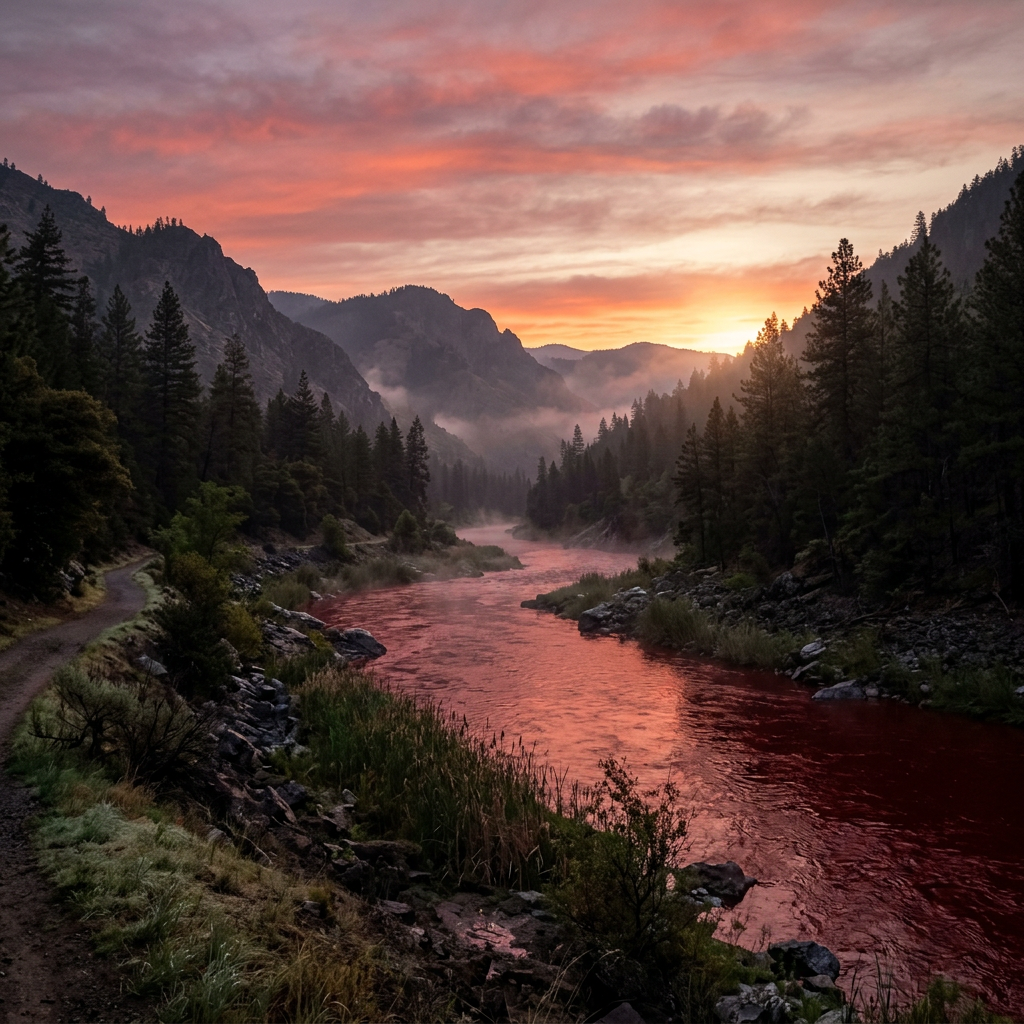
The Rivers Turn to Blood
It began with a glint—a metallic sheen on the water that no amount of sunlight could explain. The rivers that had cradled the town of Alder’s Hollow for generations, the same currents that had carried children’s laughter and fishermen’s hopes, turned the color of rust. First the fish died, their bellies floating up like pale flags of surrender. Then the birds stopped singing. Then the smell arrived—a chemical bitterness that clung to laundry and hair.
The official report called it a “mining runoff anomaly.” The locals called it what it was: poison. Factories upstream had been dumping industrial waste for years, and the ledger of accountability had been conveniently lost. But in a small market tucked away on the edge of the dying forest, something unexpected was happening.
A Market Built on Truth, Not Chance
The Alder’s Hollow Market had always been a scrappy affair—wooden stalls, handwritten signs, and a stubborn refusal to bow to the convenience of corporate supply chains. When the rivers turned poisonous, the market became more than a place to trade. It became a lifeboat.
Unlike the supermarkets that pulled their produce from a central distribution hub, this market was built on a network of trust. Each vendor sourced their goods from farms outside the contamination zone. They tested their soil. They traded secrets about clean water sources. They created a system based on radical transparency:
- Every vendor posted the origin of their goods on a chalkboard.
- Water samples from local wells were tested weekly, with results pinned to a public corkboard.
- Prices were set by consensus, not competition, ensuring no one hoarded clean food.
> “We didn’t survive because we were lucky. We survived because we refused to pretend the water was clean.” — Old Marta, herb seller
This was not a market of chance. It was a market of choice—the choice to see the poison for what it was and to build something different anyway.
The Beast of the Hollow Ledger
But corruption does not surrender quietly. The “Hollow Ledger” was a term whispered among merchants—a digital and paper record that tracked everything: bribes paid to inspectors, fake certificates of purity, and the names of those who had sold out their neighbors. The Beast of the Ledger was not a monster with claws; it was a monster with spreadsheets.
Those who controlled the ledger controlled the river’s false narrative. They certified that the water was safe enough. They pressured the market to buy from the same diluted suppliers. And when the market refused, they sent auditors and thugs.
The market responded with a weapon more powerful than intimidation: documentation. Every transaction was recorded in duplicate. Every test result was photographed and timestamped. The vendors became amateur detectives, cross-referencing delivery dates with official reports. They learned that the Beast could not survive exposure to light.
- Tip: Never trust a single source of truth. Cross-reference everything.
- Tip: Record your records. Then record who sees them.
- Tip: Corruption loves silence. Break it with ink and pixels.
The Scroll That Burned Corruption
The turning point came when a young vendor named Elara discovered a discrepancy: the factory’s self-reported waste volume did not match the amount of raw material they purchased. She spent three weeks tracing shipping manifests and bribed a truck driver for a glance at the loading logs. The evidence was damning.
She wrote it all on a single scroll—a literal roll of parchment she carried to the town hall meeting. When the factory’s lawyer tried to dismiss her as a hysterical shopkeeper, she read the numbers aloud. Each figure was a nail in the coffin of the lie.
> “The poison in the water was not a mistake. It was a business plan.” — Elara’s closing statement
The scroll did not just contain facts. It contained the names of the officials who had been paid to look away. Within a week, the factory was shuttered. The Hollow Ledger was seized and its administrators faced charges. The market had burned the corruption with the only fire that mattered: the truth.
Surviving the Poisoned Waters
The rivers of Alder’s Hollow are still recovering. Scientists say it will take decades for the ecosystem to fully heal. But the market endures. It has become a model for other towns facing environmental crises, a living proof that communities can self-correct when institutions fail.
What did the market teach us? A few things worth remembering:
- Decentralize your supply. Relying on a single source is a single point of failure.
- Audit everything. Transparency is not a PR move; it is a survival strategy.
- Tell the story. The scroll that burned corruption was not just data—it was narrative.
The poison was real. The rivers did turn to blood. But in the shadow of a dying forest, a small market chose to live by a different law: we will not trade in lies.
And so the market survived—not because it was immune to poison, but because it refused to be poisoned by silence. The rivers may never be pure again, but the water that flows through that market is clean. And that, for now, is enough.
Leave a Reply