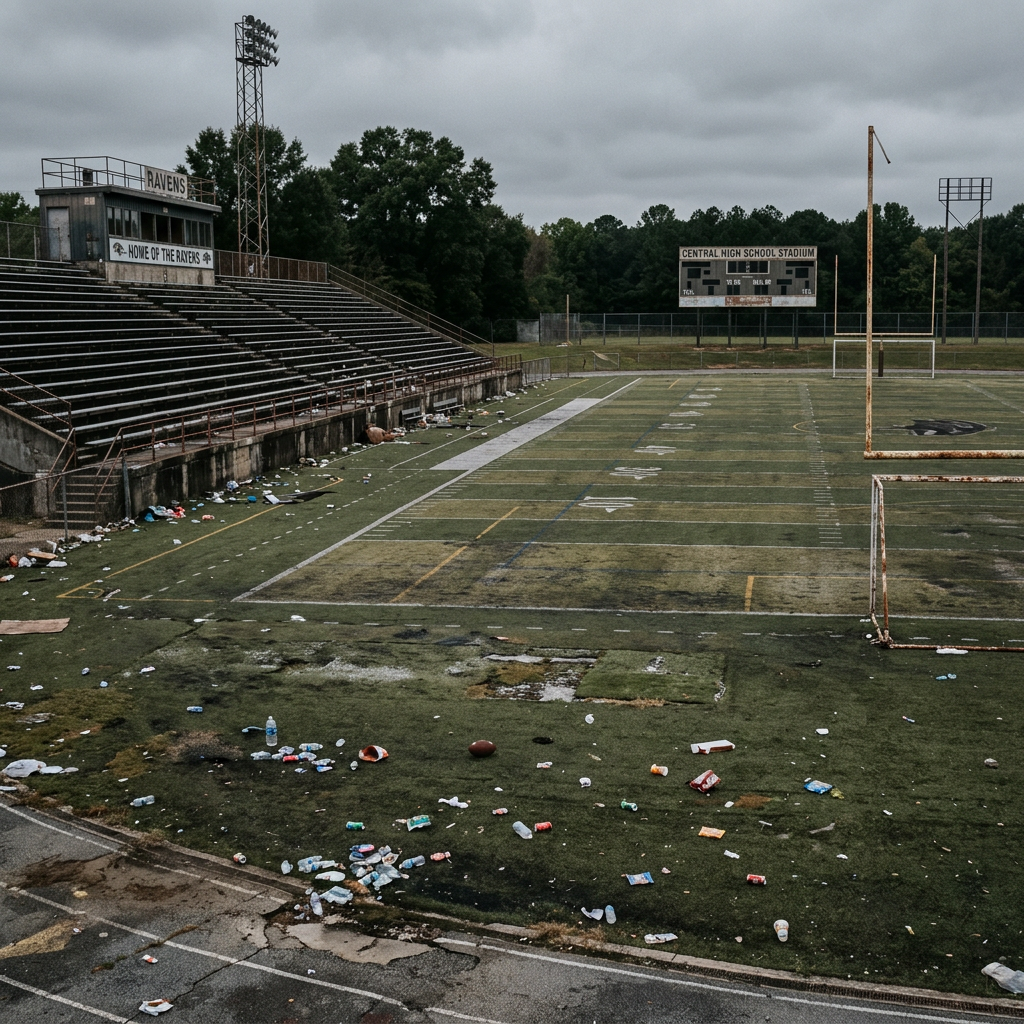
It was just another Thursday night game. The stands were half-full, the popcorn machine was sputtering, and the home team was down by twelve points. Then the announcer leaned into his microphone, and his voice cracked—not with age, but with something else. “Ladies and gentlemen,” he said, pausing to scan the bleachers, “I think this might be the last time we hear this song together.” Nobody knew it then, but that man had seen something we all refused to see: the quiet unraveling of a community that had been happening for years, right under our noses.
The Announcer’s Strange Words at the Game
That night, his announcement felt like a riddle. He didn’t talk about the score, the playoffs, or even the team’s losing streak. Instead, he spoke about the rhythm of the town—how the cheers had grown thinner, the parking lots emptier, the local diners quieter after games. He listed observations that seemed bizarre at the time:
- The number of empty seats had doubled since last season.
- Fewer local businesses were buying ad space on the scoreboard.
- The high school band had shrunk by half its members.
- He hadn’t seen a single new family at the concession stand in three months.
> “You don’t need a spreadsheet to feel a town letting go,” he said into the mic. “You just need to listen to the silence between the cheers.”
Most of us shrugged it off. We thought he was being dramatic, maybe a little sentimental. But he wasn’t talking about the game—he was talking about the economic heartbeat of our entire region. The collapse he saw wasn’t coming from the scoreboard; it was coming from the empty storefronts downtown and the for-sale signs sprouting like weeds.
Listening to a Town’s Fading Heartbeat
In the weeks that followed, I started paying attention. The announcer’s words became a kind of lens. I began to notice things I’d been ignoring:
- The local hardware store closed its doors, citing “lack of foot traffic.”
- The weekly farmers’ market shrunk from thirty vendors to just eight.
- Young people were moving away faster than old houses could be sold.
- The community center stopped offering evening classes because nobody enrolled.
This wasn’t just a sports story—it was a town obituary written in slow motion. The announcer, a man who had spent decades watching games from a bird’s-eye view, had developed a unique vantage point. He could see the attendance trends as a proxy for economic health. Each empty seat wasn’t just a lost ticket sale; it was a family that had moved, a job that had vanished, or a hope that had dried up.
> “I’ve seen this before,” he told me after a game one night. “When a town stops showing up for its own story, the story ends.”
When Every Cheer Felt Like a Warning
Once you hear the announcer’s warning, you can’t unhear it. Every cheer at the next game felt like a fragile echo. I started to see the pattern everywhere:
- Retail closures followed the same trajectory as declining game attendance.
- Real estate prices dropped in neighborhoods closest to the stadium.
- School enrollment numbers mirrored the decline in youth league sign-ups.
- Local news stopped covering the games because fewer people were reading.
The announcer had become an unlikely oracle. His voice, once just background noise, now carried the weight of a town’s survival. He wasn’t predicting a collapse; he was reading the signs that were already there. The real question wasn’t whether the town would recover—it was whether we had the courage to listen before it was too late.
The Rhythm We Missed Until He Spoke
What the announcer understood, and what we all missed, was that rhythm matters. Every community has a pulse—a weekly cadence of games, markets, school events, and church gatherings. When that rhythm goes quiet, it’s not a single beat that’s lost; it’s the entire song.
The signs were subtle but undeniable:
- The Friday night lights felt dimmer.
- The post-game pizza places closed earlier.
- The gossip at the barber shop stopped revolving around the team.
- The town’s calendar had more empty slots than filled ones.
> “A town doesn’t die in one day,” the announcer said. “It dies one missed game, one empty church pew, one closed business at a time.”
He had mapped the social geometry of our collapse, and he’d done it simply by watching the crowd. His voice became a metronome for our decay, ticking slower with each passing season.
How Sports Investing Became Our Lifeline
Here’s where the story flips. When we finally understood what the announcer was saying, a small group of us started asking a different question: What if we could treat our town’s survival like a portfolio? Instead of betting on stocks, we began sports investing—not gambling on games, but investing in the community’s vitality through the lens of sports.
- We bought shares in the local minor league team to keep it solvent.
- We sponsored youth leagues to reverse the enrollment decline.
- We created a fund to help local businesses near the stadium stay open.
- We tracked attendance as a key performance indicator for town health.
This wasn’t charity. It was a calculated bet that the announcer’s data was right: that the town’s rhythm could be healed if we fed it the right energy. We treated the team’s success as a leading indicator for everything from property values to school funding.
> “You can’t save a town by ignoring its heartbeat,” the announcer told us. “But you can invest in keeping the drums beating.”
Conclusion
The announcer’s strange words at that Thursday night game turned out to be a gift. He saw the collapse before we did because he was the one person who never stopped looking at the crowd. His voice—cracked, honest, and unflinching—became the alarm clock we desperately needed. Today, the town is still standing, not because of miracles, but because a few people finally listened to the silence between the cheers and decided to invest in keeping the music playing.
The next time you hear an announcer’s voice at a local game, don’t just hear the stats. Listen for the rhythm underneath. You might just hear the future.
Leave a Reply