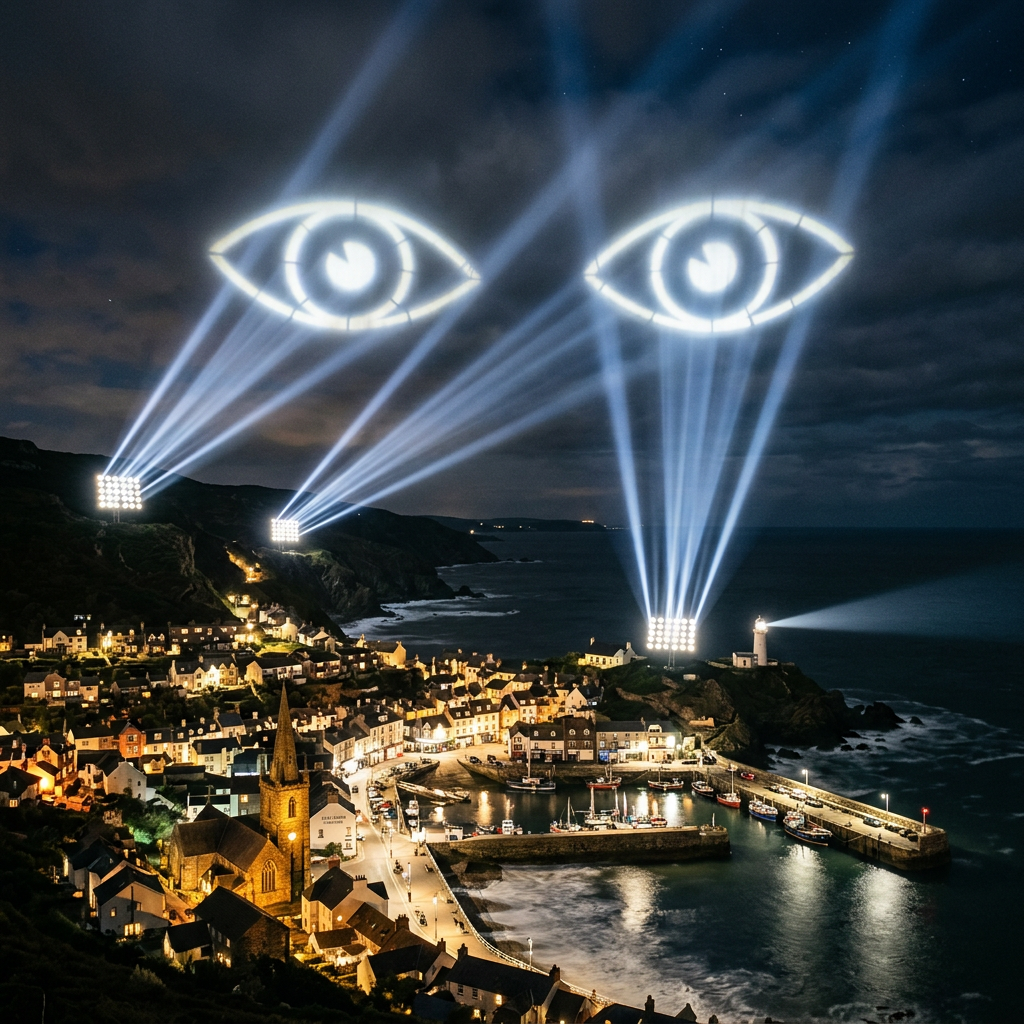
When the Floodlights Rose Like a Warning
It began, as many strange things do in small Icelandic towns, with a rumor. Someone claimed they saw a pale, unnatural glow rising from behind the Hnífsdalur mountain, long after the Arctic sun had abandoned the sky. But it wasn’t the northern lights. It wasn’t a rescue signal. It was a row of stadium-grade floodlights, angled not down at a pitch, but straight up into the void.
In Ísafjörður, a fishing village of just 2,600 souls wedged into a dramatic fjord, the lights became a nightly spectacle. They didn’t illuminate a game. They lit up the low-hanging clouds, creating a man-made aurora. Some called it beautiful. Others called it a warning—a silent scream from a community that had forgotten how to look at one another.
A Tiny Town Saw Its Own Drift in the Sky
For years, Ísafjörður had been drifting. Not geographically, but emotionally. The fish plant had downsized. The young people moved to Reykjavík. Those who stayed found themselves retreating into a quiet, collective melancholy. The town’s heartbeat slowed.
Then, the sky started glowing.
At first, the lights were a distraction. Locals would stop their cars on the main road, roll down windows, and stare. But something subtle happened. In staring up, they began to notice each other again. A neighbor you hadn’t spoken to in months would nod toward the same beam of light and mutter, “Still on tonight, eh?” It was a small, shared wonder. As one elderly fisherman put it, “We had become experts at looking down—at our boats, our books, our screens. The lights forced our chins up.”
Gambling’s Grip Broken Under an Unblinking Beam
The town’s drift had a dark undercurrent. A handful of illegal betting dens had taken root in basements and back rooms. Men with steady incomes from the fishing industry were losing paychecks in hours. Families were fraying. The town’s police officer—a single, overworked man—could only do so much.
Then came the floodlights. The same light that painted the clouds also exposed the shadows. People began walking more at night, their paths crossing the alleys where the dens operated. The unblinking beam became a symbol of scrutiny. A group of mothers started a “Night Watch” patrol, walking under the lights, chatting loudly. Their presence made the gambling dens feel watched. Slowly, the illicit games stopped. One former gambler admitted: “When the whole town seems to be staring at the sky, it’s hard to hide your dice under the table.”
Soccer Brought Us Home Before the Fall Began
The floodlights were originally installed for a purpose far simpler than cultural intervention: an under-17 soccer tournament. The town’s only artificial pitch, located near the edge of the fjord, had been deemed too dim. The local club, lacking funds for a proper roof, pooled money for the tallest lighting masts they could afford. But the masts were set too deep in the permafrost, and the mounting brackets could only tilt upward.
So instead of playing under the lights, the kids played in the light reflected off the clouds. It was softer, wider, and somehow more forgiving. The tournament became a yearly pilgrimage. Parents built bonfires. Grandparents brought thermoses of hot chocolate. For one week each autumn, the soccer pitch wasn’t just a field—it was the town’s living room. And for the first time in decades, the fall didn’t feel like a descent into darkness.
The Night Ísafjörður Learned to Look Up Together
The most profound night came unexpectedly. A storm knocked out power to the eastern half of the town. The streets went black. But the floodlights, on a separate grid, stayed on. They cast their beam into the thick clouds, creating a dome of diffused light over the entire area.
People streamed out of their dark homes. They gathered on the hill by the pitch. Someone brought a guitar. An old woman began to sing a lullaby. For three hours, the town sat on the grass, watching the sky, listening to each other. No one talked about the economy. No one complained about the fish prices. They just were together.
When the power returned, the lights clicked off at midnight. But the habit of looking up remained. The fishermen still glance at the clouds before they leave the harbor. The children still wave at the masts as they bike past. And every now and then, a visitor will ask, “Why are your stadium lights pointing at the sky?” The answer is always simple: “Because that’s where we found each other.”
Conclusion
What began as a technical mishap—a row of lights tilted too high—became a quiet revolution. Ísafjörður didn’t need a new stadium or a government grant. It needed a reason to lift its gaze. The floodlights gave the town an accidental axis, a point of orientation not in geography, but in community. They reminded everyone that sometimes, the best way to find your way is not by looking down at the map, but by looking up at the sky—and seeing your neighbor doing the same.
Leave a Reply