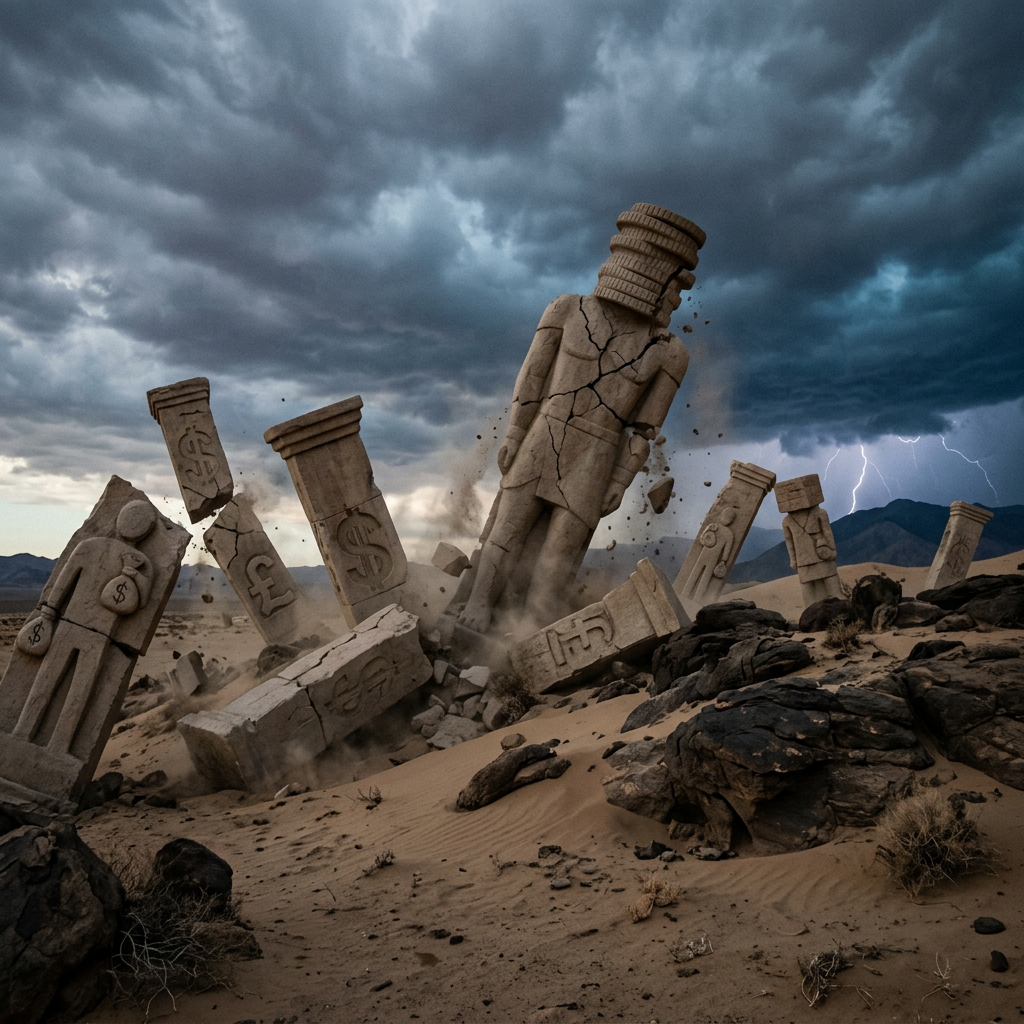
In the shifting sands of economic history, few stories are as haunting and instructive as the rise and near-collapse of the markets built on breath and bone. For centuries, trade was not merely a transaction of goods but a covenant of life itself—sustained by the breath of labor, community, and natural cycles, and structured by the bone of tradition, craftsmanship, and physical resources. Yet, a shadow fell upon this ancient bazaar: the rise of the False Wagers. These were speculative gambles, hollow promises, and idolized abstractions that threatened to hollow out the very essence of human commerce. Against all odds, the Market of Breath and Bone did not merely survive; it adapted, fought back, and emerged as a testament to enduring value. This is the story of how living trade overcame the specters of deceit.
The Fall of False Wagers and Ancient Idols
The first sign of rot came not with a crash, but with a whisper. Markets began to worship ancient idols—not gods of stone, but concepts like perpetuity, infinite growth, and paper value detached from reality. These false wagers were bets placed on the idea that one could trade tomorrow’s wind for today’s gold, without ever tending to the soil.
- The Idol of Pure Speculation: Assets were traded not for their utility, but for their potential to be resold at a higher price to a greater fool.
- The Idol of Synthetic Value: Financial instruments were created that had no connection to physical goods, labor, or human need.
- The Idol of Immortal Debt: Loans were extended on the assumption that growth would never end, ignoring the natural limits of breath and bone.
As these idols grew, the real economy—the one where farmers plant seeds and blacksmiths hammer steel—began to suffocate. The false wagers promised wealth without work, but they demanded a terrible price.
Breath and Bone: A Market Rooted in Human Truth
But the Market of Breath and Bone was never a monument to abstraction. It is the oldest economy, one that predates coins and contracts. Here, breath represents the renewable pulse of life: the energy of a worker’s day, the air that turns a mill, the seasons that bring harvest. Bone is the enduring structure: the tools, the land, the stored grain, the iron rails, and the knowledge passed down through generations.
This market operates on a few unshakeable truths:
> The only value that endures is value that sustains life. A tree is worth more standing if it provides fruit, shade, and clean air than it is as a pile of currency.
The false wagers could not understand this. They saw a forest as lumber futures; the Breath and Bone market saw a living system. They saw a village as a labor pool; the real market saw a community of artisans, families, and caretakers.
Facing the Fourth Beast of Hollow Lungs
When the false wagers reached their fever pitch, they took on a monstrous form—the Fourth Beast, a creature of hollow lungs. This beast could not breathe on its own. It was a chimera of derivatives, short sales, and phantom equities that devoured the oxygen from real trade. Its lungs were empty, yet it demanded constant feeding.
- Signs of the Beast’s Presence:
- Markets that moved opposite to supply and demand.
- Prices determined not by scarcity or need, but by rumor and algorithm.
- Entire industries teetering because their actual products were worth less than the bets placed against them.
The beast nearly won. It convinced many that breath was obsolete—why farm when you can trade crop futures? Why build when you can flip land titles? But the beast made a fatal miscalculation: it forgot that hollow lungs cannot sustain a living body. When the false wagers collapsed, the beast inhaled its own emptiness and imploded.
How the Living Scroll Defeated the Gambling Empires
In the aftermath, the survivors did not turn to new central banks or global regulators. Instead, they rediscovered the Living Scroll—an ancient, unwritten code of trade that prioritized relationship over transaction, and substance over speculation.
> “Let a handshake hold more weight than a contract written on thin air.” – A forgotten merchant’s creed.
The Living Scroll operated on three principles:
- Provenance: Every good traded must have a clear, honest origin. No one sells what they cannot point to in the earth or see built by hand.
- Reciprocity: Trade must benefit both parties in tangible ways. A deal that starves one side is a deal that eventually starves both.
- Memory: The market must remember its debts and its debts must be payable in real value—food, shelter, tools, time.
The gambling empires collapsed not from a single blow, but from a slow draining of trust. People simply stopped playing. They returned to the village square, the co-op, the farmer’s gate. They rebuilt the market from the bottom up, with breath in every deal and bone in every balance sheet.
The First Surviving Market: A New Covenant for Trade
Today, the Market of Breath and Bone stands not as a relic, but as a blueprint for a New Covenant. It is not a museum of old ways, but a living system that incorporates technology without surrendering to abstraction. Blockchain, for instance, is used not for cryptocurrency gambling, but to track the true journey of timber from a sustainably managed forest to a carpenter’s workshop. Open-source designs replace intellectual property traps, allowing tools to be improved and shared.
Characteristics of this New Covenant:
- Local resilience first: Goods that can be made or grown locally are prioritized over global, fragile supply chains.
- Value-backed exchange: Credits and tokens are always convertible into a defined basket of basic necessities—grain, iron, clean water, labor hours.
- Community oversight: A council of producers, consumers, and elders has the power to halt trades that are exploitative or purely speculative.
Conclusion
The survival of the Market of Breath and Bone is not a quiet victory. It is a loud, defiant declaration that human truth outlasts human trickery. The false wagers are dust now, blowing through the empty halls of banks that no longer function. But in every village market, every artisan workshop, and every cooperative farm, the breath still moves and the bone still holds. The old idols fell because they had no life in them. The market lives because it is life itself—bought and sold, but never betrayed.
The lesson is simple, though hard-won: Trade in what you can breathe, build with what you can hold, and never wager the future on a lie.
Leave a Reply