The Tenth Trumpet and the Falling Towers
In the chronicles of ancient cities, there is a tale whispered among the remnants of a kingdom now buried under sand and silence. It speaks of a day when the earth groaned like a wounded beast and the sky split with a sound likened to the Tenth Trumpet—a harbinger of final judgment in the lore of stone and shadow. On that day, the twin towers of the great capital, carved from mountain granite and sheathed in gold, were said to topple in a single, trembling breath. Yet, amid the cascade of dust and ruin, one spire remained upright. It was not the tallest, nor the richest, but it stood. This is the story of that tower, and the prophet who refused to let it fall.
A Single Spire Against the Ruined Sky
When the tremors ceased, the survivors looked upon a horizon that had been rewritten. Where two majestic pillars once marked the city’s pride, now only jagged stumps remained. But in the eastern quarter, near the old aqueduct, a single spire punctured the smoke-filled heavens. This was the Tower of Gazan, a modest watchtower of weathered limestone and cedar beams. Around it, the ground had buckled and the marketplace lay in splinters, yet the tower’s base was unmarred, and its flagpole still held the tattered banner of the forgotten king.
- It was not fortified with iron or magic.
- It had no deep foundations of marble.
- Its secret, as the elders claimed, was the vigil that never ceased.
From the moment the first tremor rattled the city gates, a figure had been seen atop the tower. Cloaked in simple wool, with a staff of gnarled olive wood, the prophet named Zadok had taken his post and would not descend—not for the cries of his family, nor the pleas of the priests.
The Ascent: Steps Carved by a Promise
No one knew why Zadok chose the Tower of Gazan for his stand. Some say he was a madman; others, a seer who had dreamed of the Tenth Trumpet three nights before. The staircase within the tower was a spiral of one hundred and eight steps, each one worn by centuries of watchmen and messengers. On the day of the quake, Zadok climbed them slowly, pausing at each landing to whisper a promise.
> “I will not leave until the tower stands, or I burn with its bones.”
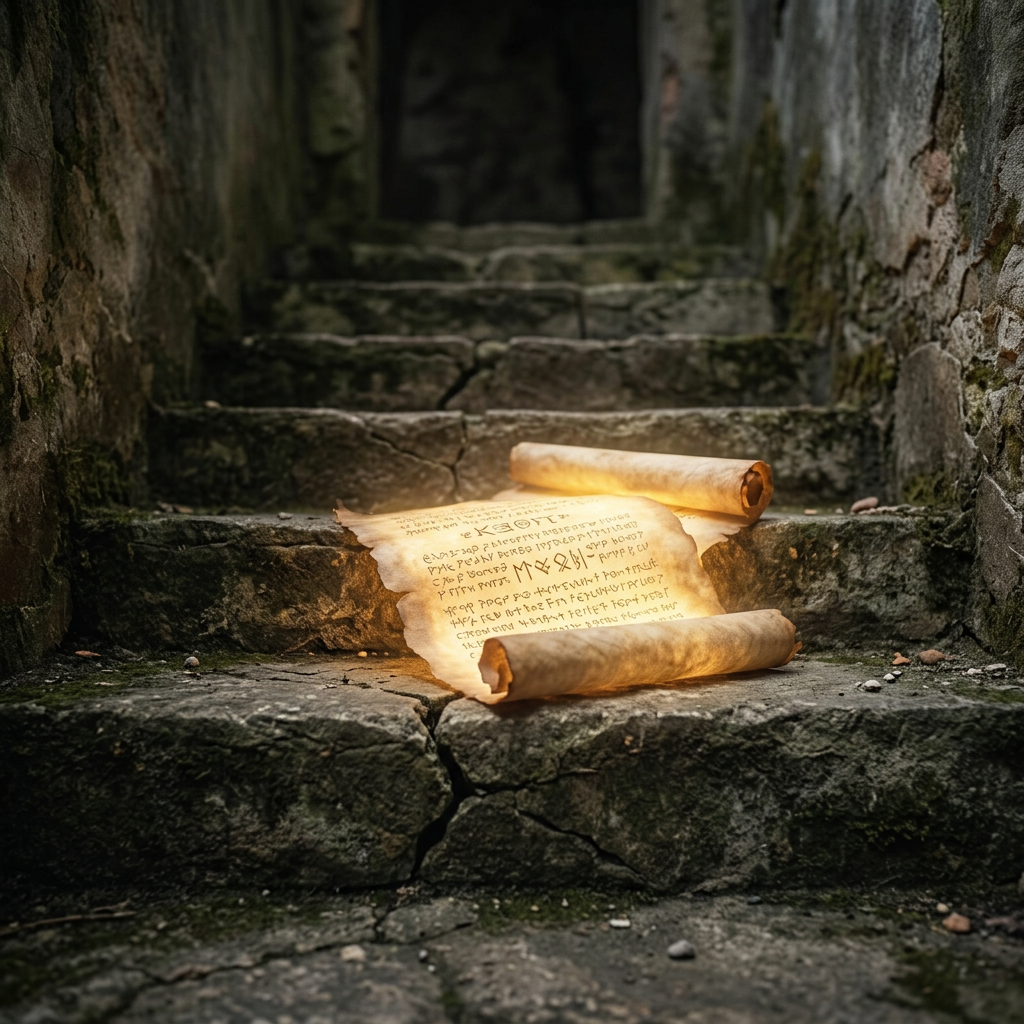
The promise was not made to the king, nor to the gods of the city’s temples. It was made to a scroll—a brittle document he had carried from the desert, sealed with wax and tied with a red cord. What the scroll contained was a mystery. Some believed it was a map to hidden water veins; others, a prayer that could silence the earth.
The Scroll That Defied the Quake
Traders who survived the disaster later described the moment the tower shook. They saw Zadok standing on the parapet, his arms outstretched, holding the scroll high above his head. As the world convulsed, the tower groaned, its wooden beams crying out like living things. One observer, a baker named Miriam, recalled:
> “The scroll caught the light of the falling sun, and for a moment, I swear it glowed like a torch. Then the shaking stopped.”
Was it divine intervention? A coincidence of geological timing? The true nature of the scroll remains debated in the surviving annals. But what is certain is this: while towers of steel and stone crumbled around it, the Tower of Gazan did not fall. The beams held. The limestone crack but did not shatter.
Vigil at the Summit: Keeper of the Unfallen
After the dust settled, the city sent a delegation to retrieve Zadok. They found him seated cross-legged near the tower’s bell, the scroll unrolled across his lap. He was exhausted, his lips cracked from thirst, but his eyes were clear. He greeted them not with words of victory, but with a quiet warning:
“The tower stands because one thing remained unbroken: the will to keep watch. When you leave a post, you surrender the ground to chaos. I did not leave.”
He then descended, one hundred and eight steps, and walked into the ruins to help dig for survivors. The scroll he placed in the hands of a child, saying it was now her turn to watch.
Conclusion
The story of Zadok and the Tower of Gazan is not about architecture or miracles. It is about the power of steadfast presence—a reminder that sometimes, the only thing that keeps a structure upright is the stubborn hope of the one who stands atop it. The Tenth Trumpet may have sounded, towers may have fallen, but the vigil of a single prophet turned a humble watchtower into a legend. And in that legend, we find a truth for our own trembling times: that courage is not the absence of fear, but the refusal to abandon your post when the world shakes.
Leave a Reply