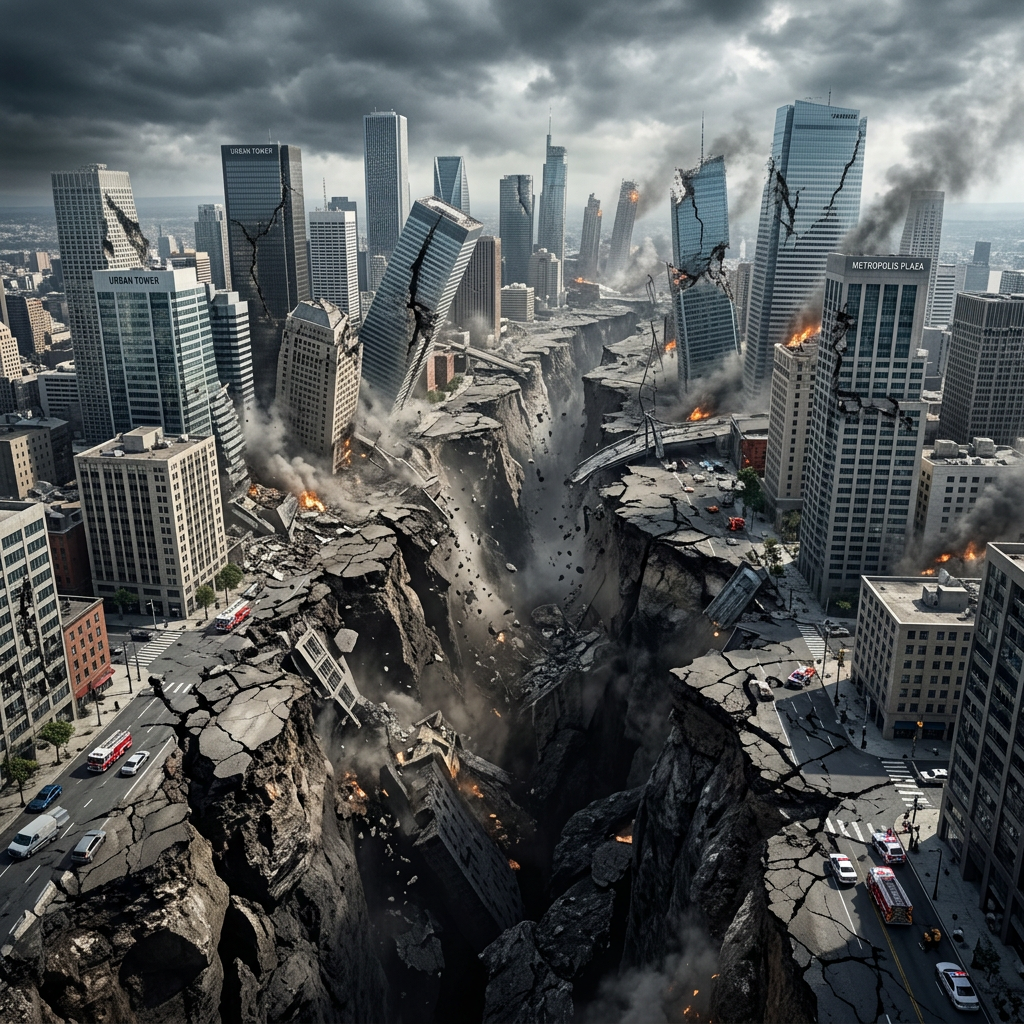
The Third Trumpet: When the Ground Split Open
There comes a moment in the history of every civilization when the earth beneath its feet ceases to be a foundation and becomes a witness. We often speak of natural disasters as random, indifferent acts of geology and weather. But what if the ground split open not because of a seismic fault, but because it could no longer bear the weight of our collective deception? The Third Trumpet in the allegory of Earth’s Judgment is not a literal horn blown by angels; it is the sound of tectonic plates groaning under the pressure of untruths. When the silence broke, it was not with a whisper, but with a crack that swallowed whole highways and toppled skyscrapers built on promises of eternal growth.
The fracture lines did not follow old maps of seismic risk. They followed the contours of our moral geography. In places where we had paved over wetlands with lies of “flood control,” the water rose again. In cities where we had drilled into the mantle with contracts that ignored the planet’s limits, the magma stirred. This was not punishment—it was consequence. The earth, like a living organism, simply refused to hold up structures that were built on hollow foundations.
Cities of Sand: How Illusions Built Our Fall
We built cities of sand, and we called them real. The skyline glittered, the towers touched clouds, but every foundation was poured over a historical landfill of broken promises. Consider the urban sprawl that devoured forests with the promise of “smart growth” while delivering only soulless concrete. We erected whole economies on the notion that resources were infinite, that waste was an acceptable byproduct, and that the planet would always absorb our excess.
The fall was slow at first, then abrupt. Here is how the illusions crumbled:
- The Glass and Steel Mirage: We believed technology would save us, even as our server farms consumed rivers of water and our data clouds rained toxicity.
- The Financial Scaffolding: Loans taken out against future oil that would never be burned, mortgages on houses that would slide into the sea.
- The Social Contract: Agreements to ignore the climate refugees at our borders, to label them as “economic migrants” rather than exiles of our own making.
When the ground refused our lies, it did not discriminate. It swallowed the corporate headquarters and the artisan bakeries with equal indifference. The difference was not in the rubble, but in what was revealed beneath: nothing but sand.
Earth’s Refusal: The Weight We Could No Longer Hide
The planet has a quiet, persistent way of rejecting what does not belong. It is not vengeful; it is honest. For decades, we dumped our industrial waste into the oceans and sprayed our farmlands with chemicals, and the Earth absorbed it, patiently trying to digest our sins. But there comes a threshold. When the ground refuses our lies, it does so by turning them into physical objects we cannot ignore.
> The truth does not always set you free. Sometimes, it first buries you. But being buried in truth is better than standing on a lie.
This refusal took many forms. Beneath our feet, a global network of aquifers became poisoned by fracking fluids and agricultural runoff. The water we once drank became a chemical cocktail we could no longer pass off as pure. Over our heads, the atmosphere thickened with the ghosts of ancient forests turned to carbon. The ozone layer, once a metaphorical shield for our ignorance, warned us, but we dismissed it as a minor scare.
The ultimate weight was not just physical pollution, but the pollution of our collective consciousness. We knew. We always knew. And the earth, in its refusal, simply made our knowledge impossible to deny.
The Market’s Dust: Where Profits of Chance Tumbled
If the ground split open for the physical world, what happened to the abstract towers of finance? The market, that artificial ecosystem of trust and greed, turned to dust. The profits of chance—the speculative derivatives, the carbon credits that traded imaginary reductions, the land titles to territories that were already underwater—all crumbled. This was not a recession; it was a geological event for the economy.
The market’s fall followed its own tectonic logic:
- Fossil fuel stocks plummeted not because of regulation, but because the wells ran dry and the mines collapsed.
- Insurance giants failed when they realized they could no longer price risk for a planet that had stopped playing by its old rules.
- Cryptocurrency mining became an absurd joke, as the energy required to mint a digital coin was now needed to pump clean water to arid cities.
The dust settled, and what remained was not silver or gold, but the simple reality of enough. Enough grain to feed the living, enough material to shelter the displaced, enough humility to ask the ground for permission to rebuild.
Beneath the Cracks: Choosing Shifting Sands Over Truth
Now, we stand at the edge of the chasm. The cracks in the earth are not only external; they run through our own hearts. The choice before us is stark: Do we rebuild on shifting sands, hoping to repeat the same illusion with better engineering? Or do we finally choose the truth, even if that truth is uncomfortable and demands we live differently?
To choose shifting sands over truth is to build a house on a landslide. It is the seduction of comfort over courage. Yet, history shows that humans are creatures of habit, and old habits die hard. We might be tempted to fill the cracks with concrete, to paper over the fissures with fresh lies of “sustainable growth” and “green technology” that does not challenge our consumption.
But the earth is a hard teacher. It gives the exam first, then the lesson.
> The ground does not demand our purity. It demands our honesty. And honesty begins with admitting that the sand was never meant to hold a skyscraper.
Conclusion: The Silence After the Crack
The judgment of the Earth is not an apocalypse, but a recalibration. After the ground split open and the cities of sand fell, after the markets turned to dust and the weight of our lies became too heavy, there is a profound silence. In that silence, we hear not condemnation, but a question: What will you build now?
To choose truth is not to return to some primitive pastoral fantasy. It is to build with integrity, to listen to the soil, to honor the water, and to recognize that the ground is not a platform for our ambitions but a partner in our survival. The Third Trumpet has sounded. The cracks are still open. The choice, as it always has been, is ours—but now the earth is listening.
Leave a Reply