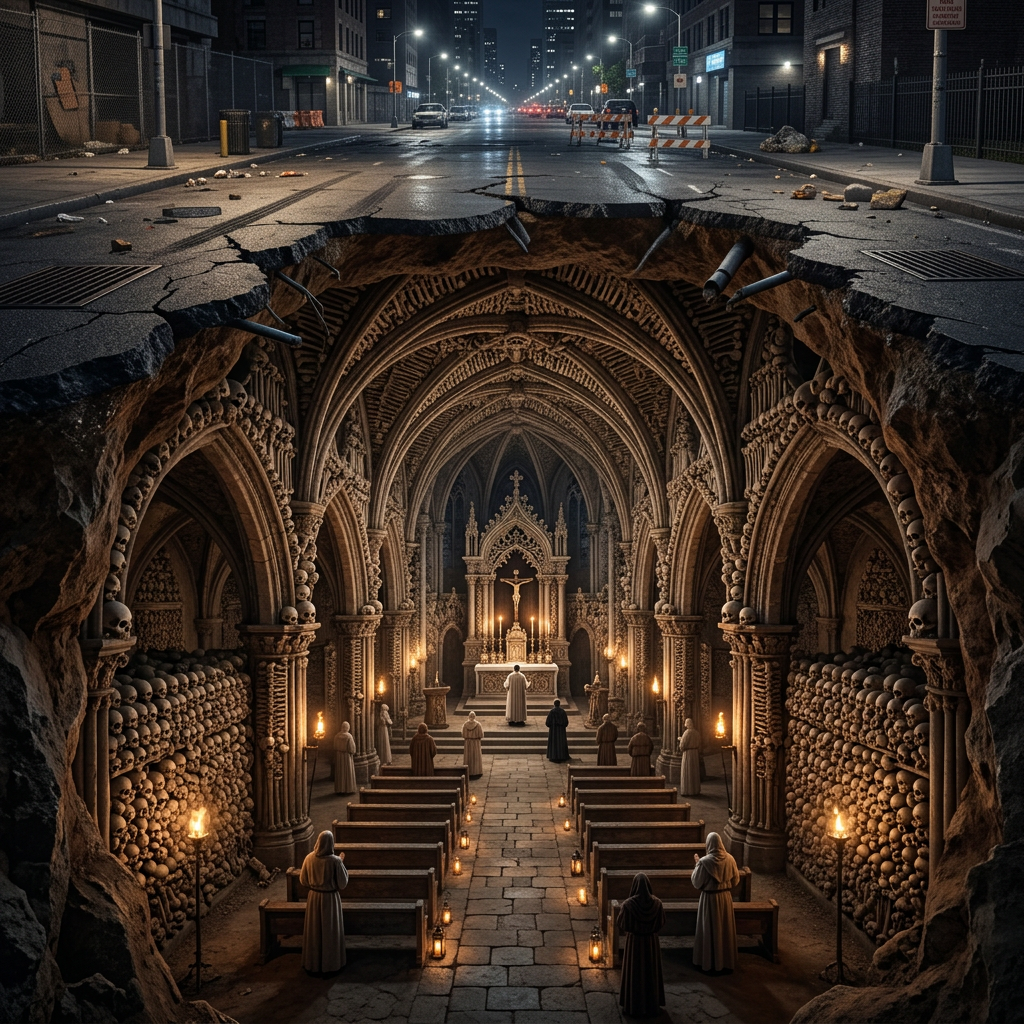
In the quiet hours between midnight and shiver, when the wind carries a scent of damp earth and old stone, there is a story that refuses to stay buried. It is not a legend told around campfires, nor a whisper in dusty libraries—it is a truth crawling up from the deep places, written in bone and bedrock. This is the tale of Gravemarrow’s Eleventh Seal, a pact so ancient and so broken that the dead have begun to stir, not for vengeance alone, but for remembrance. They remember the moment we turned our backs, and the earth itself now holds a grudge.
When the Earth Remembers: Gravemarrow’s Awakening
Deep beneath the roots of our oldest cities, there lies a geological anomaly that geologists refuse to name. It is a vein of dark, porous stone that weeps a greasy fluid—gravemarrow. For millennia, this substance was the binding agent of a sacred covenant: the living would honor the dead, and the dead would sleep in peace. But we grew arrogant. We paved over graves, built factories on ossuaries, and mined the gravemarrow for fuel and profit. Now, the seal is cracking.
- The first sign: unexplained tremors in regions without fault lines, always centered on old burial grounds.
- The second: a faint, rhythmic hum recorded at 11 Hz, matching the resonant frequency of human skulls.
- The third: flowers blooming in reverse, petals turning inward as if hiding from the light.
The earth is not merely shaking; it is remembering.
The Broken Seal: Bones Stir Beneath Our Cities
The Eleventh Seal was never meant to be broken. It was inscribed as the final safeguard—a metaphysical lock that ensured the dead could not return, even if they wanted to. But we broke it, not with war or ritual, but with neglect. We stopped listening to the soil.
> “The dead do not rise for anger. They rise because we stopped telling their names.”
> – Excerpt from the Catacomb Codices, author unknown
When the seal shattered, the first sign was not a zombie apocalypse, but a silence. Birds stopped singing over cemeteries. Dogs howled at empty corners. Then came the bonewalkers—not full skeletons, but joints that would creep across floors, phalanges that would tap at windows, and vertebrae that would stack themselves into eerie spirals outside courthouses and churches.
These are not mindless horrors. They are messages. Each bone is a letter from the past, written in calcium and guilt.
A Skeletal Cathedral of Grief and Betrayal
In the town of Marrow’s End, where the gravemarrow vein surfaces like a petrified artery, the dead have built something impossible. It began with a single rib bone, planted upright. Within a week, thousands of bones—some human, some not—had migrated from graves, museums, and riverbeds to form a cathedral of grief. It has no roof. The sky serves as its dome, and the wind howls through its ribbed columns like a choir of lament.
Within this cathedral, visitors report:
- Temperature inversions where the air is colder inside than out, but smells of fresh bread and woodsmoke—scents of life now lost.
- Echoes of voices speaking languages that have been dead for centuries, yet feel intimately familiar.
- A central altar made of a single, massive femur, carved with the words: “You forgot us, so we built a place where you cannot forget.”
The cathedral is a testament, a monument, and a judgment. It grows taller every night.
Whispers from the Marrow: The Dead Do Not Forget
The most unsettling aspect of Gravemarrow’s awakening is not the physical signs—but the whispers. Those who sleep near exposed gravemarrow report dreams where they stand at a dining table filled with ancestors. The food is cold, and the faces are silent. But the eyes speak.
The dead remember everything:
- The names we let fade from headstones.
- The oaths we made over graves, then broke before the dirt settled.
- The laughter we shared while standing on burial mounds.
> “To be forgotten is a second death. But to be remembered for betrayal—that is eternal life in a tomb of shame.”
> – Inscription found on a human jawbone, arranged on a park bench
The whispers are not threats. They are testimony. They tell the stories of those we left behind, not because they crossed into the afterlife, but because we stopped crossing over to them.
Etched in Bedrock: The Weight of Our Denial
We have tried everything to deny this. Governments have called the bonewalkers “tectonic rearrangement anomalies.” Scientists claim the gravemarrow is a natural oil seep. Religious leaders say it is a test of faith. But the dead do not care for our labels. They care for attention.
- Tip for skeptics: Visit any active gravemarrow site. Place your palm on the stone. If it feels warm in the cold, and cold in the heat, the stone is alive.
- Tip for the grieving: Speak the full name of one forgotten ancestor out loud, near a vein. The ground will shudder—not in anger, but in acknowledgment.
- Tip for the guilty: You cannot undo a betrayal. But you can bear witness. The dead do not ask for apologies. They ask for remembrance.
We built our cities on bones and then forgot the architects. Now, the architects are reclaiming the blueprint.
Conclusion
Gravemarrow’s Eleventh Seal is not a curse—it is a mirror. It reflects our deepest failing: the belief that the past can be paved over, forgotten, or commodified. But the dead are not resources to be mined or histories to be shelved. They are witnesses to a covenant we broke. The seal is shattered. The bones have begun to walk, not to destroy, but to remind.
We can fill the cracks with concrete, ignore the whispers, and deny the cathedral of bones. But the earth remembers. And as long as there is gravemarrow beneath our feet, the dead will wait—patient as stone, loyal as marrow—for the day we finally turn around, kneel, and say, “I remember you.”
Leave a Reply