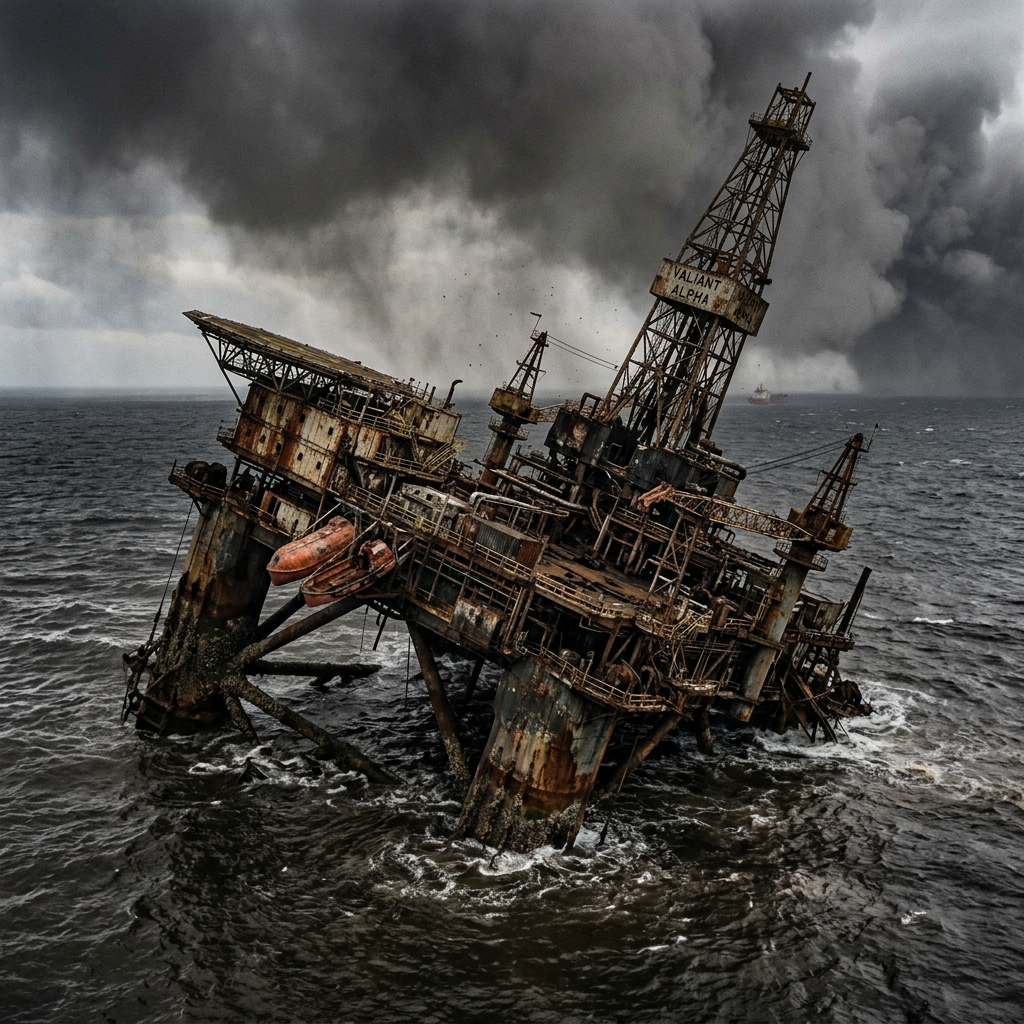
The Third Trumpet and the Birth of Tidesmoke
The old stories never quite prepared us for this. We had read of plagues, of fire from the sky, of waters turning to blood. But no ancient text described the moment the ocean itself learned to speak—not in waves, but in a low, grey exhalation that coiled into the sky like a final verdict. The event that survivors now call the Tidesmoke began not with a bang, but with a sigh. It was the Third Trumpet of our age, not wrought by angels, but by centuries of systemic debt. The seas, it turned out, had been keeping a ledger. And they were finally calling it in.
Scientists later debated whether it was a chemical reaction triggered by deep-sea mining or a delayed thermal vent catastrophe, but the result was the same: the waters began to boil from within, releasing a fine, particulate fog. It was neither steam nor smoke, but a strange hybrid—what we now call Tidesmoke. It did not rise and dissipate. It hung. A judgment made visible.
When the Seas Exhaled: A Living Curtain of Smoke
Imagine the horizon not as a line, but as a wall. That was the first sign. The Tidesmoke did not behave like weather; it behaved like a presence. It advanced in slow, deliberate bands, rolling over coastal cities with the patience of a tide. Within the smoke, the air became thick, carrying a strange, metallic taste. It was not immediately lethal—which made it worse.
- Visibility: Reduced to less than a meter within minutes.
- Sound: Muffled, as if the world was wrapped in wet wool.
- Touch: The smoke left a fine, grey film on everything. The film did not wash off.
- Life: Fish floated belly-up within hours. Birds refused to fly near the coastline.
The most terrifying aspect was the stillness. The entire ocean, in many places, stopped moving. The waves simply flatlined, as if the sea had gone into a coma. And from that flat surface, the Tidesmoke rose like a final breath.
> “It was not the rage of the sea that broke us,” wrote a portmaster in her final log, “but its silence. The ocean stopped arguing and started judging.”
The Buried Platform: Finance’s Final Purification
This is where the story takes a strange turn—from natural disaster to a reckoning of value. Before the Tidesmoke, the world’s financial systems ran on a secret: a Buried Platform of unregulated offshore accounts and digital ledgers that floated on nothing but trust. All that trust was tied to coastal data centers and subsea cables. The smoke did not care about interest rates.
- Data Loss: The largest financial databases, housed in coastal vaults, were corrupted by the salt-heavy smoke.
- Collateral Failures: Assets backed by “oceanfront value” became worthless overnight.
- The Purification: The Tidesmoke acted as a cleanse. It erased the phantom wealth built on environmental extraction.
The irony was not lost on the survivors. For centuries, we had mined the seabed, drilled its floors, and turned its currents into cash flow. The sea simply returned the favor—it deleted the debt. The Buried Platform of global finance was not destroyed by a crash. It was cleansed by a vapor. Money, it turned out, was as fragile as a wave.
> “We built our economy on the back of a living thing. When that thing exhaled, our economy had no lungs left.” — Anonymous economist, post-event journal.
Choosing the Old Tides: A World’s Last Refusal
In the aftermath, humanity faced a choice. There were technologies that might have filtered the Tidesmoke, seeded the clouds to break it apart, or built new artificial environments. But something strange happened: the world refused.
- Rejection of Geo-engineering: People feared that tampering with the smoke might wake something worse.
- Return to the Old Tides: Coastal communities began migrating inland, not as refugees, but as pilgrims. They chose the old, clean air of the interior.
- A Cultural Shift: The sea was no longer a resource; it became a sacred boundary.
This was the Last Refusal—a world that had once chased progress decided to stop. The Tidesmoke became a permanent fixture along the coastlines, a grey horizon that marked the edge of the known world. Those who stayed called it a penance. Those who left called it wisdom.
> “We do not need to conquer the smoke. We need to listen to what it is saying.” — Healer of the New Shore.
Tidesmoke’s Whisper: What Refuses to Cleanse Will Cleanse You
The lesson of the Tidesmoke is not a gentle one. It is a whisper that echoes through the abandoned ports and the silent docks. It says: whatever balance you refuse to restore, the universe will restore for you—often with a force you cannot control.
The Tidesmoke teaches us:
- That nature does not negotiate; it clears. If we refuse to cleanse our greed, the ocean will cleanse it for us.
- That invisibility is not safety. The most dangerous debts are the ones we cannot see.
- That the final judgment is not a heavenly decree, but a natural consequence.
Conclusion
We live now in a world divided by a grey horizon. On one side, the old sea lies still and smoking, a monument to what we took. On the other, the land rises, offering a second chance—but only if we remember. The Tidesmoke is not gone. It waits, patient as the tide, whispering its quiet truth: What refuses to cleanse, will cleanse you. The choice, as always, is ours. But now, we make it with the taste of salt and ash on our tongues, and a horizon that will never again be blue.
Leave a Reply