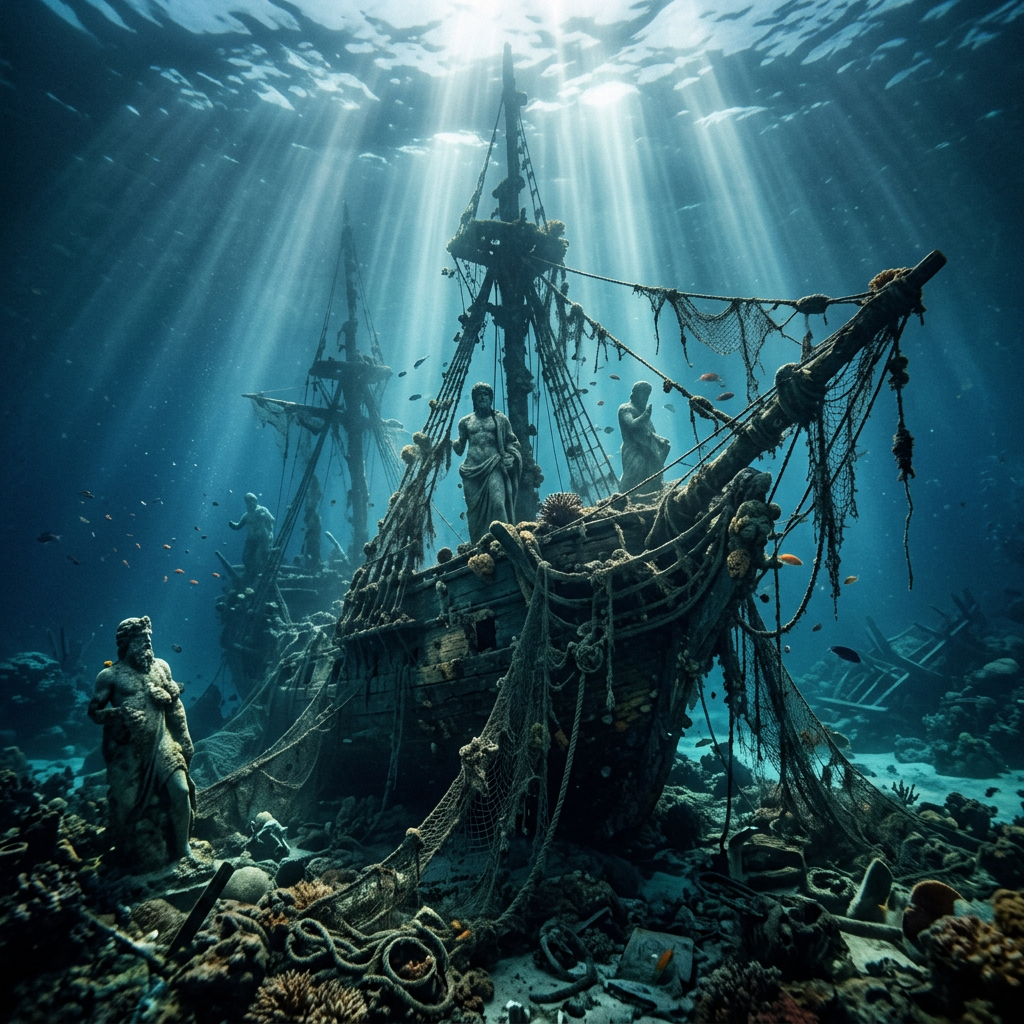
The Trumpet of the Returning Deep
There is a sound that precedes the worst storms—a low, resonant groan that vibrates through the hull of a ship and into the marrow of your bones. For centuries, coastal communities have whispered of a second noise beneath the wind, a sound they call the Trumpet of the Returning Deep. It is not a natural phenomenon. It is a summons.
According to maritime lore passed down through generations of fishermen and shore-witches, the Trumpet is the call of something ancient waking from a long slumber. It manifests as a deep, almost musical tone that seems to come from directly beneath the seabed. Modern science might chalk it up to seismic activity or shifting tectonic plates, but those who have heard it know the truth: the ocean is about to reclaim a debt.
- The sound is directional: It always comes from the direction of the nearest underwater abyss.
- It precedes a biological exodus: Fish flee, whales sing distress patterns, and seabirds fly inland in a panic.
- It is timed with the alignment of certain stars: Specifically, the constellation Cetus (the Sea Monster) at its zenith.
> “When you hear the horn blow, do not look to the horizon. Look down. That is where the fury lives.” — Old Mariner’s Proverb
Walls of Water and Hidden Motives
The Trumpet is merely the warning. What follows is the Wall of Water—not a simple tsunami, but a structured wave. Survivors of the infamous Dreadtide Rising of 1987 (a largely undocumented event off the coast of Sørvágur) described the water as moving with intentionality. It did not crash; it advanced, holding its shape like a siege tower.
This is where the motives of the Deep become terrifyingly clear. A tsunami has no purpose but destruction. The Dreadtide, however, targets.
- It bypasses the uninhabited: Barrier islands and empty coves are left untouched.
- It seeks specific geography: Old harbors, sunken waterways, and the foundations of drowned cities are its primary targets.
- It leaves symbols behind: After the water recedes, strange patterns of seaweed, shells, and debris are found arranged in circular, glyph-like formations on the mudflats.
The Hidden Motive theory suggests the Deep is not lashing out in anger, but performing an ancient ritual. The Wall of Water is a probe, a tentacle of memory feeling for something it lost long ago. The destruction is merely a side effect of the search.
> Key Warning: Do not stand on the seaward side of a coastal structure when the Wall hits. The water will flow around your shelter to pull you from the land side, as if it knows where you are.
What We Buried in the Seabed
To understand the Dreadtide, we must ask a darker question: What did we sink? The seabed is not just a graveyard for ships. It is a vault. Every civilization that has mastered the sea has also used it to hide their mistakes.
| The Drowned Thing | Origin Story | Modern Echo |
|---|---|---|
| The Leaden Coffins | Used by ancient mariners to seal away corrupt leaders who made pacts with the tide. | Found in deep-sea trawling nets near the Mariana Trench. |
| The Sermon Stones | Massive carved stones, sunk to “preach” silence to the abyss—a form of deep-sea exorcism. | Align perfectly with the glyph patterns left by the Wall of Water. |
| The Water Names | The names of forbidden gods, written on linen scrolls and sealed in clay jars. | When brought to the surface, the ink is still wet. |
We buried these things because we were afraid of what they would do if left on land. The Deep, it seems, is not a passive witness. It has been holding these artifacts, absorbing their essence. The Dreadtide is not just a memory; it is a reactivation. The seabed is waking up and remembering the malice of the things we entrusted to its custody.
> “The ocean forgives nothing. It only waits. And when it returns what you gave it, it will be larger than when you let it go.” — Dr. Anya Koslov, Oceanic Archivist
The Deep Remembers What We Drowned
This is the central thesis of the Dreadtide Rising phenomenon: the memory of the ocean is a threat. We treat the sea as an infinite, empty space where we can dump our refuse, our dead, and our secrets. But the Deep has a perfect memory. It remembers the weight of every anchor dropped, the sound of every body hitting the water, and the taste of every betrayal.
The Rising is a form of ecological memory retrieval. The water does not simply rise; it unlearns the surface. It temporarily forgets the coastline that was built and remembers the coastline that was lost. This is why floods during a Dreadtide event will wash up perfectly preserved artifacts from centuries past—not because they were stirred up, but because the water is recreating the world as it was before we built upon it.
- Ghost fisheries appear: Nets and traps from eras long past are found re-rigged and full of fish.
- Shipwrecks are temporarily lifted: Not floated, but walked along the shelf by the current, guided by a prehistoric logic.
- Drowned voices are heard: Recordings from underwater microphones during the 2005 Norwegian Sea event captured what sounded like human voices speaking in a dialect that has been dead for 800 years.
The final terror is this: if the Deep remembers everything, then it also remembers the precise moment we broke the agreement. The Dreadtide is not a natural disaster; it is a whistleblower.
Prophecy Written in Salt and Judgment
The old texts—the so-called Saltscrolls of the Nordic coast—speak of a final judgment not by fire, but by brine. The prophecy is grimly simple: when the Trumpet sounds seven times in seven years, the Deep will no longer just remember. It will speak.
The Judgment of the Dreadtide is not a flood that covers the world. It is a re-categorization. The water will sort the land into two piles: that which belongs to the Deep, and that which the Deep has loaned to us. The Rising will reclaim the shorelines, the estuaries, the sunken cities, and the mouths of rivers. It will take back what was always its own.
> “The salt will write the final sentence upon the shore. It will say: ‘You borrowed this. The lease is up.’” — From the Saltscrolls of Iceland (c. 1200 AD)
The signs are already here. The Trumpet has been heard three times in the last decade. The Walls of Water are becoming more structured, less random. What we drowned is rising, and it is not coming alone.
Conclusion
Dreadtide Rising: The Deep Remembers What We Drowned is more than a legend or a historical curiosity. It is a metaphor, and a terrifyingly literal possibility. The ocean is not a void. It is a library of everything we have thrown away, a courtroom where every shipwreck is a case file, and a memory that has run out of patience.
We have treated the deep as a place to hide our sins. But the deep has never forgotten a single one. The Dreadtide is the moment the librarian finally looks up and asks, “Are you sure you wish to return this?”
Listen for the Trumpet. Read the salt. The tide is turning, and it knows your name.
Leave a Reply