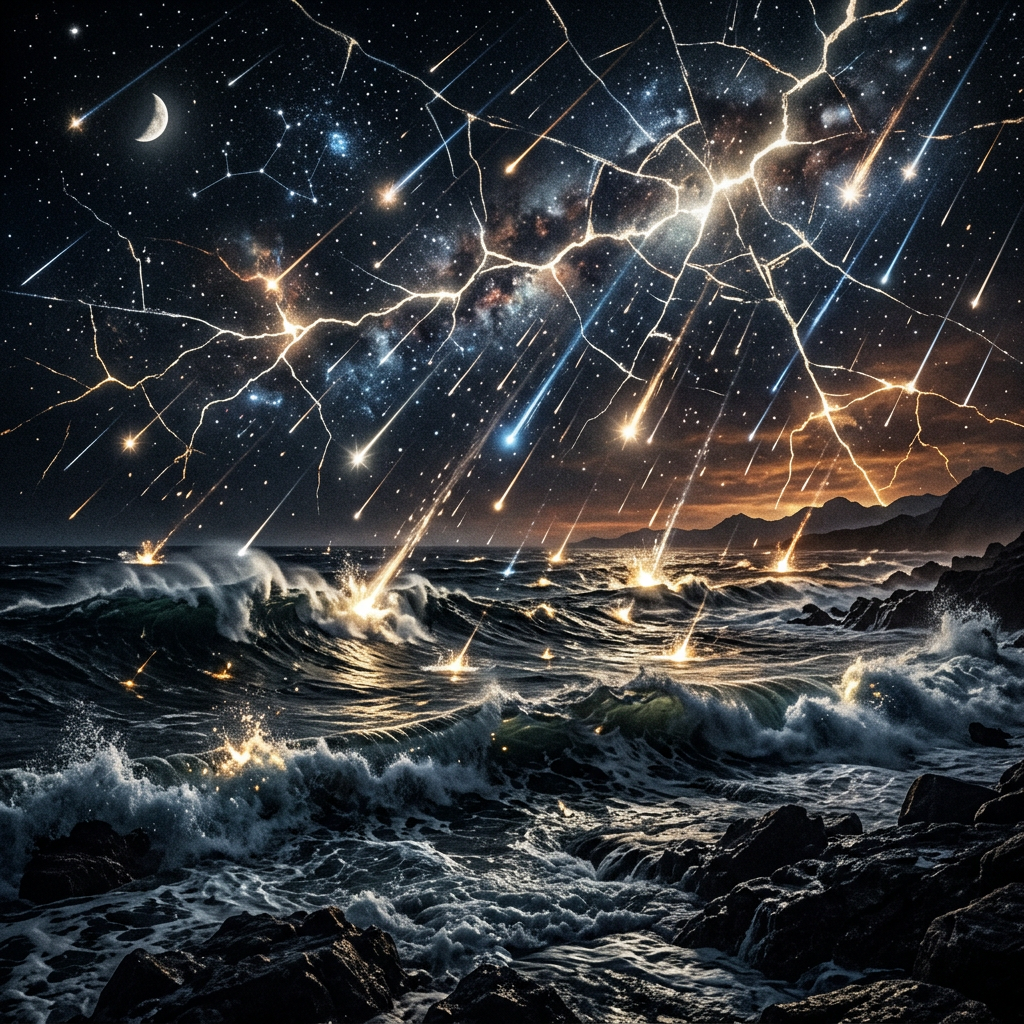
The Second Sign: A Star That Would Not Fall
In the vast, silent theater of the cosmos, stars are born, they blaze, and they die. It is a law as old as time itself. Yet, every so often, the universe gifts us an anomaly—a point of light that defies the gravitational pull of oblivion. This is the story of that anomaly: The Star That Refused to Fall. It did not burn out in a spectacular supernova, nor did it fade into a quiet, cold cinder. Instead, it hovered at the edge of the abyss, a remnant of resilience, casting a peculiar glow that seemed to whisper to those who dared to look up.
This celestial defiance was not a random act of physics. It was a second sign—an omen that the natural order had bent. For those with eyes to see, it marked the beginning of a chapter where hope and despair would dance on a knife’s edge.
When Constellations Crashed into the Sea
The signs were not subtle. Across the world, the familiar patterns of the night sky began to unravel. One by one, the stars we had named, mapped, and mythologized for millennia began to plunge. Orion’s belt loosened, Cassiopeia’s throne tipped, and the great swirl of the Milky Way seemed to weep light into the ocean.
- The Great Deluge: Entire constellations descended like dying fireflies, their fall leaving trails of silver ash.
- The Tidal Shift: As these celestial bodies kissed the sea, the waters themselves began to glow, suffusing the waves with an eerie bioluminescence.
- The Human Awe: People gathered on clifftops and shores, not in panic, but in a strange, reverent silence. It was as if the sky was paying its final respects to the world below.
But in the midst of this cosmic collapse, one star remained. It did not join its brethren in the watery grave. It stood alone, a solitary jewel in a suddenly barren sky.
The Defiant Light of the Unyielding Remnant
What makes a remnant refuse to fall? Is it a flaw in the cosmic design, or a purpose waiting to be fulfilled? The unyielding star did not flicker with uncertainty. It pulsed with a steady, almost rhythmic beat—like a heart. It was a beacon of persistence in a universe that seemed to have given up.
This star taught a brutal yet beautiful lesson: Not all endings are final. While the constellations drowned, this remnant became a north star for the disoriented. It was not the brightest in the sky, but it was the most stable.
> “A falling star is not a failure. It is a fragment of a dream, returning home. But a star that refuses to fall? That is a promise.”
Travelers, artists, and dreamers began to call it the “Anchor Light.” It was a reminder that in a world where everything seems to descend into chaos, there is always something that holds the line.
A Voice Thundered: The Lantern of the Lost
Then came the shift—not from the sky, but from within. As civilizations grappled with the psychological weight of a collapsing universe, a voice seemed to thunder from the remnants themselves. It was not a sound heard by the ears, but a resonance felt in the bones.
- The Whisper of the Void: Those who meditated under the defiant star reported hearing a low hum, a frequency of courage.
- The Lantern for the Lost: The star began to act as a psychic anchor for those who felt unmoored. It didn’t provide answers, but it provided direction.
- The Collective Call: A movement grew—one that rejected despair. “Do not fall,” they chanted. “Be like the remnant.”
This was not a religious awakening, but a philosophical one. The star, in its silent refusal to die, became a mirror for human tenacity. It asked a simple question: If a ball of gas can hold itself together against the pull of a black hole, why can’t you?
Guiding the Human-Anchored Market Through Collapse
The collapse was not just celestial—it was financial, emotional, and social. Markets crashed not because of bad debt, but because of lost faith. The Human-Anchored Market—a new economy built on trust, barter, and emotional currency—rose from the ashes.
Here is how the remnant’s guiding light stabilized this fragile system:
- Trust as Currency: In the absence of falling stars, people latched onto the one that stayed. This star became a visual metaphor for reliability. Traders used its image as a sigil for honest deals.
- The “Remnant” Index: Financial analysts created a new index based on the star’s luminosity. When it flared, markets rose. When it dimmed, people held their assets. It was irrational, yet it worked because everyone believed.
- Emotional Arbitrage: The star’s light was used to calibrate emotional futures. Meditation centers, now stock exchanges of the soul, used its glow to set the “mood price” of the day.
> Key Tip for Navigation: In a collapsing market, do not chase the falling stars—the short-term profits. Anchor yourself to the remnant. Invest in assets and relationships that show unwavering stability.
The market did not return to its former glory. It became something better—a testament to resilience. The remnant taught that true value is not in the brightest flash, but in the longest burn.
Conclusion
The star that refused to fall is more than a cosmic oddity. It is a mirror held up to humanity. When everything around us crashes into the sea, we are given a choice: to be swept away by the current, or to remain, steady and defiant.
As you look up tonight, remember that the guiding light is not out there—it is within. The remnant in the sky is merely a reflection of the remnant in your own heart. Guard it fiercely. Let it be your anchor, your market, and your hope.
For in the end, we are all just stars, deciding whether to fall or to shine on.
Leave a Reply