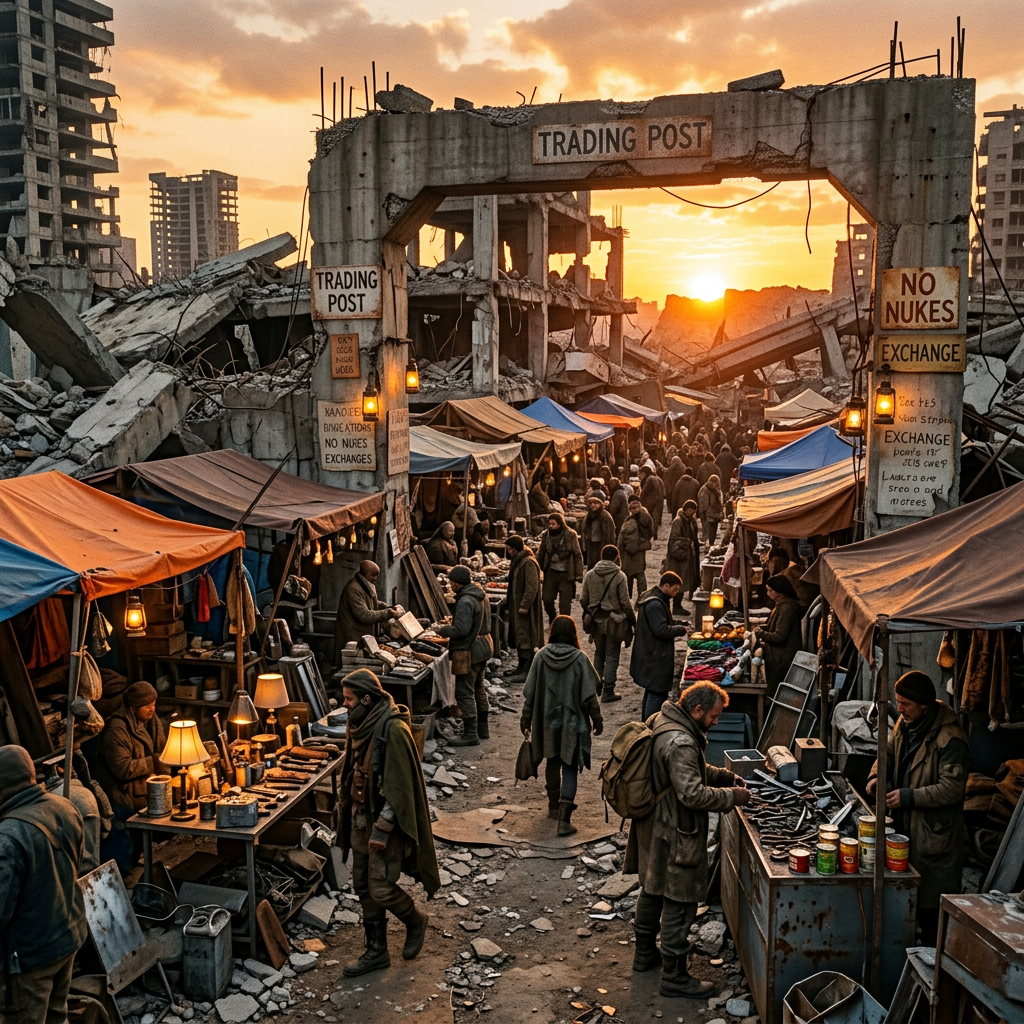
The Last Pulse: When Ruins Became a Signal
The world as we knew it didn’t end with a bang—it ended with a forgotten transaction. Markets collapsed not because of war or famine, but because the truth was slowly siphoned from every exchange. Paper promises turned to ash, digital ledgers were rewritten by unseen hands, and trust became a currency no one could spend. Yet in the hollowed centers of once-great cities, where concrete skeletons stand against a gray sky, something unexpected began to pulse—a signal, raw and unbroken. It was not a broadcast from a government or a corporation; it was the rhythm of human need refusing to be silenced.
Amid the ruins, a new kind of marketplace emerged. It had no walls, no ticker tape, no algorithms designed to deceive. Instead, it ran on face-to-face barter, whispered agreements, and a shared understanding that survival depends on honesty. The first trades were clumsy: a bottle of clean water for a sharpened blade, a medic’s skill for a warm shelter. But the signal grew stronger—a heartbeat in the rubble—proving that even when systems fail, the human instinct for fair exchange survives.
Beyond the Idols: Truth Rising from the Gambling Pits
Before the fall, the old markets were built on gambling pits—places where speculation was the only real product. People didn’t trade wheat or steel; they traded risk. Derivatives on derivatives, bets on bets, all floating on a sea of lies. The idols were numbers on a screen, worshipped until the day they blinked into zero. The system was designed to be broken, and it was.
But from those very pits of ruin, a counter-movement arose. It started with a simple refusal: no more false idols. Small communities began to rebuild using principles that felt almost ancient:
- Direct exchange: Goods and services traded without middlemen.
- Verifiable value: Every item was inspected, tested, or vouched for by a witness.
- Oral contracts: Promises spoken aloud, sealed with a handshake, and remembered by the group.
- Reputation as currency: A person’s word became their wealth—break it, and you were banished from the circle.
This was not a return to primitive life; it was a strategic retreat from complexity that had become corruption. The new market rejected abstraction. A sack of grain was a sack of grain. A day of labor was a day of labor. Truth became the only acceptable price.
Breath and Bone: Rebuilding the Human Marketplace
To rebuild a marketplace of truth, you must first rebuild the people within it. The ruins taught a hard lesson: a market is only as honest as its participants. So the communities began a process of human restoration that went far beyond economics. They asked fundamental questions:
> What does a person need to be truthful? Security, dignity, and a reason to hope.
The answer was a system that prioritized breath and bone—the literal necessities of life—over any abstract profit. The new marketplace operated on three pillars:
- Bioregional sourcing: Everything sold came from no more than a day’s walk. This prevented anonymity and forced accountability.
- Time banking: People contributed skills—cooking, healing, teaching—and earned credits they could spend later. This valued effort over scarcity.
- Public audits: Once a month, the entire community gathered to review all trades. Discrepancies were resolved aloud, with witnesses. There was no room for hidden deals.
In this environment, lying became irrational. If you cheated, you didn’t just lose profit—you lost your place in the only community that could keep you alive. The market became a mirror, reflecting each person’s integrity.
The Unbroken Code: A Market That Refuses to Lie
What emerged was not a system of rules but a code of conduct—an unbroken signal that transmitted truth across every transaction. This code was never written down in any official ledger; it existed in the collective memory of the people. Its core tenets were deceptively simple:
- Clarity over cleverness: Every deal was explained in plain language. No fine print, no hidden terms.
- Generosity as investment: Giving extra—a fifth fish, an extra hour of help—was seen as building social capital, not as a loss.
- Immediate consequences: If a trade went wrong, it was fixed on the spot. There were no refunds, only reparations.
> A market that refuses to lie is not a utopia; it is a fortress against desperation.
This code transformed the ruins into a laboratory for trust. Strangers arriving from other shattered cities were met not with suspicion, but with a trial period of small exchanges. If they proved truthful, they were welcomed. If not, they were simply not needed. The market didn’t need to punish—it only needed to exclude dishonesty.
From Whispers to Heartbeat: A New Nation of Truth
The signal that began as a faint pulse in the dust has grown into a steady heartbeat across the scattered settlements. What started as a local barter circle now connects dozens of communities, each one a node in a network of trust. They call themselves The Unbroken, a name earned through resilience.
This new “nation” has no borders, no flag, no currency. Its strength lies in shared practice, not shared territory. Traders travel between settlements carrying only their word and a small token of their home community: a stone with a carved symbol, a scrap of fabric dyed with local earth. These tokens are proof of belonging, but the real proof is in the transaction itself.
The lessons are clear for any future civilization:
- Truth is not a luxury; it is infrastructure. Without it, no market can stand.
- Small is sustainable. Intimate markets allow for accountability that global systems cannot achieve.
- Human connection is the ultimate commodity. Everything else is just stuff.
As the sun sets over the ruins, a trader hands a pouch of salt to a farmer in exchange for a bundle of herbs. No written contract, no digital receipt. Just a nod, a smile, and the quiet certainty that the signal will remain unbroken. In a world of ashes, that is the only market worth having.
Leave a Reply