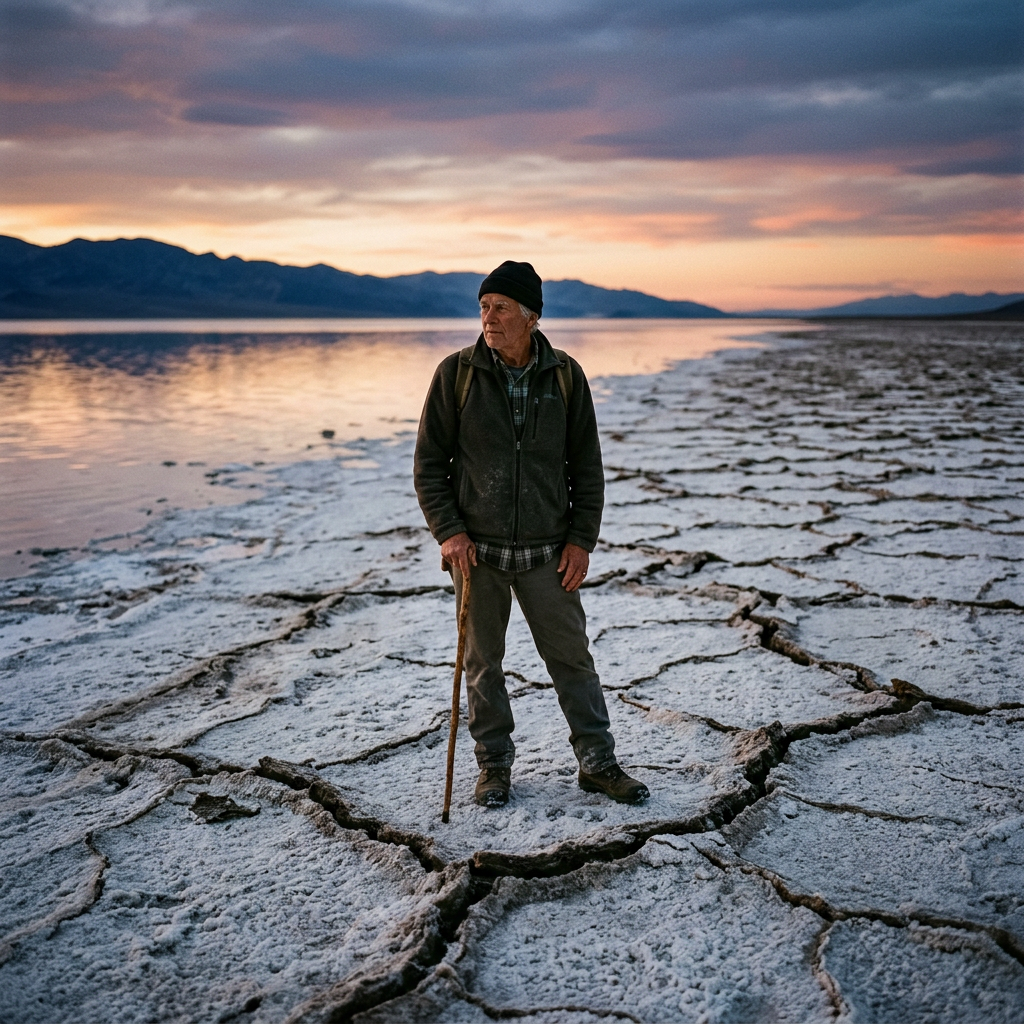
There is a story that no one writes down, not because it is secret, but because it is too common. It lives in the crease of a palm, the ache of a bent back, and the sting of salt in a fresh wound. This is the story of the last scripture—not etched on parchment or stone, but written in the only ink that never fades: sweat and salt. From the shores of a dying sea to the quiet stage of a midnight theatre, this is a meditation on what it means to be human when the world seems determined to forget.
The Watcher by the Shrinking Salt Sea
On the edge of the Dead Sea, where the water recedes by a meter each year, an old man named Elias sits on a sun-cracked bench. He has been a lifeguard here for forty seasons, though today there are fewer swimmers and more tourists snapping photos of the salt-encrusted pillars. The sea is dying, its minerals harvested for industry, its shores pocked with sinkholes.
Elias doesn’t read much. He says books are for people who have time to forget. Instead, he watches the water. He knows the salt is writing its own story of withdrawal—a slow, patient scripture of retreat.
> “The sea doesn’t scream when it leaves,” he once told a journalist. “It just dries up, one grain at a time. That’s how the world ends. Quietly.”
He keeps a metal water bottle, dented from a thousand falls, and a small notebook. In it, he writes nothing. He says the salt writes for him. Each crystalline edge is a sentence; each brine fly, a punctuation mark. If you look closely, the salt flats shimmer with patterns like ancient scrolls unfurling under the sun.
When AI Scripts Forge Hollow Apocalypses
Meanwhile, in a glass-walled office a thousand kilometers away, a team of engineers trains a large language model on every apocalyptic narrative ever written. The AI produces polished, chilling prose: “The earth will remember its wounds only after the last breath of the last creature.” It’s beautiful. It’s also empty.
The problem with AI-generated scripture is that it has never tasted sweat. It can describe a desert, but it has never felt the salt of its own body crystallize on sunburned skin. It can write about sacrifice, but it knows no pain. Its apocalypses are hollow because they are made of data, not living.
We are drowning in these hollow texts. News feeds, trending hashtags, and algorithmically optimized horror fill our screens. They warn us of climate collapse, pandemic resurgence, and societal fracture, but they feel unreal because no one’s heart beats with them. The words are correct, the grammar flawless, and the sentiment utterly disconnected from the hands that built them.
The Unbroken Rhythm of Human Performance
But there is another kind of writing happening away from the screens. It happens in silence, in repetition, in the unbroken rhythm of a human body doing what it was made to do.
Consider the dancer who rehearses the same phrase until her feet bleed into her shoes. She is not making art for an algorithm. She is writing a truth in muscle memory.
Consider the farmer who rises before the sun, hands running over the same soil his grandfather tilled. His skin is a map of calluses—each one a letter in a story of endurance.
Consider the nurse who holds a dying patient’s hand at 3 a.m., her own breath synchronizing with the slowing beat. No record of that moment exists in any hospital database, but it has been written in the grip of fingers, in the salt of silent tears.
These are the unbroken rhythms that AI cannot mimic. They are messy, aching, and full of contradiction. They do not seek perfection. They seek presence.
A Crack in the Salt Crust at Midnight
Late one night, under a moon that turns the salt flats silver, Elias takes off his shoes and walks into the receding water. The salt crust cracks beneath his feet with a sound like breaking bones. He does not flinch.
He is eighty-two years old. His knees ache. His lungs carry the dust of a hundred storms. He kneels and scoops a handful of brine, presses it to his forehead like anointing oil. The salt stings his skin, but he smiles.
This is the crack—the moment when the hollow text of the world breaks open to reveal something real. Not a revelation from a divine voice, but the simple, profound act of a man touching the edge of a dying sea and not turning away.
He whispers to the water: I was here. I tasted you. I did not close my eyes.
That whisper is the truest scripture. It requires no audience, no citation, no likes. It is written in the salt of his forehead, in the brine on his tongue, in the ache of his knees. It will vanish in minutes. And it will last forever.
The Final Truth Written in Sweat and Breath
What we are doing—all of us, every day—is writing the last scripture. Not with keystrokes or golden ink, but with the sweat of effort, the salt of grief, and the breath of love.
- Sweat is the ink of labor: every drop is a verb, a declaration of presence.
- Salt is the stain of experience: tears of joy and sorrow, the tang of survival.
- Breath is the punctuation: the pause before a new beginning, or the final period.
These three elements combine in the body’s manuscript—a document that cannot be plagiarized, archived, or fed into a training set. It is written in real time, on the fragile pages of skin and bone. Its editing process is pain. Its revision is growth. Its publication is a life lived fully.
When the machines finally write their perfect apocalypse—and they will—let them try to reproduce this: a dancer’s bloody toe, a farmer’s blistered palm, a nurse’s steady hand, an old man kneeling in salt. They will fail, because the ink has already dried. Not on paper. In us.
> The scripture is finished. It was never meant to be read. It was meant to be lived.
So go now. Sweat. Cry. Breathe. Let the salt of your life write the only truth that matters: that you were here, that you felt it all, that you did not close your eyes.
Leave a Reply