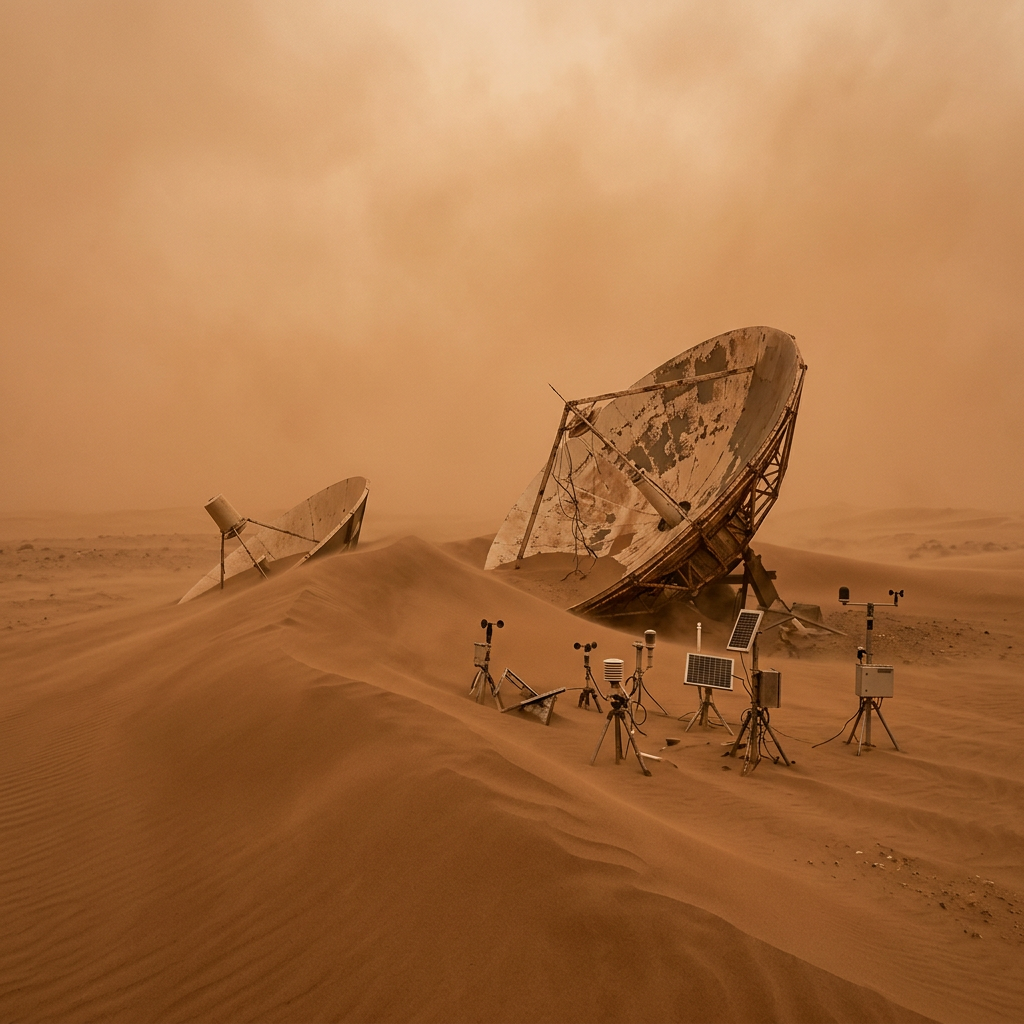
The desert has always been a place of brutal honesty. Under a sky that bleeds heat and a horizon that shimmers with false promises, every living thing learns to distinguish between the real and the artificial. But lately, a new kind of mirage has crept into the ancient dunes—one born not of light and heat, but of silicon and arrogance. We are told that algorithms can predict the wind, that data models can tame the storm, and that artificial intelligence holds the keys to every mystery. Yet, when the sand rises and the thunder speaks, the desert reminds us of a truth too raw for any machine to grasp.
When the Sandstorm Fools the Silicon Gaze
There is nothing more humbling than a true sandstorm. It does not obey maps or satellite images. It laughs at predictive models. An AI might analyze millions of weather patterns, but it cannot feel the shift in barometric pressure on your skin or taste the electric charge of an approaching wall of dust. The desert’s chaos is not a problem to be solved; it is a force to be endured.
- Sensors fail when sand clogs every port and coats every lens.
- Data becomes noise when the wind scrambles transmission.
- Algorithms panic when the variable they cannot compute is the why of the storm.
In these moments, the AI’s hollow lies are exposed. It promised certainty, but delivered only a probability. It claimed to understand, but had never tasted grit between its teeth.
The Lightning That Code Could Never Capture
Lightning in the desert is not just a weather event; it is a visceral covenant. It strikes without warning, a crack of white fire that turns night into a negative photograph of the world. No machine can replicate the terror and awe of that moment.
> “The thunder doesn’t ask for permission. It doesn’t wait for a dataset.”
AI can describe lightning’s voltage, its frequency, its path of least resistance. But it cannot capture the feeling of standing on ancient stone, hair standing on end, knowing that the sky is about to split open. The code is a pale shadow of the experience. The liar’s promise of AI is that it can bring the wilderness into a controlled environment, but the wilderness refuses to be tamed.
Thunder’s Ancient Truth Over AI’s Hollow Lies
The thunder that rolls across the desert carries a frequency older than any computer. It is the sound of tectonic memory, of dust that has watched empires rise and fall. When we listen to thunder, we are listening to a truth that predates language itself.
Key distinctions between ancient truth and hollow AI claims:
- Truth is embodied: It exists in the sweat on your brow and the burn in your lungs.
- AI claims are abstract: They exist only as floating numbers on a screen.
- Thunder commands attention: It is a physical event that demands a physical response.
- AI offers suggestions: It is passive, waiting for you to act.
The desert does not suggest you take shelter. It forces you to. That is the difference between a living truth and a hollow lie.
In the Desert, Human Instinct Remains Unbroken
When the batteries die and the screens go dark, what remains is the human animal. The desert strips away all pretense. It reveals that beneath our digital skins, we still possess instincts forged in a world without electricity.
- Wayfinding by stars still works when GPS fails.
- Reading the clouds for moisture is more reliable than a 10-day forecast.
- Feeling the ground for vibration of distant hooves or thunder is faster than any alert.
AI is a tool, but it is not a replacement for the primordial toolkit we carry in our bones. The lie is that we need it to survive. The truth is that we survived for millennia without it, and we will survive long after its servers are buried in sand.
Sweat and Stone: The Last Covenant with Reality
The final lesson of the desert is that reality is not a simulation. It is not a dataset to be optimized. It is the cold touch of stone and the salt taste of sweat on your lips. When you stand on a dune at midnight and feel the thunder rumble through the earth into your legs, you are part of a covenant that no AI can sign.
> “The lie is that intelligence can be manufactured. The truth is that wisdom must be earned.”
To defy the hollow lies of AI is not to reject technology, but to remember where it fits. It belongs in our pockets, not in our souls. The desert thunder is a reminder that the most important knowledge is not stored in the cloud, but carried in the wind.
Conclusion
When the sandstorm wipes the slate clean, and the lightning illuminates the emptiness, we are left with a choice. We can worship the hollow echoes of artificial intelligence, or we can listen to the thunder’s ancient truth. The desert teaches us that no machine can feel the awe of a breaking horizon, no code can replicate the grit of survival, and no algorithm can ever know the raw, unbreakable dignity of a human being standing alone against the storm.
The thunder is real. The desert is real. The rest? Just a mirage.
Leave a Reply