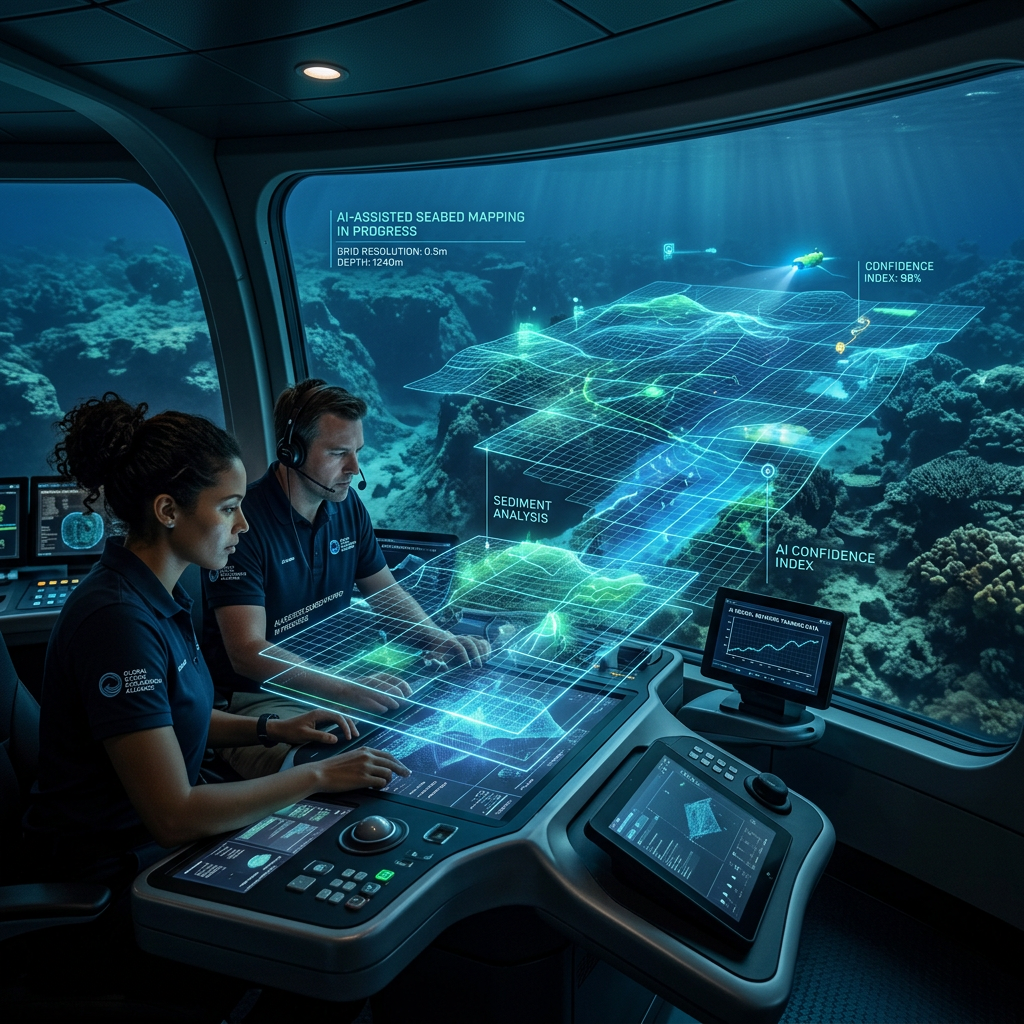
The Abyssal Witness: Listening to Tectonic Hymns
Deep beneath the waves, where sunlight dies and the ocean becomes an eternity of ink, the earth does not rest quietly. The abyssal plain is not a silent tomb—it is a cathedral of rumbling seismic whispers, hydrothermal vents singing chemical anthems, and tectonic plates scraping against each other in slow, grinding hymns. For centuries, we imagined the deep as a vacuum of stillness. But modern hydrophones have revealed a different truth: the abyss speaks. It groans with the birth of new crust, hisses with escaping methane, and hums with the low-frequency pulse of the planet’s own heart.
> “To hear the abyss is to realize we are not the only ones with a voice on this planet.” — Marine geologist Dr. Elena Voss
As we listen deeper, we are forced to ask: what happens when we stop projecting our fears onto the dark and start paying attention to what is actually being said?
Phantom Continents: When AI Maps the Deep
We have mapped less than 25% of the ocean floor to any meaningful resolution. The rest remains a realm of phantom continents—vast mountain ranges, submerged volcanoes, and hidden trenches that appear only as blurs on outdated charts. Until recently, we relied on sonar streaks from ships, limited and slow. Now, machine learning models are being trained to predict seafloor topography from satellite gravity data. The results are astonishing: AI can now hallucinate the shape of a trench 10,000 meters down, filling in gaps with eerie accuracy.
Imagine algorithms dreaming of mountains that no human eye has seen. These AI-generated blueprints are not perfect, but they are becoming our first true atlas of the abyss. And as the maps sharpen, so does our understanding of how pressure, currents, and geological forces shape the stage for life—and for performance.
| Human Mapping (Sonar) | AI Predictive Mapping |
|---|---|
| Slow, ship-by-ship | Fast, satellite-driven |
| High accuracy locally | Lower accuracy, but covers vast areas |
| Expensive and limited | Scalable and cost-effective |
Seven Miles of Silence, One Voice of Truth
At Challenger Deep, the deepest point in the Mariana Trench, the pressure exceeds 1,000 atmospheres—enough to crush steel like paper. The environment is silent in human terms, yet the physical truth of that place is anything but quiet. Here, the abyss speaks with the voice of absolute constraint. Every molecule, every organism, every point of data is subject to forces that defy our terrestrial intuition.
Yet, remarkably, life persists. Piezophiles—pressure-loving microbes—thrive in this crushing darkness. They are the only voice that answers the abyss on its own terms. Their biochemistry is a masterclass in adaptation under extremis. For them, pressure is not a barrier but a medium. They teach us that true performance is not about avoiding pressure, but about aligning with it so completely that it becomes invisible.
> “Pressure doesn’t break you. It reveals you. The question is: what are you made of, when the weight of the world is on your shoulders—and your every cell?”
The Arena Where Breath Defies All Pressure
Human free divers, pilots in deep-sea submersibles, and even engineers designing pressure-rated systems all face the same fundamental arena: the point where external force meets internal resilience. Consider a free diver descending to 100 meters. Her lungs compress to the size of a fist. Her heart rate slows. Her blood vessels constrict to protect her core. This is not a fight—it is a negotiation with physics.
In this arena, performance is defined by three key pillars:
- Psychic preparation: Mental visualization to override primal panic.
- Biomechanical efficiency: Conserving oxygen through perfect movement.
- Equipment reliability: Trusting every seal, valve, and composite material.
Success here is not about being stronger than the pressure. It is about becoming so fluid, so responsive, that pressure itself becomes the medium of your stride. The diver does not defeat the abyss—she dances with it.
Humanity’s Final Frontier: Performance Over Depth
We are drawn to the deep not because of its depth, but because of what the journey does to us. When the abyss speaks, it asks the hardest question: Who are you when everything familiar is stripped away? In space, we call it the vacuum. In the ocean, we call it pressure. In life, we call it crisis. The lesson is always the same.
Performance is not about reaching the deepest point. It is about how you return. It is about the data you carry, the calm you maintain, and the story you bring back to the surface. As we map phantom continents and listen to tectonic hymns, we are really mapping the contours of our own capacity. The abyss does not care about your achievements. It only asks how you behave under true load.
> “You don’t conquer the abyss. You befriend it. And if you listen well, it will teach you the grammar of resilience.”
In the end, the deepest frontier is not measured in meters or miles. It is measured in performance under pressure—the quiet, unbroken grace of being fully present when the weight of everything says you should break. That is the voice of the abyss. And it is, finally, a voice of truth.
Leave a Reply