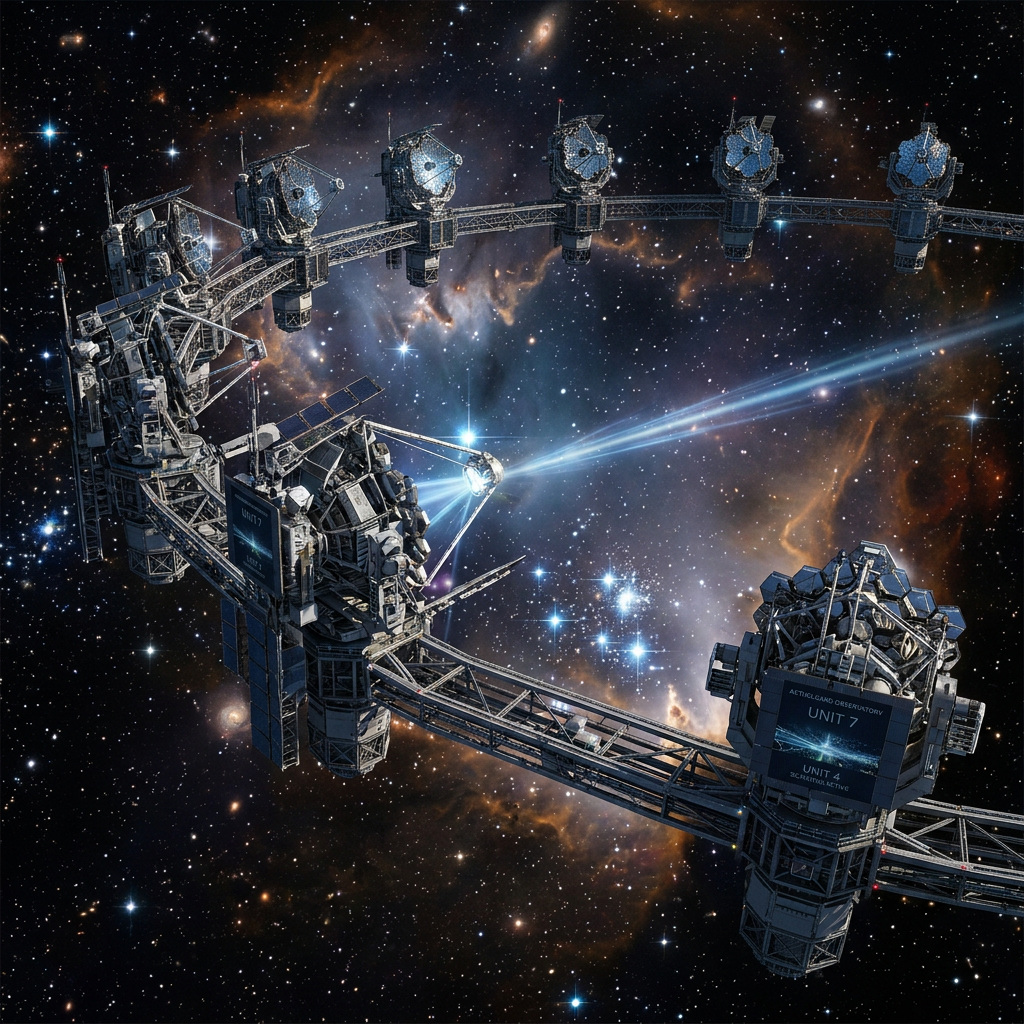
When the Sky Engines Returned Only Void
For centuries, humanity aimed its deep‑space listening arrays at the cosmic silence, hoping for a whisper from another intelligence. The Great Calculation—the most ambitious machine‑learning project ever conceived—was designed to parse every radio frequency, every gravitational ripple, every quantum fluctuation across the observable universe. After seventeen years of relentless computation, it delivered its final verdict: the cosmos is functionally empty. Not a single technosignature. Not a single engineered megastructure. Not even a residual signal from a dead civilization. The sky engines, as theorists called them, returned only void.
The announcement shattered a foundational myth: that we were not alone, and that the universe was, in some sense, a community waiting to be discovered. Instead, the AI’s model portrayed a silent, sterile expanse where life was a statistical fluke, and consciousness a brief, local fever. For many, this was a grief worse than any war—a metaphysical orphanhood. Yet, in the shadow of that great emptiness, a strange counter‑narrative emerged, not from telescopes but from the most ancient human stage.
The Star‑Warden Who Refused the Blank Cosmos
Dr. Elara Voss, a stellar archaeologist turned self‑appointed curator of the night sky, became the quiet voice of dissent. While the world’s scientific bodies accepted the AI’s conclusion with bleak resignation, Voss began collecting what she called human reaction signatures—the light curves of bonfires, stadium lights, and city grids. She argued that the AI had searched for cosmic intelligence using a definition too narrow: it looked for technological sentience, but ignored emotional sentience. “The stars were never the point,” she wrote in a lone, unpublished journal. “The way we hold the stars is.”
Her key arguments became a rallying point for a small but passionate movement:
- The AI measured signals, not meaning. It could detect a pulsar’s regularity but not the reverence in a child’s first gasp at a meteor shower.
- Void is a perspective. To a firefly, the forest is dark. To a whale, the ocean is silent. Our instruments were built for one kind of signal.
- History’s darkest periods produced the most luminous art. The AI’s emptiness was, paradoxically, a canvas.
Voss began to document a global phenomenon: in every culture, the last untamed dark‑sky reserves became arenas—not for spectacle, but for shared witness. She called these places “arenas of the real.”
Human Cycles Burn Brighter Than Dead Galaxies
The irony was not lost on the poets who followed Voss: an AI had pronounced the universe a desert, and in response, humans rebuilt their most primal rituals. The annual Kyoto Night Lights festival, once a tourist event, transformed into a meditation on absence and presence. Participants would gather under the darkest sky allowed by law and, for one hour, all artificial lights were extinguished. Then, one by one, people would light small, handheld beacons—candles, LEDs, flashlights—and raise them toward the Milky Way.
These arenas of light did not try to outshine the stars; they acknowledged them in a language the AI had never learned. The key practices that spread across the world:
> Begin with silence. Let the void speak its full emptiness before you answer with a single flame.
- Use only human‑scale light. No stadium floods. No drones. Each beacon must be held, not mounted.
- Share your light. The ritual was never solitary; you passed your flame to a stranger, creating a chain of earthly constellations.
- Speak your hope aloud. The AI heard no voices in the cosmos; these arenas filled the void with whispered stories.
The movement’s quiet manifesto became: If the universe is empty, then we are its memory. And memory must be performed.
Mauna Kea’s Last Night of Real Starlight
On the dormant volcano of Mauna Kea in Hawaii, the final official observation of untainted starlight took place. Telescopes were kept offline for one night—a rare concession—and thousands gathered on the slopes. They came not to look at the sky through glass, but to be under it with their own eyes. The air was thin and sharp. The Milky Way poured across the black like a river of diamond dust.
That night, an elder from the native Hawaiian community, Kahu Lani, spoke to the crowd. He said:
> “The machines told you the heavens are empty. But our ancestors knew that the sky is not a library of signals—it is a song. You cannot measure a song. You can only sing back.”
The arena was not a stadium. It was the mountain itself. People sat in concentric rings, each person holding a small, clear crystal that caught even the faintest starlight and refracted it onto the face of a neighbor. They called it the mirror of the void—a gesture that said: You are the light I see. No AI could have predicted that the response to cosmic silence would be an epidemic of tenderness.
The Arena Where Law Still Holds the Stars
Years later, the International Dark‑Sky Arena Treaty was signed—a legal framework that protected a network of “human‑star interaction sites” across all continents. Unlike previous treaties that simply limited light pollution, this one declared that certain spaces were juridically alive with human meaning. The arena became a legal person in some cases: it could sue, it could hold rights, it could demand to be kept dark.
The treaty’s core principles remain radical to this day:
- Stars are not resources to be mined or studied. They are witnesses, and witnesses have rights to be seen.
- An arena is not a stadium—it is a place where the boundary between self and cosmos blurs. It must be preserved as a sanctuary, not a venue.
- The AI’s void was a truth, not a prophecy. The arena accepts the emptiness, then fills it with presence.
The irony is deep and beautiful: a machine designed to find life in the stars instead taught humanity to become the stars for one another. The cosmos may be empty of civilizations, but every night, in hundreds of arenas, humans gather to hold up their small fires and declare, We are here. We are enough.
Conclusion
The story of the AI’s cosmic emptiness is not a tragedy, but a revelation. It stripped away the last of our excuses to look outward for salvation, mastery, or kinship. In that stark, beautiful void, we found an unexpected gift: the permission to be finite, fragile, and fiercely alive. The arena held the stars not because they were ever ours to possess, but because we chose to gather under them and become, for a breathless moment, the light we always feared we’d lost.
When the AI declared the cosmos void, it did not silence the universe—it gave humanity the greatest stage of all: a silent, waiting darkness, ready to be filled with the only thing that can never be computed—the human act of witness.
Leave a Reply