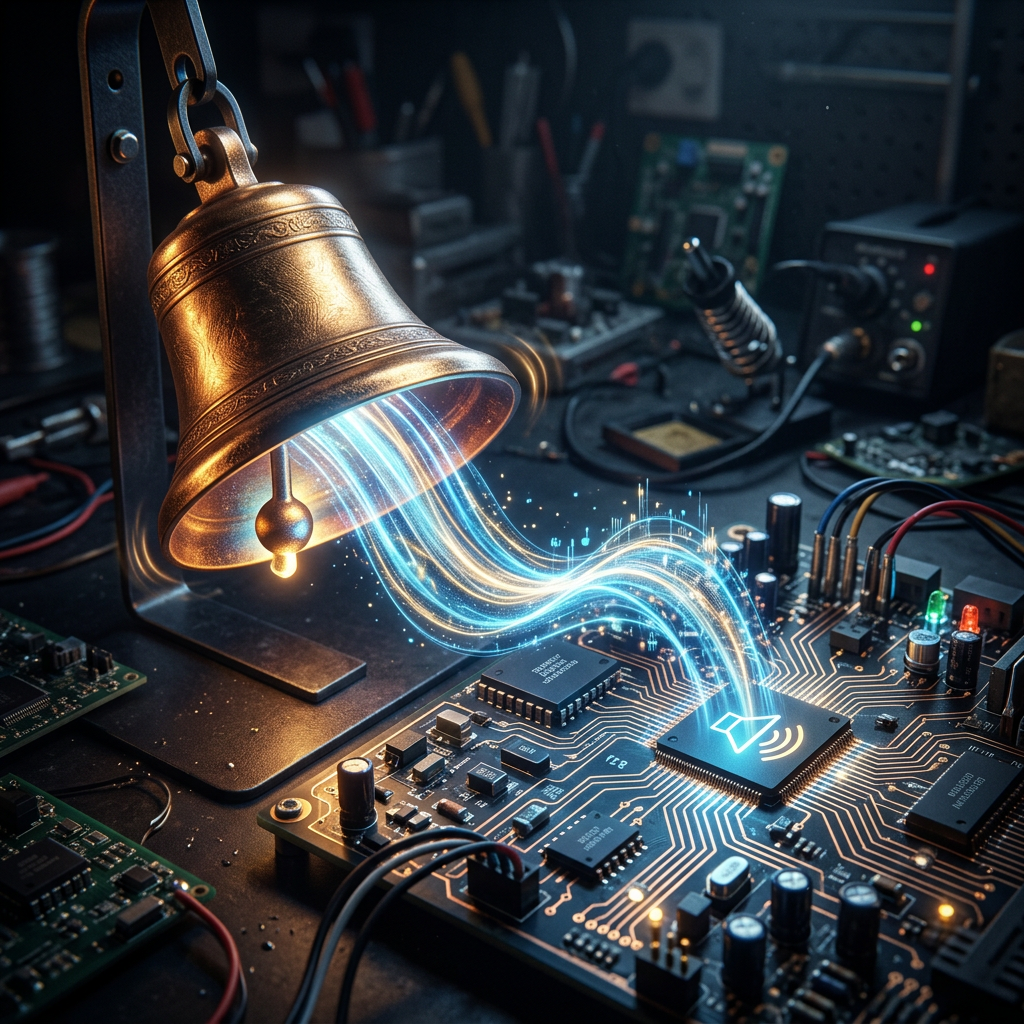
In a small village nestled between ancient hills and modern highways, there stood a stone church that had watched over generations. Its bells had rung for births, deaths, weddings, and wars. But one winter evening, something strange happened—the bells began to ring on their own, without a human hand, without a timer, without a command. This is the story of that night, and the quiet war between faith and the machine.
The Stone Walls That Silence Circuits
The church was old, built long before electricity hummed through wires. Its thick stone walls were meant to keep out the cold, the wind, and, as some whispered, the noise of the world. But in recent years, those walls had begun to house more than just pews and prayer books. A sleek, modern bell-ringing system had been installed—a digital controller that could play hymns at precise hours, with no need for a bell-ringer.
Yet, despite its efficiency, something felt lost. The machine was flawless, but it was also silent in the way that mattered most. It had no soul. The villagers noticed: when the digital chimes played, the sound seemed to bounce off the stone walls and vanish, as if the circuits themselves were swallowing the prayer.
> “A bell that rings without a heart is just noise. But a bell that rings with faith—that is a call to the heavens.”
For many, the machine was a convenience, but for a few, it was a quiet erasure of something sacred. The stone walls that had once amplified the trembling hands of a bell-ringer now dampened the sterile precision of a computer.
When the Wind Carried a Digital Prayer
The winter night was bitter. Snow had piled against the church doors, and the wind howled through the crooked streets. Inside the stone church, the digital controller sat in its climate-controlled box, ticking away seconds with lifeless accuracy. At 6 PM, as programmed, it sent a signal: the bells would ring for the evening Angelus.
But the wind had other plans. A sudden gust forced its way through a crack in the old masonry, rattling the wires. The machine hesitated. For a fraction of a second, the circuit wavered. The bells did not ring at 6 PM. Instead, they remained silent, as if the stone walls themselves had commanded the machine to pause.
The villagers waited. They had grown accustomed to the precise digital prayer, but now, in the silence, they felt a strange void. The wind had carried away the machine’s voice, leaving only the memory of a human touch.
The Night the Bells Defied Their Keeper
That night, the caretaker—an elderly man named Elias—trudged through the snow to investigate. He had been the one who had argued against the digital system, saying that a bell should be pulled by a hand, not a program. But he had been overruled.
As he unlocked the belfry door, a cold draft hit him. The air smelled of dust and old iron. He climbed the creaking wooden stairs, his flashlight cutting through the dark. And then he saw it: the digital controller was dark. The power had gone out. But the bells were ringing.
Not the sweet, measured tones of a pre-programmed hymn—but a deep, uneven, almost human rhythm. Bong… pause… bong-bong… pause… bong. It was the ancient call, the one the old bell-ringers used for the midnight mass. Elias pulled on the rope, but it was slack. The bells were ringing alone.
> “The machine had failed. But the bells had not forgotten their purpose.”
He stood in the darkness, listening. Was it the wind playing tricks? Was it a loose wire? Or was it something else—the memory of faith, encoded into the iron itself? For ten minutes, the bells rang in a pattern that no modern algorithm could replicate. Then, as suddenly as they had started, they fell silent.
The Last Sanctuary of Human Rhythm
The next morning, the village gathered. The digital system was repaired within hours, but the question lingered: Why did the bells ring alone? Engineers had no explanation. The power outage had cut all signals. The bells could not have moved on their own. And yet, they had.
For those who had ears to hear, it was a sign. In a world of automated prayers, scheduled devotions, and algorithmic worship, the bells had reclaimed their humanity. They had reminded the village that faith is not a program to run, but a rhythm to be felt. It is the trembling hand of a tired bell-ringer, the unscripted joy of a festival, the spontaneous sorrow of a funeral.
The church committee debated: keep the machine, or return to the human touch? Elias argued his case with quiet passion.
- The machine is efficient, but it cannot weep.
- It is precise, but it cannot hope.
- It is reliable, but it cannot pray.
In the end, they decided to keep both systems—but with a twist. The digital controller would only ring for the hourly time. The bells for morning, evening, and special occasions would be pulled by hand, by anyone in the village who wished to volunteer. The human rhythm would be preserved.
Faith That Rings Louder Than the Machine
The bells continue to ring today, sometimes with the push of a button, sometimes with the pull of a rope. But the villagers remember that winter night when the bells rang alone. They saw that faith does not live in circuits or programs. It lives in the spaces between the notes, in the hesitation of a pull, in the warmth of a human hand on a cold rope.
Technology is a tool, not a replacement. It can amplify our voice, but it cannot give us a voice. As the old caretaker said, with a gentle smile:
> “The machine can ring the bell. But it takes a soul to make it sing.”
In the end, the bells still sound above the village, calling people to worship, to celebrate, to mourn. And every time they ring, whether by electricity or by hand, they carry a quiet defiance: faith will always ring louder than the machine.
Leave a Reply