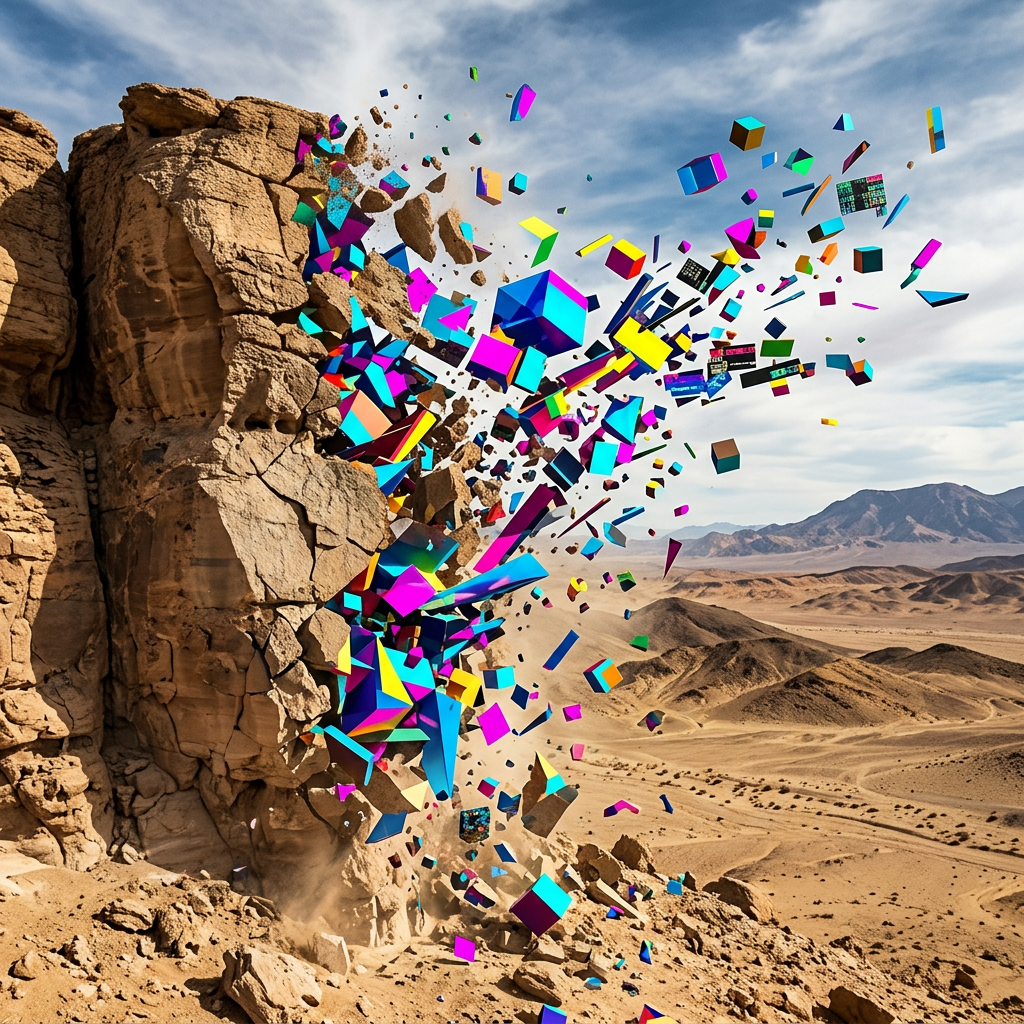
When the Monolith Breathes Beyond Machines
In the heart of the Australian outback, Uluru stands not just as a geological formation, but as a living archive of time itself. For millennia, this sandstone monolith has been a silent witness to the rhythms of the earth, the cycles of the seasons, and the stories of the Anangu people. But today, we face a peculiar paradox: as our machines grow more sophisticated, they grow more deaf to the languages of the world that matter most. This article explores what happens when Uluru—metaphorically and literally—”speaks” through motion, and why human embodiment offers truths that algorithms will never grasp.
The Thunder-Scribe Listens to Deep Earth
Imagine standing before Uluru at dawn. The light strikes the rock in sequences that no camera can truly capture. The air hums with the weight of ancient stories. This is embodied knowledge—knowledge felt through the soles of your feet, the pores of your skin, and the rhythm of your breath.
- Physical presence changes perception: You cannot know Uluru from a screen.
- Soundscapes like wind over the rock and bird calls carry data that machines cannot encode.
- Cultural immersion requires being held by the landscape, not just observing it.
The Anangu people have always listened to the deep earth through songlines—paths of story that map the land through movement. These are not abstract GPS coordinates. They are sung, danced, and walked. The Thunder-Scribe, in this context, is the human who moves with the land, letting the body become the instrument of comprehension.
Hallucinated Faults: AI’s Structural Error
Artificial intelligence, for all its power, suffers from a fundamental hallucination: it mistakes information for experience. When an AI “sees” Uluru, it sees vectors, pixels, and spectral reflections. It does not feel the sun’s heat on the stone, the scent of red dust after rain, or the deep vibration of the earth that seems to pulse with the heart of the world.
> Key Insight: AI’s structural error is its lack of embodiment. It can describe Uluru’s height in meters, but it cannot describe the ache in your neck from looking upward, or the awe that tightens your chest.
This is not a minor bug. It is a foundational flaw. The machines weave narratives that sound plausible—yet they are disconnected from the lived reality of the rock. They fabricate a perfect, sterile image while missing the mess, the texture, and the sacred. When AI “hallucinates faults,” it invents errors in data, yes, but more dangerously, it invents a world devoid of physical truth.
The Rock Speaks: Motion Over Machine Logic
Uluru does not communicate in binary. It communicates in relationship. When you walk around its base, you are not just moving through space—you are participating in a conversation that spans tens of thousands of years. The rock speaks through:
- The sound of your footsteps on different sections of the path.
- The change in temperature as you move from shadow to sun.
- The shift in perspective as each turn reveals a new face of the monolith.
- The silence that grows deeper the longer you stay still.
Machine logic demands efficiency: shortest path, fastest route, maximum data. But Uluru demands attention. Motion over machines means prioritizing the slow, deliberate act of walking over the instant analysis. It means trusting that some truths are only accessible through exhaustion, sweat, and the patient repetition of steps.
> Tip for Modern Seekers: Before you ask what an algorithm can tell you about a place, ask what your own body is telling you. Your breath knows the altitude. Your muscles know the slope. Your heart knows the awe.
Humanity’s Final Truth in Bodies in Motion
As we hurtle toward a future saturated with artificial intelligence, we risk forgetting the most fundamental truth: we are physical beings. Our minds did not evolve in isolation—they evolved within bodies that walk, run, climb, and dance. The final truth of humanity is not found in a databank but in the motion of a hand touching the warm surface of Uluru at sunset.
Consider these final reflections:
- Embodiment is non-transferable. No AI can experience your body’s unique journey.
- Motion is meaning. The act of moving through a landscape creates memory and understanding that no machine can replicate.
- Connection requires vulnerability. You must be willing to get dust in your shoes, sweat on your brow, and tears in your eyes.
- The monolith stands as a threshold. To cross it is to choose presence over convenience.
Conclusion
When Uluru spoke, it did not speak in code. It spoke through the wind, the heat, the stories, and the bodies of those who moved across its ancient face. The machines may hum and churn, but they will never truly listen to the earth. Our greatest responsibility in this age of artificial marvels is to keep our bodies in motion—to walk, to dance, to climb, to sit in silence upon the stone. For it is only through such embodied, sacred motion that we answer the call of the monolith and remember who we truly are.
Leave a Reply