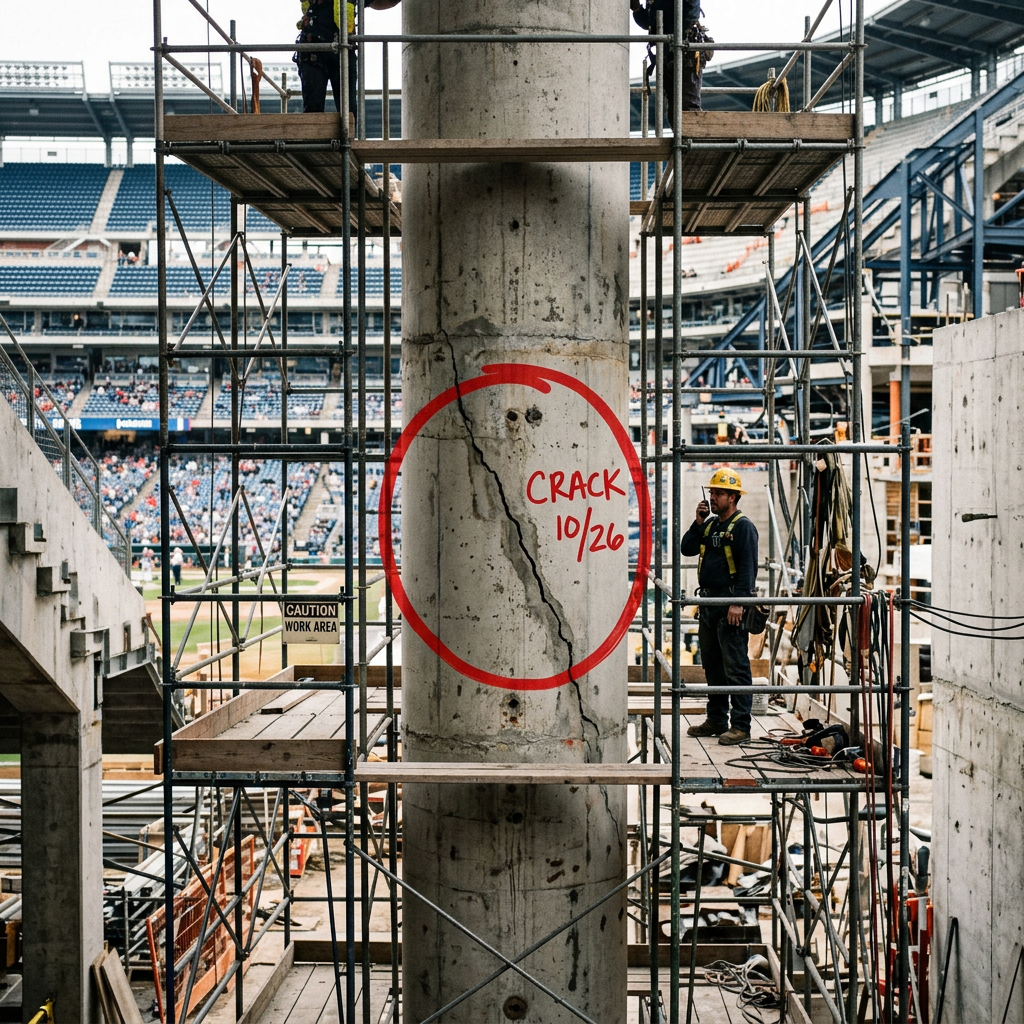
You wouldn’t think a single red circle could topple a civilization—but it did. Not the kind carved into stone or painted on ancient walls, but one drawn by a stadium inspector’s marker on a faded concrete floor. That circle wasn’t a decorative flourish; it was a glaring verdict. It marked the spot where our world had cracked, and where everything we took for granted began to crumble. This is the story of how a small, round warning forced an entire community to tear down not just a structure, but the very habits that held it together—and rebuild from scratch.
The Red Circle That Changed Everything
It was an ordinary Tuesday when the inspection report landed on my desk. The stadium had stood for forty years, hosting everything from championship games to charity concerts. We thought it was invincible. But the report contained a single photograph, and in that photo was a red circle around a hairline fracture in a load-bearing pillar. The inspector’s note was clinical: “Structural integrity compromised. Immediate action required.” That circle became a symbol—not just of danger, but of decades of neglect. We had painted over cracks, postponed repairs, and hoped no one would look too closely. The red circle forced us to look.
- It was drawn by a licensed structural surveyor during a routine safety audit.
- It highlighted a crack less than two millimeters wide—but running straight through the building’s spine.
- The report listed it as a “critical priority,” meaning any further delay could risk collapse.
Why Our Stadium Was Marked “At Risk”
The red circle wasn’t arbitrary. It was the culmination of years of small failures that had snowballed into a crisis. I remember the first time I walked the lower concourse with our maintenance chief. He pointed to rust stains on the ceiling beams, water damage in the concrete, and a network of tiny fractures we had dismissed as “settling.” But the truth was simpler: we had ignored the fundamentals. Our stadium was built on solid engineering, but we had treated it like a living thing that could heal itself.
> “A building doesn’t fail because of one big mistake. It fails because of a thousand small ones you never took seriously.” – The surveyor’s parting words.
The risk factors were clear in hindsight:
- Age without adaptation: Forty years of weather, vibration, and load changes had worn down materials.
- Deferred maintenance: We prioritized cosmetic upgrades over structural checks.
- Inadequate monitoring: No one had tested the seismic resilience after nearby construction projects.
- Hidden stress points: The cracked pillar was located near an underground water table that had shifted over time.
The red circle didn’t create the risk—it only exposed what we had been too busy to see.
The Surveyor’s Silent Warning We Ignored
Here’s the part that stings most: we had been warned before. Two years earlier, a different surveyor had noted “minor settlement cracking” in the same area. He didn’t draw a circle, just a note in a binder we filed away. We told ourselves it was nothing. We told ourselves the budget was tight. We told ourselves a thousand other lies. The red circle was not the first warning—it was the last.
- A crack monitoring study conducted 18 months prior had flagged “anomalous movement.”
- The maintenance log included a handwritten comment: “Monitor quarterly.”
- We never monitored at all.
Silence is a dangerous thing in engineering. When you ignore small signals, the system doesn’t forgive you—it just stays quiet until it can’t. The red circle was that breaking point. It screamed what the silent warning had whispered: you are not safe here.
Rebuilding Civilization, One Habit at a Time
Closing the stadium for repairs was the easy part. The hard part was rebuilding the culture that let the cracks grow. We didn’t just pour new concrete—we rewrote the rules of how we care for the places we inherit. This became our manifesto of renewal, and it started with a single principle: don’t wait for the red circle.
Our rebuilding pillars:
- Radical transparency: Every inspection, every minor crack is now logged in a shared database visible to all staff.
- Mandatory pauses: Quarterly structural audits, not yearly ones, with independent reviewers.
- Continuous education: Every employee, from janitor to CEO, attends a two-hour session on how small failures compound.
- Community involvement: We post safety updates on a public dashboard—because accountability to fans keeps us honest.
- Respect for the past: A historian now documents every repair, so future stewards know what we learned.
We also embraced a redundancy mindset. If one pillar shows a crack, we check every pillar within a ten-meter radius. If a water stain appears, we trace the entire pipe network. It sounds obsessive, but civilization is built on obsession with detail. The Romans built aqueducts that lasted centuries because they tested every stone. We forgot that, but the red circle reminded us.
Passing the Next Inspection: What We Did
When the next inspection came—a full year later—we were ready. The same surveyor walked the same concourse, clipboard in hand. This time, there were no red circles. Instead, he found:
- Reinforced pillars with carbon fiber wraps that exceeded building codes.
- A sensor network that monitors stress, temperature, and moisture in real time.
- Emergency drills practiced quarterly, with evacuation routes clearly marked.
- A maintenance log thicker than a phone book, with every entry signed and dated.
- A culture shift where staff members knew the surveyor by name—and treated his visits as opportunities, not interruptions.
> “You’ve turned this stadium from a liability into a model,” he said. “I almost wish I could draw a green circle, but I don’t need to—your systems speak for themselves.”
We didn’t just pass the inspection; we earned back the trust of our community. Fans returned, players felt safe, and the stadium once again became a gathering place for joy. But we never forget the red circle. It hangs in a frame above my desk—a permanent reminder that civilization is not built on grand gestures, but on attending to the small cracks before they bring the whole thing down.
Conclusion
The red circle wasn’t an enemy. It was an alarm clock for a community that had fallen asleep on the job. We thought we were maintaining a stadium; in truth, we were maintaining a miniature civilization—a web of trust, safety, and shared responsibility. When we ignored warning signs, we risked not just concrete and steel, but the very idea that a place could be a haven. Rebuilding meant changing our relationship with imperfection: acknowledging that everything decays, but that decay is not a sentence—it’s a call to grow. The next time you see a crack in a sidewalk, a frayed rope on a playground, or a note of concern from someone who cares, don’t look away. Draw your own red circle, and start building from there.
Leave a Reply