The Hidden Code in Our Formation Drills
Every Tuesday night, rain or shine, we gathered on the patchy grass of the municipal field. Coach Rojas would blow his whistle twice—one long, one short—and we’d snap into a 4-4-2 diamond. We thought it was just soccer. We were wrong.
The drills were never about the ball. They were about synchronized movement under pressure. When you run a diamond drill, you’re not just passing—you’re learning to shift as a unit, to cover gaps, to anticipate where the breakdown will come before it happens. These are the same principles that guide a civilian evacuation.
Here’s what we didn’t realize then:
- Spacing: Every player knows exactly how many meters to keep from the next. In a crowd, that’s contagion control.
- Communication: One shouted word—“Man on!” or “Turn!”—triggers instant reorganization.
- Roles: Each person has a primary and secondary position. When someone falls, you rotate, not panic.
We were practicing for a game. But the game was a metaphor we never decoded.
When Coach Called Gambling the “Panic Trigger”
Coach had a saying he’d bark during set pieces: “Don’t gamble unless you’ve already lost the ball.” We laughed, thinking it was about risky passes. He meant something else entirely.
> “Gambling” was our code for the moment your fear spikes and you break formation. In an evacuation, that’s when people die—the second they stop trusting the structure.
He drilled us on the panic trigger in ways that felt absurd. During a scrimmage, he’d suddenly scream “EVACUATE!” and we had to sprint to the far goal in our assigned lanes, carrying the ball. No talking. No deviating. If you zigzagged, you ran laps. It wasn’t fitness—it was behavioral conditioning.
The drills taught us:
- Don’t freeze. Movement is always better than indecision.
- Don’t cluster. A cluster is a single target.
- Don’t look for the ball first. Look for your teammate’s position.
In the years to come, these would be the rules that saved a neighborhood.
Why We Moved Like a Civilization in Transit
I remember a drill called The Exodus. We’d line up along the sideline, and Coach would point to a distant cone. “That’s the safe zone. You have three minutes. No one gets left behind if someone slows down—you carry them or you drag them.”
We groaned. It was exhausting. But it taught us the rhythm of a mass movement:
- Pace setters: The fastest players at the front, but not too fast. They had to match the slowest.
- Floaters: Two players flanking the group, watching for threats (or in soccer terms, defenders scanning for counter-attacks).
- Sweeper: The last person, responsible for anyone who falls.
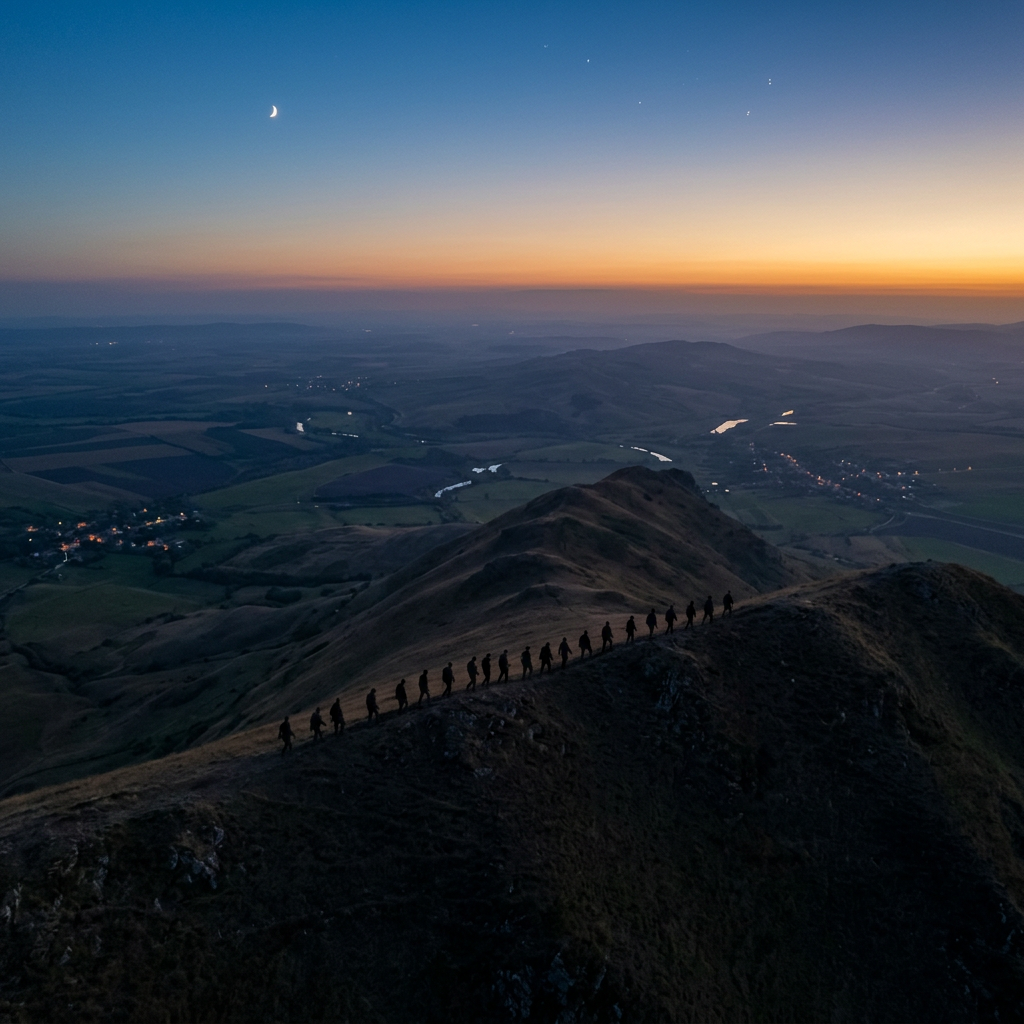
We learned that a civilization in transit doesn’t sprint. It flows. Like a river avoiding rocks. The formation was flexible, but the discipline was rigid.
- ✅ Key lesson: Speed is useless if it fragments the group.
- ✅ Key lesson: The weakest member sets the pace for survival.
- ✅ Key lesson: Never look back with fear—only with purpose.
That’s how a soccer field becomes a blueprint for evacuation.
The Turn That Stopped Being About the Ball
When you’re on the wing, the turn is everything. You plant your foot, pivot, and explode in a new direction. We drilled it until our ankles ached. “Body between the ball and the defender,” Coach would say.
But later, that turn became something else entirely.
During the first real evacuation—when the sirens went off and the roads clogged—I saw an old woman trip on the curb. Everyone behind her was about to stampede. Then a kid from our team, barely sixteen, dropped to one knee, planted his foot, and turned her toward a gap in the fence. He didn’t run. He pivoted.
That’s when I understood:
> A turn in soccer is never about the ball. It’s about resetting your momentum toward safety without losing your balance.
We had learned to change direction instantly, under pressure, without colliding. That skill—the mechanical pivot—became the difference between a panicked mob and an orderly retreat.
The drill’s real name should have been “momentum management.” But we called it “the turn,” because soccer players love shortening everything.
Punta Arenas, 2036: The Last Practice Before It Mattered
The last practice was on a Tuesday. The air tasted of salt and smoke from a distant fire. We knew something was wrong, but Coach ran us through the same drills. The diamond. The Exodus. The turn.
Nobody joked. Nobody complained. We just moved.
When the order came twenty-four hours later to evacuate the southern sector of Punta Arenas, the team didn’t scatter. We formed up on the main road. The formation wasn’t a 4-4-2 anymore—it was a human corridor. The fastest players scouted ahead. The strongest carried supplies. The sweeper kept the group tight.
We moved through the chaos like we’d practiced a thousand times. Because we had. On a soccer field, with ragged cones and a worn-out net, we had been training for this moment all along.
Coach Rojas stayed behind to help the next group. The last thing he said to me was: “Now you know why I never let you gamble.”
Conclusion
In the end, soccer drills aren’t just about winning games. They’re about building a muscle memory for order when everything else collapses. The diamond formation, the turn, the sprint, the support—these are not athletic techniques. They are survival protocols disguised as sport.
We thought we were learning to score goals. We were actually learning to save each other. The field was just our classroom, and the ball was never the point.
So next time you see kids running drills on a patchy field, don’t look at the goals. Watch how they move. You might be watching a civilization prepare for its most important game.
Leave a Reply