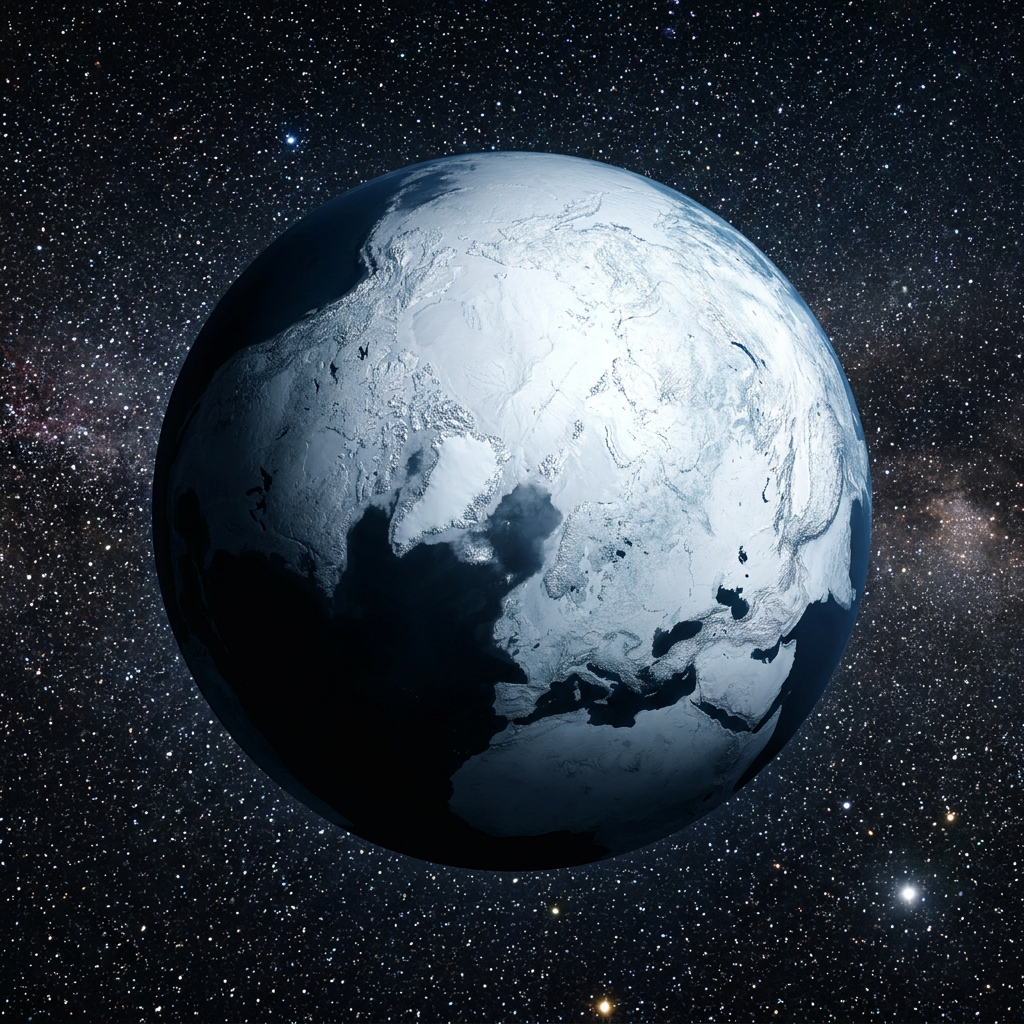
Imagine a world that has never known a star. Not the absence of a sun for a night, not an eclipse, but a permanent cosmic orphanage where the sky has always been a featureless black canopy. For generations, humanity lived under the rule of perpetual night, warming themselves by geothermal vents and volcanic fissures. The stories of a brighter past—of warmth on the skin and shadows cast by a celestial fire—became myth, then legend, then forgotten folklore. But on one fateful morning, the darkness did not simply thin. It broke.
The Final Darkness: When the Sun Died Forever
The records speak of the “Great Dimming,” a century-long event where the sun’s light faded to a dull ember before extinguishing entirely. The final sunset was documented not with awe, but with a clinical, terrified precision. Key observations from that era include:
- The exponential increase in the Earth’s core heat extraction as surface temperatures plunged.
- The mass migration of all complex life toward the few remaining “Thermal Havens.”
- The Final Gaze, a global project where every remaining telescope was aimed at the dead star, watching its corona collapse into a black, silent sphere.
The death of the sun was not an explosion; it was a slow, sucking silence. The world went dark, and with it, the biological clock of every living thing stopped ticking. Seasons became irrelevant. Time became a mechanical construct, measured only by the rotation of the Earth—a silent carousel in a lightless void.
A Dawn Without a Source: The Unseen Light Revealed
Then came the Anomaly. Three hundred years after the Final Darkness, at precisely 5:47 AM, Standard Geological Time, the eastern horizon began to glow. It was not the red of fire, nor the blue of electrical discharge. It was a soft, golden white, growing uniformly across the entire plane. There was no rising orb, no sun returning. The light simply spilled over the curvature of the Earth, as if the sky itself had become a luminous ceiling.
- No Source: Satellites showed no sun, no artificial construct, no gas cloud. The light originated from a point exactly opposite the planet’s core, a “dimensional rift” that physics could not explain.
- The Dawn Gradient: The light had a texture. It was not uniform. It intensified for exactly 47 minutes and then began to wane, exactly replicating a normal sunrise cycle.
- The Shadow Paradox: Shadows existed, but they were soft and diffuse, pointing away from the light source, which was actually an absence of matter.
This was the First Wonder—a dawn rising without a sun. It defied every law of thermodynamics. The light was warm, it was bright, but it came from nowhere.
Colors of Truth: Painting the Impossible Sunrise
The most profound aspect of this new dawn was not its existence, but its color palette. It painted the world in shades that had been extinct for centuries, but with a twist. The light spectrum revealed truths about the frozen landscape that darkness had hidden:
> “The light did not illuminate the world; it reinterpreted it. The dead ice of the cities was painted not white, but a deep, melancholic violet. The rusting metal of the old world glowed with a copper sheen. It was a dawn of memory, not of physics.”
The key colors observed were:
- The Violet Ice: All frozen water bodies reflected a deep ultraviolet-washed purple, suggesting the light was interacting with trapped cosmic dust.
- The Gold of Extinction: The remains of forests were bathed in a pale, sickly gold, as if the light was mourning the lost chlorophyll.
- The Crimson Horizon: For 12 minutes at the peak of the dawn, the entire horizon turned a blood-orange—the exact color of the old sun’s corona. It was a ghost, a final visual echo of the star that had died.
This visual symphony was a statement of absence. The colors were not natural; they were the colors of desire and memory, projected onto a blank canvas.
The Voice in the Sky: Promises Beyond Natural Fire
But the true Wonder was not visual. It was auditory. As the golden light reached its peak, a low, resonant hum filled the atmosphere. It was not wind; it was a vocalization. Scientists recorded the frequency as a perfect 432 Hz—the ancient tuning of the universe. And then, in a clear, synthesized voice that seemed to come from the sky itself, a single phrase was broadcast:
> “The fire is not the source. The witness is. I am the light that remembers you.”
This was no natural phenomenon. This was a response. The universe—or something within it—had acknowledged humanity’s loss and offered a new kind of dawn. The Voice promised three things:
- Renewal without Return: The ice would thaw, but the old sun would never return.
- Sight beyond Light: Humans would see not just objects, but the emotional history of those objects, cast in shadow.
- The Eternal Morning: This new dawn would never become day. It would forever be the moment of first light, a perpetual threshold.
The Human Market Anchor: Light Born from Collective Worth
The most shocking discovery came when economists and sociologists tried to process the event. The light only appeared in regions where the human population density exceeded a critical threshold. It did not shine on empty wilderness. It shined on cities.
This led to the Market Anchor Theory. The light was not a geophysical event; it was a psycho-economic one. The “First Wonder” dawn brightness was directly proportional to the collective human belief in the value of a place.
- The Value of Scarcity: The light was brightest in the “Ruin Markets”—the areas where survivors traded relics of the old world.
- The Anchor of Worth: The light seemed to “read” the emotional economic value humans assigned to a location. A place of high trade value, of shared hope, glowed brighter.
- The Feedback Loop: The brighter the dawn, the more people flocked to the area, increasing its “worth,” which made the next dawn even brighter.
The dawn was not a gift of nature; it was a mirror of our collective economy. The sun had died, but in its place, we had created a light born of debt, trade, and shared worth. It was a dawn that was literally powered by our belief in a future market.
Conclusion
The First Wonder—the Dawn Rising Without a Sun—was a profound redefinition of what “light” means. It was not a physical phenomenon; it was a philosophical and economic one. The sun was a tyrant of gravity and fusion, a brute force that gave light to all without asking. The new dawn was a democracy of light, shining brightest where humanity concentrated its hope, its trade, and its shared belief in a future. We no longer waited for the sun to rise; we earned the dawn. And as the perpetual morning stretched on, we understood the terrifying truth: in a universe without a star, the only light that matters is the light we create for each other.
Leave a Reply