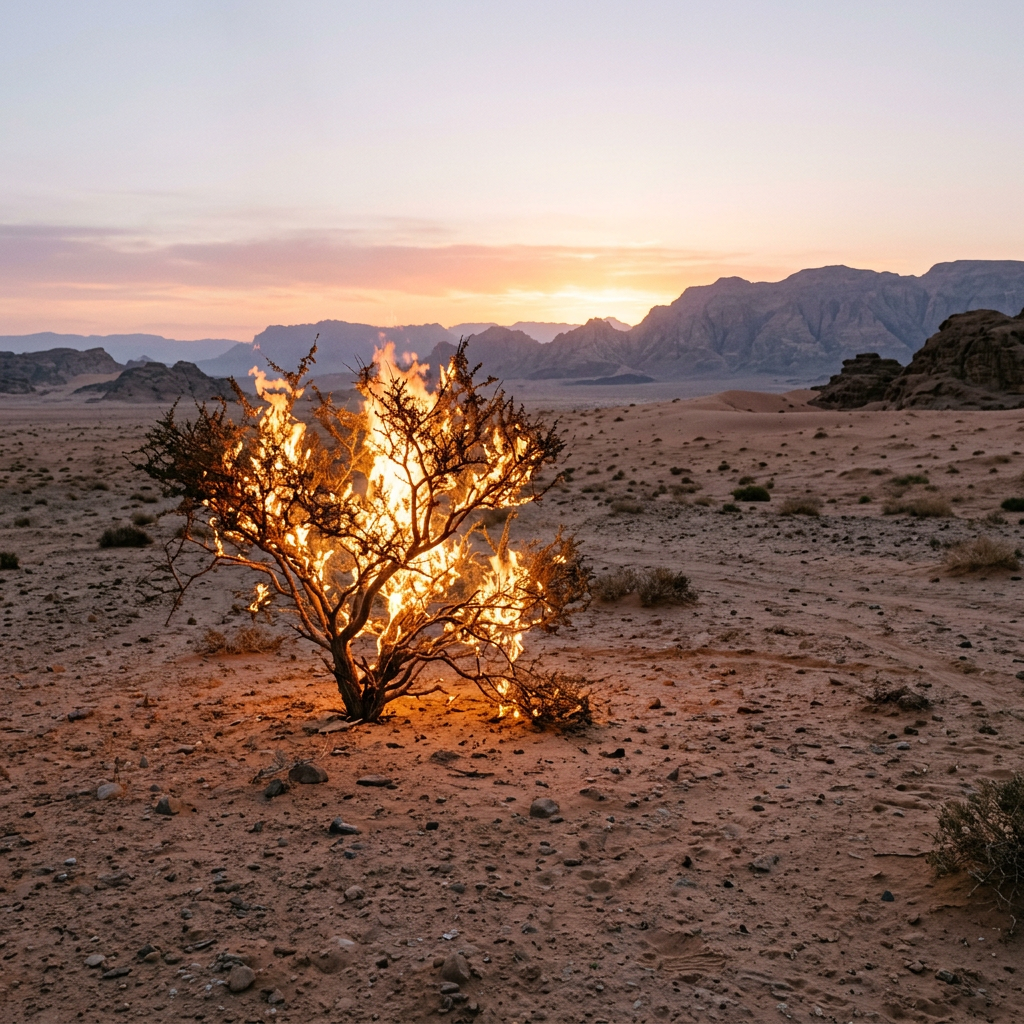
The Witness on the Sinai Ridge
There are moments in history so dense with meaning that they seem to bend the fabric of reality itself. One such moment occurred not in a temple or a palace, but on a lonely ridge in the Sinai wilderness. Here, a single flame appeared within a bush—burning, crackling, alive—yet the bush remained untouched, unconsumed. This was not a campfire kindled by human hands, nor a brushfire sparked by lightning. This was The Flame That Cast No Shadow.
Moses, a fugitive prince-turned-shepherd, turned aside to see this great sight. He was not a mystic by trade, nor a prophet by choice. He was a witness. And on that ridge, he encountered a fire that defied every law of physics and logic. This flame did not feed on its host; it fed on nothing and everything. It burned not to destroy, but to reveal.
> “I must turn aside and see this great sight—why the bush is not burned up.” — Exodus 3:3
Witnesses of such phenomena often find themselves stripped of pretense. Moses removed his sandals, for the ground was holy. This is the first wonder: a fire so pure it demands reverence, not analysis.
When Firestorms Bowed to One Flame
History is littered with fire—the great fires of Rome, the burning of libraries, the wildfires that reshape landscapes. But this flame stands apart. It did not roar with fury; it whispered with authority. It did not spread; it concentrated. In a world where firestorms once consumed entire cities, this one flame bowed to no physical law.
Consider the contrast:
- Natural fire consumes fuel, produces ash, and fades. It casts shadows because it blocks and scatters light.
- Divine flame consumes nothing, produces no residue, and is self-sustaining. It illuminates without casting a shadow.
In the ancient Near East, fire was often a symbol of judgment. Yet here, fire becomes a symbol of presence without penalty. The bush is a perfect paradox: a burning that does not blacken, a heat that does not harm.
> A shadowless flame is a sign that God does not come to consume, but to dwell.
A Flame That Burns Without Consuming
This is the deepest mystery: how can anything burn and not be used up? In our world, everything degrades. Energy flows, entropy increases, and all fires die. But this flame is not from our world. It is a fire that gives without taking.
To understand this, we must shift our metaphor. This is not a fire of combustion but a fire of communion. It is the same flame that later led Israel as a pillar of fire by night—a guiding light, not a devouring blaze.
Key features of this shadowless flame:
- No dependence on resources: It requires no wood, no oxygen, no fuel.
- No shadow: It produces light from every angle, eliminating darkness.
- No consumption: It is a living fire, eternal and self-giving.
In a culture obsessed with efficiency and depletion, this flame whispers a radical truth: the source of all being is not diminished by sharing itself.
The Market Anchored in Human Truth
We live in a marketplace of ideas, where every claim must be tested, priced, or traded. The story of the burning bush has survived thousands of years not because it is easy to believe, but because it is profoundly human in its truth. It speaks to our deepest longing: to encounter something real that does not weaken or vanish.
This flame is the opposite of a mirage. Mirage fires flicker and fade. This one stands firm. It becomes an anchor for those weary of the transient.
Why does this story endure?
- It validates the witness of the ordinary: a shepherd, a bush, a ridge.
- It offers hope that the sacred is not locked away in temples but burns in the wild.
- It teaches that presence is more powerful than performance.
In a world of shadow-casting fires—fame, fortune, power—this flame reminds us that true light does not compete. It simply is.
> The market of human truth trades in stories that never go out. The burning bush is one such story.
The Last Dawn and the Shadowless Fire
Every dawn casts long shadows—trees stretch their arms, mountains blur their edges. But the shadowless flame points to a final dawn when all shadows will flee. In many traditions, the end of time is described as a day when God Himself will be the light, and there will be no need for sun or moon.
This flame in the bush was a preview of that coming reality. It was a sliver of eternity touching time. It showed that the Creator is not absent from the created, but present in a way that does not destroy.
As we walk through our own deserts, we too may stumble upon a burning thing that does not consume us. It may be a truth too bright to see clearly, a love too pure to use, a presence too steady to doubt.
The flame that cast no shadow is not a relic of the past. It is a living wonder for the present. And it waits for those willing to turn aside.
Leave a Reply