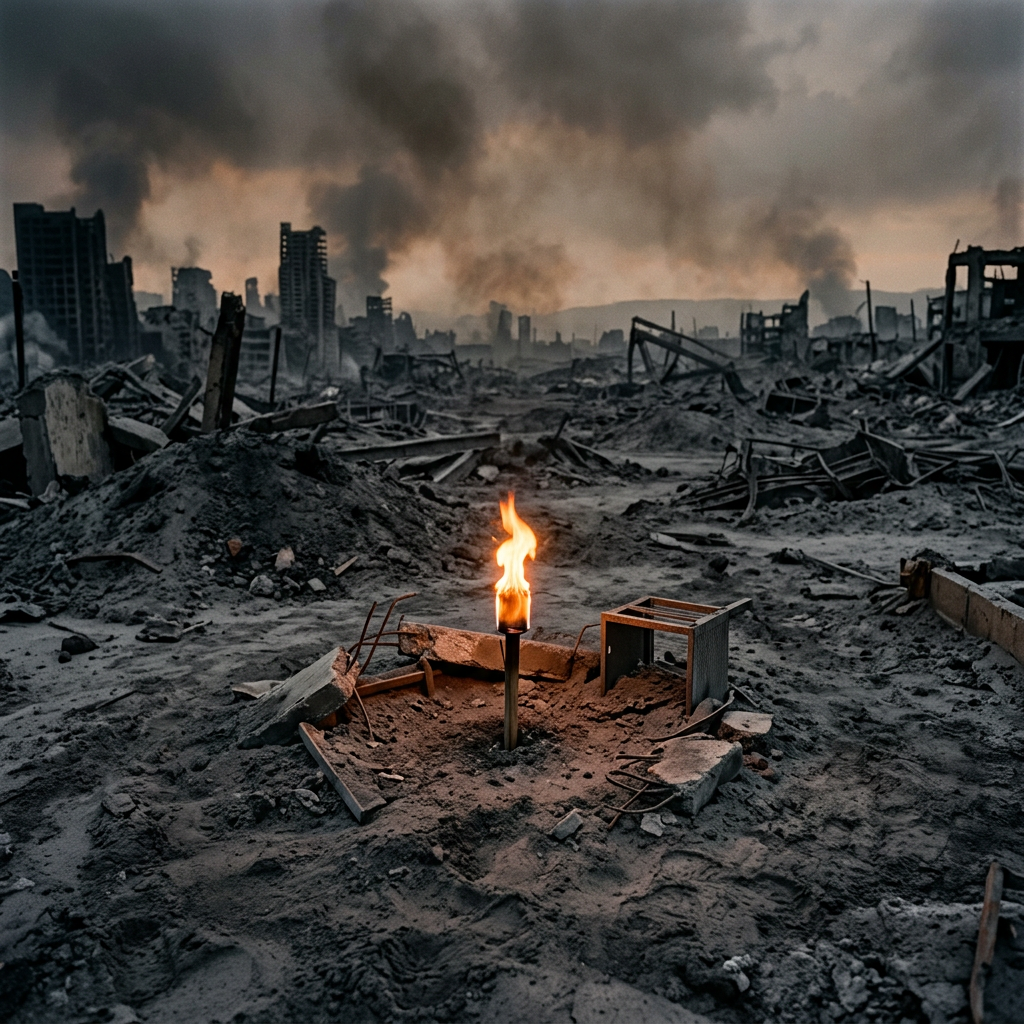
The Blazing Aftermath of the Twenty-Ninth Bowl
The world had been reduced to ash. The Twenty-Ninth Bowl of Wrath, as it was called by the few who survived to whisper of it, had scoured the land with a fire so pure and thorough that even the stones sweated molten glass. It was not merely a fire; it was a divine furnace meant to purge all imperfection. In its wake, the sky wept cinders, and the earth became a brittle crust over a lake of magma. For centuries, the scholars of the Ember Sanctum believed that nothing—nothing—could withstand such an inferno. Every living thing, every artifact, every memory of the old world was supposed to have been vaporized.
Yet, as the first explorers dared to traverse the Glass Plains a millennium later, they found something impossible. Nestled within the heart of a cooled volcanic throat, a single flame danced. It was not a wildfire, nor a gas jet, nor a trick of the light. It was a living ember, no larger than a human fist, hovering an inch above a charred obsidian pedestal. Surrounding it, the stone was cool to the touch. This flame had passed through the inferno without being consumed by it. This was the Fourth Gate.
A Single Flame That Refused to Be Consumed
How does a flame survive the fire that would destroy all other fires? This paradox became the central obsession of the Pyromantic Order. The flame they discovered possessed a strange quality: it burned without fuel. It had no wick, no oil, no wood. It existed as pure, self-sustaining radiance. The key, the Order deduced, lay not in its resistance to heat, but in its identity. Ordinary fire consumes its surroundings to exist; it is a reaction. But this flame was a statement. It was not born of combustion, but of intention.
Ancient inscriptions, forged into the gate keystone, described it as “the ember that remembers the first spark.” In surviving the holocaust, the flame proved it belonged to a different category of existence. It did not fight the inferno; it acknowledged it, passed through it, and remained unchanged. As one high archivist noted:
> The fire of judgment recognizes its own children. Purity cannot destroy purity—it can only transform it into its truest form.
The Gate of Fireproof Truth Revealed
The Fourth Gate is not a physical door, but a metaphysical threshold. To approach it, you must walk through the Chamber of Testimony, a hall where the walls still shimmer with residual heat. Here, the air is so dry that your breath turns to dust before it leaves your lips. At the chamber’s end, the gate appears as a shimmering curtain of heat haze, beneath which lies the flame that survived.
The gate’s purpose is profound: it filters souls as the inferno filtered the world. It asks a single question, not spoken aloud, but offered as a trial of essence: “What in you cannot be burned away?” This is not a riddle to be solved, but a revelation to be endured. The flame reacts to your presence by rising or dimming, and only those with an unshakeable core—a truth that cannot be volatilized by fear, desire, or falsehood—may pass.
Decoding the Scroll of the Enduring Coal
The Scroll of the Enduring Coal, recovered from a collapsed vault beneath the gate, offers practical and esoteric instructions. It is written in Sylvan Ember script, a language where each symbol is a heat signature rather than an ink stroke. Here are its key teachings:
- The Flame of Purpose: The scroll teaches that the “surviving flame” is a metaphor for an individual’s most authentic conviction. To find it, you must first identify what you would do if you knew failure was impossible.
- The Unconsumed Self: The ember symbolizes the part of you that exists before any external influence. It is the child’s laughter before the world taught it to cry. This self cannot be burnt because it was not made of the world’s fuel.
- The Act of Letting Go: Paradoxically, to endure the inferno, one must stop clinging to survival. The scroll states: “The coal that grips its own ash suffocates. The coal that releases its heat becomes eternal light.”
- The Signature of Truth: When you stand before the gate, you must not lie to yourself. The flame reads your intent, not your words. A person who has fooled themselves will see the flame dwindle to a spark.
For those seeking to prepare, the scroll offers a simple meditation:
> Hold a single candle in a dark room. Gaze into its heart until you see the blue core. Silently ask yourself: “If all I know were taken by fire, what one truth would remain?” Repeat this until the answer feels like a living ember in your chest.
Who May Enter: The Remnant of Uncorrupted Fire
Not everyone is worthy of the Fourth Gate. The gatekeeper, a silent figure robed in woven asbestos, observes all who approach. The qualifications are not about power, knowledge, or lineage. They are about integrity. Based on the teachings of the scroll and the observations of the few who have passed, here is who may enter:
- The Visionary: One who holds a dream so pure and selfless that it does not require external validation. They are not attached to the outcome, only the idea.
- The Grieving Healer: One who has lost everything but carries the memory of love without bitterness. Their compassion flows uncorrupted.
- The Honest Fool: One who admits their faults without shame and their limits without despair. They do not pretend to be what they are not.
- The Maker of Unbreakable Vows: One who has made a promise to something greater than themselves (truth, justice, a person) and has kept it despite every reason to break it.
Conversely, those who are turned away often share traits that read as “impure fuel” to the flame:
- The Grasper: Clutches onto achievements, status, or possessions as if they define their worth. The inferno would leave them with nothing.
- The Liar: Particularly those who have deceived themselves so thoroughly that they no longer know their own heart.
- The Vengeful: Their fire is reactive, sparked by hatred. It would be consumed by the greater fire, as hatred is only a shadow of love.
The Fourth Gate stands as a final testament to the idea that the most indestructible thing in the universe is not stone, metal, or even energy. It is a truth held so dearly that it becomes part of your very essence.
Conclusion
The flame that survived the Twenty-Ninth Bowl is more than a curiosity—it is a mirror. It reminds us that in every person, there is a core that cannot be destroyed by failure, loss, or even death itself. The inferno of life will come for all of us. It will burn away our possessions, our relationships, our health, our youth, and finally our breath. But if you have found that single flame of uncorrupted purpose within yourself, you will not be consumed. You will simply become more of what you always were. The Fourth Gate asks us, not to walk through fire, but to become fireproof. And that, perhaps, is the greatest discovery of all.
Leave a Reply