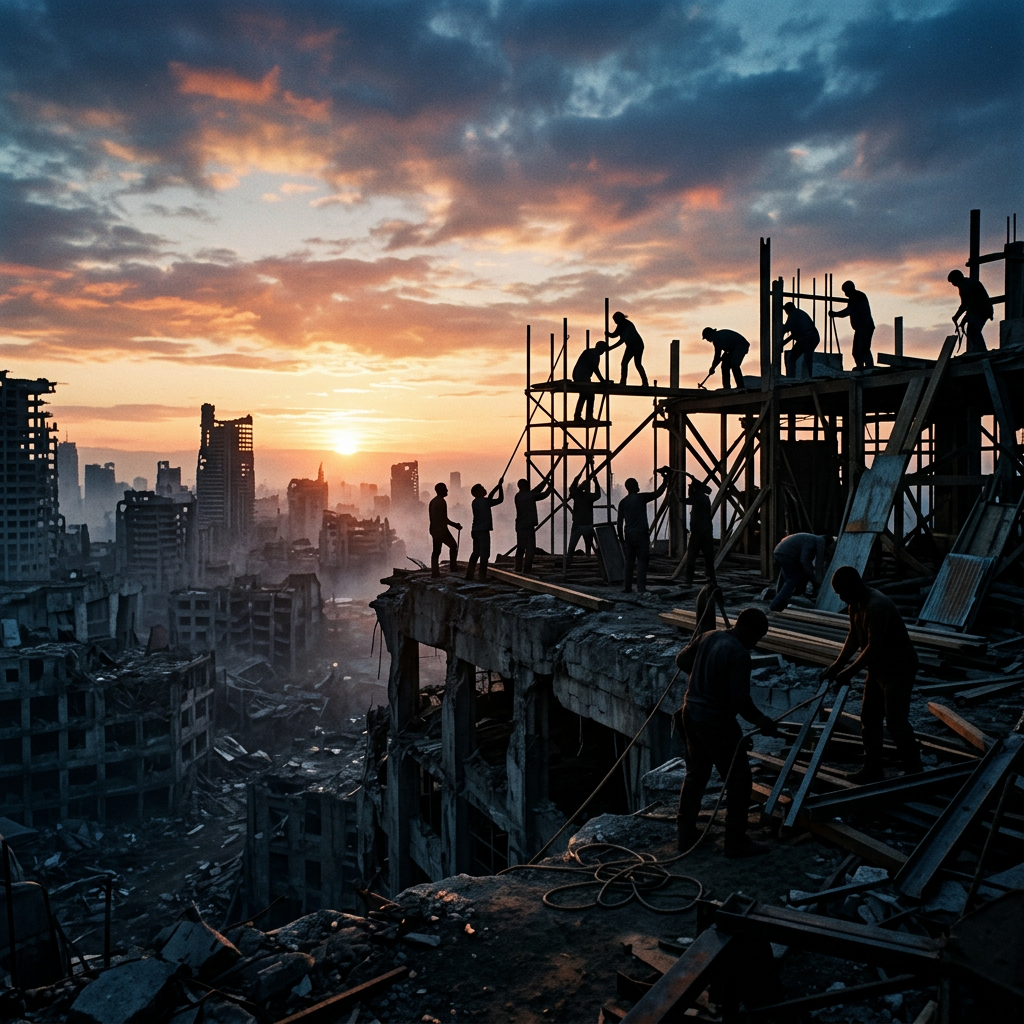
The last markets didn’t collapse. They dissolved. First went the stocks, then the bonds, then the very concept of trust in paper. When the final city grid went dark, humanity didn’t mourn—it adapted. From the ash of old, corrupt systems, a single rule emerged: What is scarce is sacred.
The Fall of False Economies
For centuries, markets were built on paper promises and algorithm-driven speculation. When the global power grids failed and the digital ledgers burned, those promises evaporated into static.
- Speculative assets became worthless overnight—no server, no value.
- Debt-based currencies hyperinflated into nothing.
- Centralized trust collapsed because there was no central command left.
The ruins taught a brutal lesson: an economy built on abstraction dies when reality reclaims its throne. People scavenged not for dollars, but for physical truth: clean water, fertile soil, and functional tools.
A Single Ray Pierces the Void
But one truth survived the twilight. In the hollowed shell of an old data vault, a group of survivors discovered something unexpected: a physical ledger buried beneath the rubble. It wasn’t digital. It was etched onto crystalline sheets, impervious to electromagnetic pulses.
This was not a record of debt. It was a record of contribution.
> “Value is not what you promise to give. Value is what you have already given.”
The first post-apocalyptic currency was born—not from government decree, but from documented labor, resource cultivation, and community defense.
The Rise of the Fifth Pillar
The old world had four economic pillars: land, labor, capital, and entrepreneurship. The new world added a fifth: resilience.
Resilience became the measure of a person’s ability to:
- Grow food in irradiated soil.
- Repair machines with salvaged parts.
- Protect a settlement from roaming scavengers.
- Preserve knowledge that could rebuild civilization.
Communities began issuing Resilience Stamps—tokens earned for verifiable contributions to survival. A stamp could buy a liter of purified water, a night’s shelter, or a cartridge of ammunition.
The Final Market Declared
Once the fifth pillar was established, the survivors needed a place to trade. They declared the Final Market on the ruins of the old continent’s capital—a neutral zone where no weapons were allowed and all transactions were recorded in the crystal ledger.
Key rules of the Final Market:
- No debt: All trades are final. No credit, no interest.
- No speculation: You cannot buy to resell. You must use what you acquire.
- No hierarchy: Every trader’s vote counts equally in setting exchange rates.
- No trust required: The ledger is public, physical, and auditable by all.
This market didn’t just trade goods. It traded meaning.
Dawn Crowns a Ruined World
The first transaction in the Final Market was not for food or fuel. It was for a book of botanical drawings—a pre-war encyclopedia of edible plants. In exchange, the seller received fifty Resilience Stamps and a promise of protection from two neighboring settlements.
> “We do not trade to get rich. We trade to survive long enough to remember who we were.”
The dawn that broke over the ruined world was not warm or golden. It was bitter gray, filtering through a haze of volcanic dust. But it was light. And where there is light, there is commerce—not as greed, but as a covenant of continuity.
Conclusion
The “Last Dawn” teaches a profound truth: markets are not born from abundance, but from necessity. When old systems crumble, new ones rise—not from boardrooms, but from campfires. The economy of the future is not digital or ethereal. It is the weight of a hoe in your hand, the heft of a seed bag, and the quiet agreement between two people that what you can do matters more than what you own.
Leave a Reply