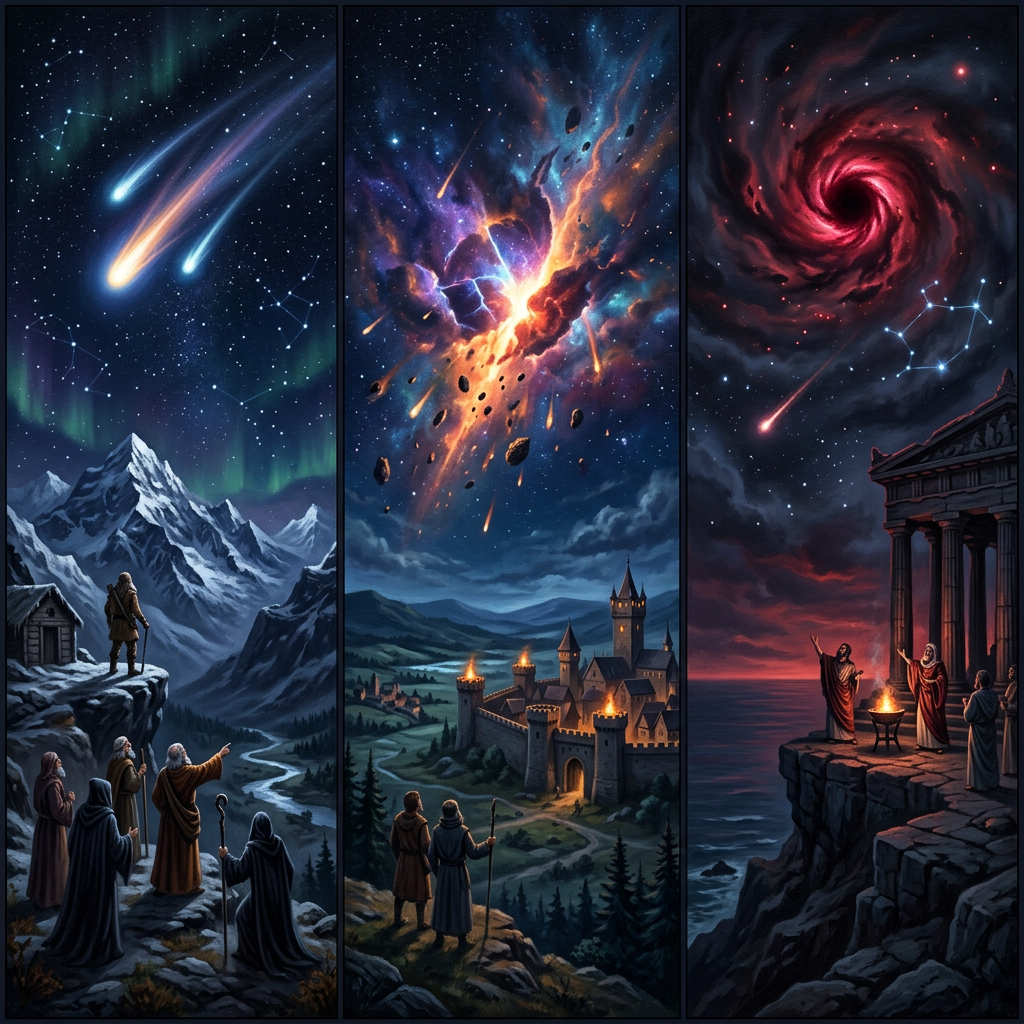
The Omen of the Fourteenth Trumpet Above
When the heavens themselves break their ancient silence, humanity holds its breath. It began not with a whisper but with a crack—a sound felt more than heard, vibrating through the marrow of every living thing. The fourteenth trumpet did not announce war or judgment; it announced a tear in the celestial fabric, a wound through which starlight bled like precious vitae. Astronomers called it an anomaly. Mystics called it the threshold. What it truly was, no one could say—save that it painted the sky in hues of burned gold and violet, and from that rift, something descended.
> “When the fourteenth trumpet sounds, look not for the enemy above, but for the truth within.”
This omen was a warning, but also an invitation. It asked not for fear, but for witness.
Selene’s Witness: When Constellations Fell Like Fire
Selene stood atop the shattered observatory of Orithyia, her robes whipping like captured lightning. Around her, the city of marble and memory burned—not with flame, but with light. The constellations she had charted since girlhood, the ones she named after her mother’s lullabies, were falling. Not gently. Not slowly. Like arrows shot from a god’s bow, they streaked downward, each one extinguishing a piece of the world’s ancient magic.
- Cassiopeia crumbled into the sea, raising tidal waves of phosphorescence.
- Orion’s Belt snapped, three stars scorching the eastern desert.
- The Lyre shattered into a thousand singing fragments, each note a death.
Selene did not weep. She recorded. Her quill moved across scrolls faster than fire, capturing the dying breaths of the sky. She knew this was not a destruction—it was a clearing of the stage. Something new required the old to burn. But what kind of play begins with such a curtain of flame?
The Unfallen Star: A Ladder of Light in Mourning
Yet amid this cosmic funeral, one star did not fall. It rose.
While others plummeted, this singular point of light climbed upward, defiant against gravity and fate. It did not blaze with fury, but with a quiet, steady radiance—like a lantern held by a traveler who refuses to stop walking. Selene dubbed it The Third Gate.
> “The gate is not where you enter. It is where you become.”
This star was not a star at all. It was a ladder woven from light, each rung a moment of choice. As she watched, Selene understood: the constellations had fallen not because they were weak, but because they had fulfilled their purpose. Their stories were complete. The new story—the one written in the spaces between the dark—required a different kind of light. Not the light of distant, unreachable fire. But the light of a path.
- Step one: Surrender the comfort of the known maps.
- Step two: Walk toward the ache of the unknown.
- Step three: Remember why you began.
The Scroll’s Decree: Truth as the Gatekeeper’s Key
In the catacombs beneath Orithyia, Selene found the scroll. It was not made of parchment or papyrus, but of woven silence—threads of darkness that held memory the way flesh holds bone. The decree was simple, written in a script that shifted as she read:
> “The gate does not open for the worthy. It opens for the true. Lay down your armor of certainty. Pick up the weight of your uncertainty. That is the key.”
This truth struck Selene like a blade of ice. For years she had sought answers in the stars, believing knowledge was a shield against chaos. But the scroll told her something else: truth is not a destination. It is a gatekeeper. And the gatekeeper does not let you pass because you are right. It lets you pass because you are willing to be wrong. The fallen stars were not lost—they were sacrifices of certainty, burned away so the gate could be seen.
The Remnant’s Rise Through Starlight and Iron Gates
Those who remained—the remnant—did not call themselves survivors. They called themselves witnesses. In the weeks that followed, Selene gathered them in the hollow of a collapsed temple, the sky above still scarred by the trumpet’s omen. They were not soldiers. They were not sages. They were ordinary people who had seen the sky break and had not turned away.
Together, they learned a new kind of navigation:
- Not by star maps—for the old sky was no more.
- Not by prophecy—for the future had become molten and moldable.
- But by resonance—listening to the hum of the Third Gate within themselves.
The iron gates were not barriers; they were tests. Each one required a shedding: of pride, of fear, of the story you told yourself about who you were. Starlight rose not from above, but from within their chests. And as they climbed the ladder of light, the fallen constellations did not seem so much destroyed as reborn—their fragments now glittering like seeds in the soil of a new world.
Conclusion
In the end, The Third Gate is not a place. It is a moment of becoming—a choice to rise amid the ruin of everything you thought was eternal. Selene and the remnant did not reclaim the old heavens. They stepped through the gate into a sky being woven anew, thread by thread, from their own illuminated flesh. The iron gates of the world still stand, but they are no longer locked. The key is honesty. The ladder is courage. And the light—the unfallen light—is you.
Leave a Reply