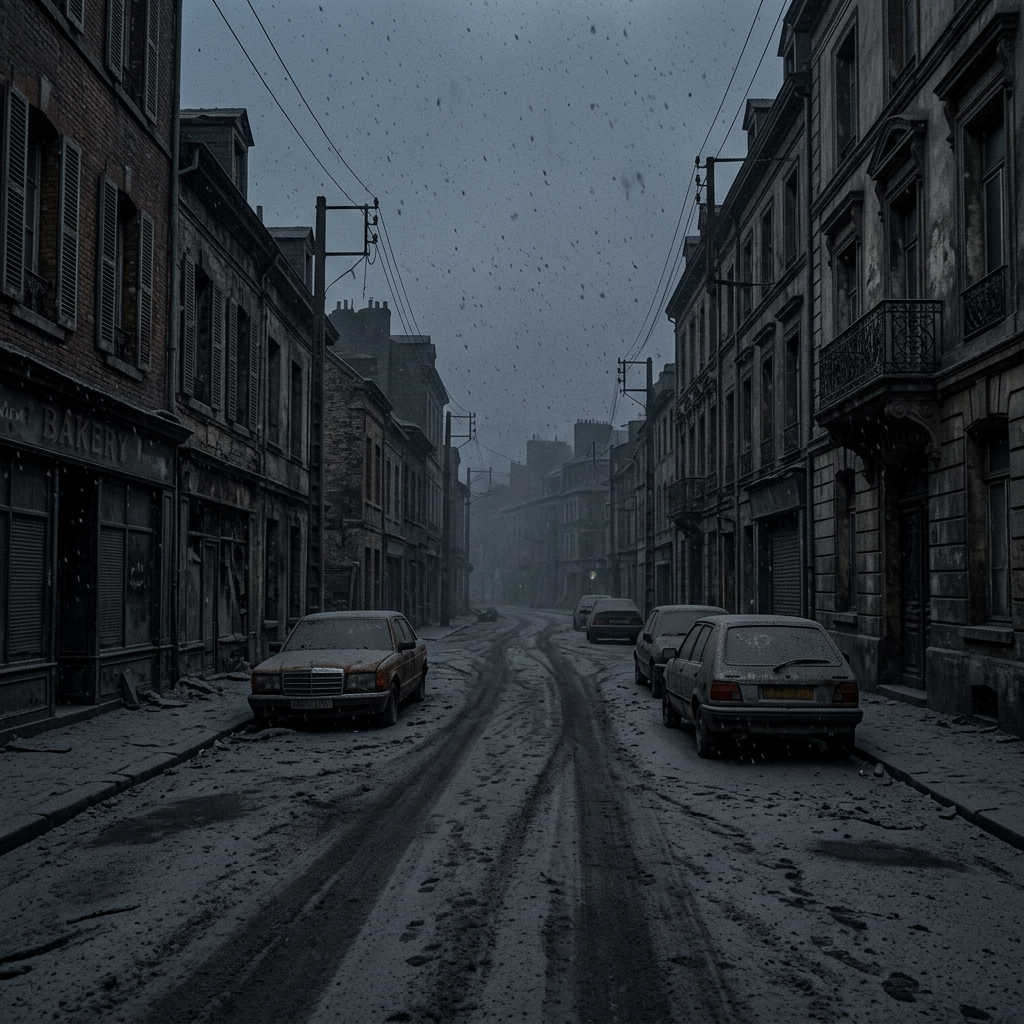
It began not with a bang, nor a whisper, but with a sigh from the heavens. A fine, gray ash drifted down upon the city, settling on rooftops, cars, and the shoulders of hurried commuters. At first, it was dismissed as a volcanic oddity, a meteorological anomaly. But soon, the truth became undeniable: this was no ordinary ash. It was a memory—a record of every lie ever told within its reach. And it remembered everything.
The Gray Snow That Brought Our Buried Truths
The first flakes fell with a deceptive gentleness. People brushed them off their coats, coughing slightly at the acrid taste. But within hours, the ash began to speak. Not in words, but in images and feelings that seeped into a person’s mind the moment they touched the fallen dust.
- A businessman watched his wife’s face contort with hurt as the ash replayed his whispered “working late” while he was actually at a bar.
- A politician felt the cold sting of a thousand broken promises as the ash swirling around his podium showed a crowded rally cheering for a healthcare plan he never intended to pass.
- A child saw, in a small pile of ash by his bedroom window, the “perfect grades” report his parents had forged, now glowing with a sickly, false light.
The gray snow did not judge; it simply remembered. Every lie, from the smallest white fib to the grandest fraud, was etched into its crystalline structure. The streets no longer crunched with grit; they crunched with the brittle remnants of deceived trust.
When the Eleventh Bowl Remembered Every Word
It was not a matter of if the ash would reveal the deepest secrets, but when. The old adage about the apocalypse spoke of seven bowls of wrath. This felt like an eleventh—a specialized judgment aimed at the one thing that kept humanity fragile: our ubiquitous dishonesty.
The ash had a peculiar property. It didn’t just show the lie; it showed the context. It revealed the fear behind the boast, the greed behind the promise, the self-protection behind the evasion. As I stood on my porch, I saw my own reflection in a drifting flake. It showed me telling my mother I loved her casserole, when in truth, I had thrown it in the trash. It seemed trivial, but the ash felt heavier for it.
> The worst lies are not the ones we tell others, but the ones we practice on ourselves until we believe them.
The ash forced me to look at a lie I had polished for a decade: that I had left my hometown for “opportunity,” when the real reason was a bitter argument I never had the courage to resolve. The gray snow fell with a soft, condemning hiss.
Ashfall That Exposed the Lies We Protected
We like to think that our lies protect others. We call them “kindness” or “tact.” The ash did not accept this distinction. It treated the lie of “everything will be fine” to a child in a failing marriage with the same weight as a corporate cover-up of toxic waste.
The consequences were immediate and chaotic. Friendships shattered as the ash revealed who had been mocking whom behind their backs. Marriages disintegrated as long-buried infidelities were replayed in the driveway, in the very car where they happened. The stock market crashed as the ash unveiled inflated quarterly reports.
- Relationships: The ash became a weapon. A couple arguing on the street would be suddenly silenced as a gust of wind kicked up a swirl of ash that showed their partner an uncomfortable truth about their “old friend.”
- Commerce: Every transaction became a trial. The price tag was no longer just a number; it was a scroll of the item’s true cost—the underpaid labor, the cheap materials, the exaggerated claims.
- Self-reflection: The most terrifying aspect was the solitude. In the quiet of a bedroom, a person’s personal pile of ash would shimmer, replaying the lies they told themselves about their weight, their work, their happiness.
The protective layers we had built around our fragile egos were being systematically erased. We were left standing, naked, in a storm of our own making.
Judgment Fell Like Dust from a Broken Sky
This was not a divine judgment from a god on a throne. It was a mechanical, inevitable consequence. The sky had become a broken clock, its gears grinding down to release a fine dust of cosmic accountability.
People tried to escape. They attempted to vacuum it up, but the machines only spread the lies into the air, creating denser, more damning clouds. They tried to wash it away, but the water only made it stick, forming a muddy paste that clung to skin and clothes. The ash had to be accepted.
I remember my neighbor, a proud man who had lied about his war record for fifty years. He stood outside, arms wide, as the ash settled on him. It showed the truth: a minor administrative role miles from the front, not the heroic charges he had described. He cried, not from shame, but from relief. The story was finally over.
> The judgment of the ash was its silence. It showed the truth and waited. It did not punish; it simply displayed.
The chaos began to subside as a strange peace settled in. The world still the same color of mournful gray, but the tension in the air had changed. It was no longer the tension of hidden fear, but the tension of exposed honesty.
The Scroll’s Fire That Burned Through Our Silence
The ash did not last forever. As quickly as it came, it began to fade, but not without a final act. The prophecy spoke of a scroll that would burn away the lies. The ash, it turned out, was that scroll, consuming itself in a final, silent fire.
As the sun finally broke through the gray clouds, the ash crystals caught the light. For a moment, the entire world was a field of glittering fire. Every lie that had been exposed turned to a brilliant, white-hot ember and vanished. The silence that followed was not the silence of shock, but the silence of a world that had finally run out of evasions.
The sky cleared. The streets were swept clean by a gentle rain. But something had changed. The air felt lighter. Conversations were hesitant at first, but they were real. People spoke without the complex architecture of fabrication. The world was poorer for the loss of its fantasies, but infinitely richer for gaining the truth.
Conclusion
The ashfall taught us a terrible lesson: that the weight of our lies is far heavier than the weight of our truths. We spent so much energy building, maintaining, and defending our false stories that we forgot how freeing it is to simply say, “I was wrong,” or “I was afraid.” The gray snow was a cataclysm, but it was also a purification. It remembered every lie we told, and in doing so, it gave us a chance to forget them, and to begin again with nothing but the simple, terrifying, and beautiful truth.
Leave a Reply