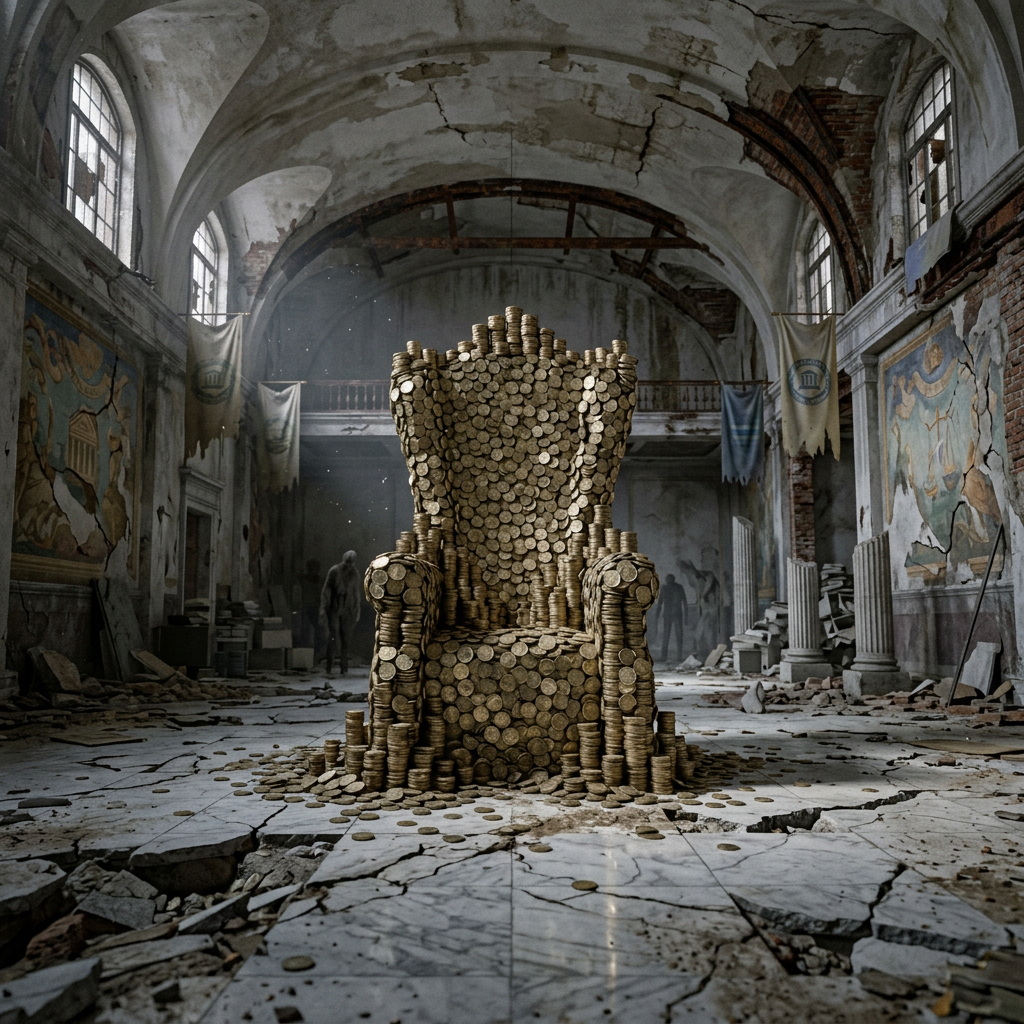
In the world of high finance and speculative markets, certainty was once considered a quiet, almost invisible force—less glamorous than the roar of a bull run, less dramatic than a market crash. Yet, it was the bedrock upon which all sustainable prosperity was built. But something shifted. The ancient foundations cracked, and what emerged was not a slow erosion, but a sudden shattering. This is the story of The Tenth Bowl: the moment when certainty itself poured out, not as a flood of salvation, but as a hammer blow against greed’s most arrogant fortress.
When Certainty Shook the Throne of Greed
For decades, greed wore a crown forged from ignorance. Investors piled into systems that promised infinite returns, building towers of speculation on sand. The wealthy few whispered, “Trust us, we know what we’re doing.” But certainty—the cold, unfeeling truth of mathematics and consequence—waited patiently. When the Tenth Bowl was poured, it did not bring chaos; it brought clarity. And clarity is the death of illusion.
The throne of greed was built on three legs:
- Opacity: The belief that complexity hides risk.
- Deception: The promise that the system works for everyone.
- Inertia: The idea that “too big to fail” is a law of nature.
Certainty shattered each leg. Transparent ledgers revealed hidden leverage. Smart contracts enforced immutable terms. And decentralization ensured that no single player could hold the system hostage. Greed’s throne, once untouchable, became a relic.
The Great Quake: Systems Crumbling into Dust
The quake was not a physical event; it was a structural collapse of trust. Traditional markets, built on layers of intermediaries and manual reconciliation, cracked under the weight of their own complexity. Here is what the great shakeout looked like:
> Observation: The average settlement time in legacy finance was T+2 days. In a world moving at internet speed, that 48-hour gap became a chasm where fraud and front-running thrived.
When the Tenth Bowl fell, the following systems turned to dust:
- Banks as gatekeepers: No longer the sole arbiters of value transfer.
- Collateralized debt obligations: Exposed as house-of-cards promises.
- High-frequency trading algorithms: Outpaced by on-chain finality.
- Centralized exchanges: Replaced by trustless, self-custodial models.
The Tenth Bowl: A Choice Between Truth and Chance
The imagery of the Tenth Bowl is potent. In ancient texts, bowls were vessels of both blessing and judgment. Here, the bowl represents a final, unmediated choice. You now stand at the crossroads:
| The Path of Chance | The Path of Truth |
|---|---|
| Emotional bets based on hype | Verifiable data and logic |
| Centralized authorities “guessing” prices | Decentralized oracles confirming reality |
| Leverage and margin calls | Collateralized, over-collateralized positions |
| “Trust me” promises | Trustless code you can audit |
The choice is binary. The Tenth Bowl forced every participant to decide: Will you trade on rumor, or will you build on certainty?
Foundations of Silence: The Platform We Refused
There was a foundation offered to the world—a platform of silence, not noise. It did not promise Lamborghinis or moon landings. It promised something far more radical: peace. This platform was built on principles that greed’s architects actively refused:
- Provable scarcity: No infinite printing of tokens behind closed doors.
- Immutable records: Every transaction etched in stone, not editable in a database.
- Sovereign identity: You control your keys, your assets, your destiny.
- Game-theoretic security: Attacking the system costs more than the reward.
Why did we refuse it for so long? Because silence does not sell. Greed requires a siren song of urgency and FOMO. The quiet hum of a verifiable, secure network is not sexy. But when the earthquake came, those standing on the platform of certainty remained standing.
> Key insight: Greed builds on sand because sand is cheap and easy to shape. Certainty builds on bedrock—silent, unglamorous, and eternally stable.
The Scroll’s Verdict: What Chance Built, Certainty Falls
The final scroll unrolled, and the verdict was undeniable. Every system, every empire, every fortune built on chance and opacity was judged by the light of on-chain truth. Here is the verdict:
- Ponzi schemes: Exposed by transparent token flows—the exit liquidity was obvious.
- Unbacked stablecoins: De-pegged when the market demanded proof of reserves.
- Yield farms promising 1000% APY: Revealed as inflationary tokenomics that benefited only the earliest insiders.
- Centralized lending platforms: Froze withdrawals, while DeFi money markets kept functioning.
The moral is clear: What chance builds, certainty falls. Only foundations laid with verifiable truth, cryptographic guarantees, and decentralized consensus survive the Tenth Bowl.
Conclusion
The Tenth Bowl was not a punishment; it was a revealing. It stripped away the gilded costumes of greed and showed the naked truth beneath. We now face a choice that cannot be deferred: return to the comforting lies of centralized chance, or embrace the demanding but liberating discipline of decentralised certainty.
The bowl is empty. The choice is yours. Build on sand, and you will remember the quake. Build on stone, and you will remember only the peace.
Leave a Reply