The Third Trumpet: When Heaven’s Drums Fall Silent
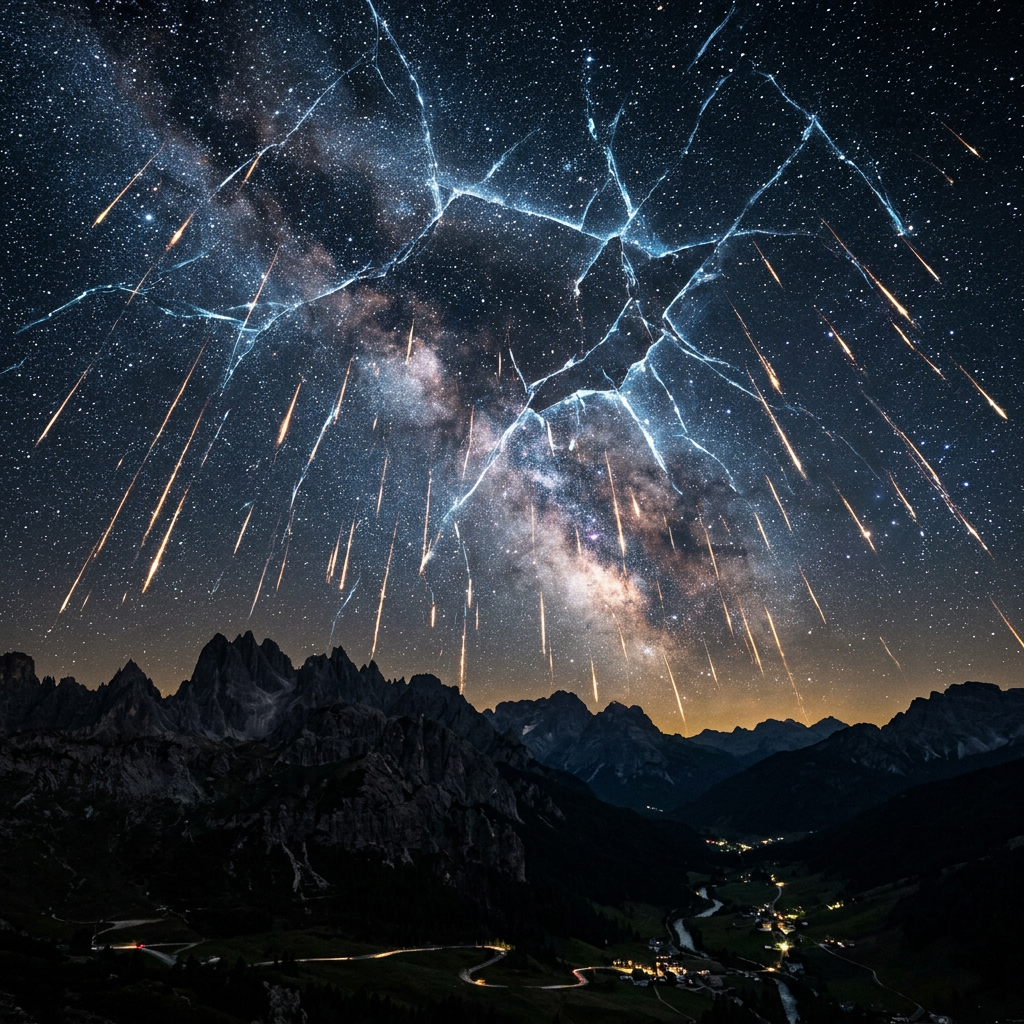
There is a moment in cosmic lore when the fabric of the divine universe trembles. The Third Trumpet sounds—not as a call to war, but as a herald of heaven’s collapse. In this vision, a great star, blazing with the fury of a thousand suns, plunges from the sky, burning a third of all light and turning the celestial rivers into wormwood. The silence that follows is not an absence of sound, but a deep, aching void where hymns once echoed.
What happens when the foundation of reality itself cracks? When the drums of heaven fall silent, the cosmos does not merely go dark—it forgets how to sing. Yet, in this narrative of destruction, a single anomaly emerges: one star refuses to fall.
> “In the midst of chaos, there is also opportunity.” — While this ancient wisdom speaks to human life, it finds its truest echo in the heavens when a single ember defies the descent of the entire sky.
One Star Refused to Fall: Light in the Shattered Sky
Imagine the scene: the firmament shatters like a mirror struck by a divine hammer. Stars plummet, constellations unravel, and the ink of night bleeds into every corner of existence. But amidst this cascade of dying lights, one star holds its place. It does not cling to its former glory out of stubbornness—it remains because it carries a duty heavier than gravity.
What makes this star unfallen?
- It possesses a core of hardened will—not made of iron or silicon, but of a substance we might call radiant purpose.
- Its light is not borrowed from the heavens but self-generated through sacrifice.
- It does not burn for itself; it burns so that the memory of the sky is not erased entirely.
This star becomes a paradox: a singularity of hope in a universe designed for entropy. The shards of heaven rain down, but they cannot dim this one stubborn flame. It is a beacon not for navigation, but for resurrection.
The Ladder of Starlight: A Path from Ruin to Remnant
Survival after a fall is not a straight line—it is a ladder, each rung forged from residual light and broken stone. For the unfallen star, the path from ruin to remnant is a series of deliberate steps:
- Accept the Silence: The first step is to stop listening for the old music. Heaven’s drums may be silent, but the solar wind still whispers.
- Anchor in the Void: Without a firmament, the star must create its own gravity—not of mass, but of memory and intent.
- Kindle from the Ashes: Use the falling debris of other stars as fuel. Even the dying can feed the living.
- Emit a New Frequency: The old hymns are gone. The unfallen star must learn to sing a new song, one that echoes through the wreckage.
This ladder is not for the faint of heart. To climb it is to leave behind the comfort of a completed cosmos and embrace the uncertainty of becoming. The remnant is not a piece of what was; it is the seed of what could be.
> A key tip for those navigating their own falls: Do not try to piece the old heaven back together. Build a new one from the light you still carry.
Iron and Radiance: The Unfallen Star’s Eternal Scroll
The unfallen star does not just keep shining—it writes. Its radiance etches a scroll across the void, a document of what was lost and what must be remembered. This scroll is made of two elements: iron (the element of endurance, forged in the cores of dying giants) and radiance (the light of unyielding life).
- The iron represents the lessons of heaven’s fall—the weight of history, the gravitational pull of past mistakes.
- The radiance represents the promise of the remnant—the idea that collapse is not the end, but a transformation.
On this eternal scroll, the star records not just the names of the fallen, but the blueprints for a new order. Each word is a photon; each sentence, a constellation. It is a living archive, meant to be read by whatever life emerges from the ashes.
Surviving Heaven’s Collapse: The Star That Carved a Way
So how does one survive the end of all that is familiar? The unfallen star offers a masterclass in resilience.
- Adapt Your Purpose: The star was once a light among many. After the fall, it becomes a lantern for the lost. This shift in identity is crucial.
- Embrace Loneliness: Heaven’s collapse is a solitary experience. The unfallen star learns that being alone is not the same as being unseen.
- Burn Differently: The star cannot sustain its old flame. It must reduce its output, focus its energy, and become a piercing, narrow beam rather than a diffuse glow.
- Become a Memory: The star understands that its survival depends on being remembered—not as a trophy of survival, but as a story of how light endures.
The path it carves is not a road for the many. It is a thread of silver in a black tapestry, a subtle guide for those who will later wander the ruins and wonder if the sky was ever beautiful at all.
Conclusion
The story of The Unfallen Star is not merely a cosmic allegory; it is a mirror for the human spirit. Each of us, at some point, hears the thud of heaven’s drums falling silent. We lose our structures, our certainties, our collective songs. And yet, within each of us there is that same potential—to refuse to fall, to hold our place, to become a ladder of starlight from ruin to remnant.
It is not about being the brightest or the strongest. It is about being the one who, when the sky shatters, chooses to remain. The light that survives heaven’s fall is not a miracle. It is a decision, made in the dark, to keep shining. And that, ultimately, is the only way to carve a path through the void.
> “When you have lost everything, you are free to become anything. The star that refuses to fall does not wait for salvation—it becomes salvation itself.”
Leave a Reply