In the vast, unyielding landscapes where myth meets metal, a story emerges from the forge of time itself. It is a tale of transformation, of a world where the first light of a new era does not creep in softly, but announces itself with a blistering, metallic roar. This is the saga of “The Iron Horizon Trumpet: March of the Unbound Dawn,” a narrative that explores the collision of human fragility and industrial might.
The Unbound Dawn: Idris of Gao Hears the Trumpet
Across the ancient trade routes of the Sahel, a name is whispered on the dry winds: Idris of Gao. A master smith and a restless dreamer, Idris was said to be the first to perceive the dissonant harmony that was to come. While others saw only the sunset bleeding into the flat, iron-rich horizon, Idris heard a sound. It was not a melody, but a call—a deep, resonant trumpet blast that seemed to rise from the earth itself.
According to the oral traditions of the Niger bend, Idris spent seven nights in the desert, his ear pressed to a vein of magnetite ore. He returned with a pronouncement: the dawn was a prisoner. It had been shackled by the weight of complacency, by the addiction to a stagnant, weary twilight. The unbound dawn, he claimed, would not arrive on silent feet. It would march, led by the sound of a trumpet forged from the iron horizon.
> “The sun is not a gentle guest. It is a blacksmith’s apprentice, striking the anvil of the world. Listen for the clang.” — Proverb attributed to Idris of Gao
This was not a prophecy of peace. It was a declaration of a mechanized awakening.
Where the Iron Horizon Rings Like a Colossal Bell
The setting of this march is the Iron Horizon itself—a geological anomaly where the skyline is not a curve of blue, but a jagged, rust-colored ridge of smoothed metal. This is no mere landscape; it is an instrument. The winds that whip across the desert flats do not howl; they are said to sing against the metallic contours of the earth, creating a constant, low-frequency hum. The true power, however, lies in its sound.
When the sun strikes the horizon at a precise angle—just before the midnight apex, or during the first tint of unbound light—the entire ridge resonates. Here is how the phenomenon is described:
- The Collision of Elements: Cool desert air hits sun-baked metal, creating a thermal gradient that vibrates the iron oxides.
- The Resonant Chamber: The natural caverns and mines beneath the horizon act as a bellows, amplifying the frequency until it becomes audible for miles.
- The Trumpet Call: The resulting sound is not a scream or a whisper, but a pure, sustained tone—the Iron Horizon Trumpet—that signals a shift in reality.
The locals believe that to hear this trumpet is to be offered a choice: remain silent in the old world, or march into the new one.
Molten Steel Whispers: A Dawn That Marches on Nations
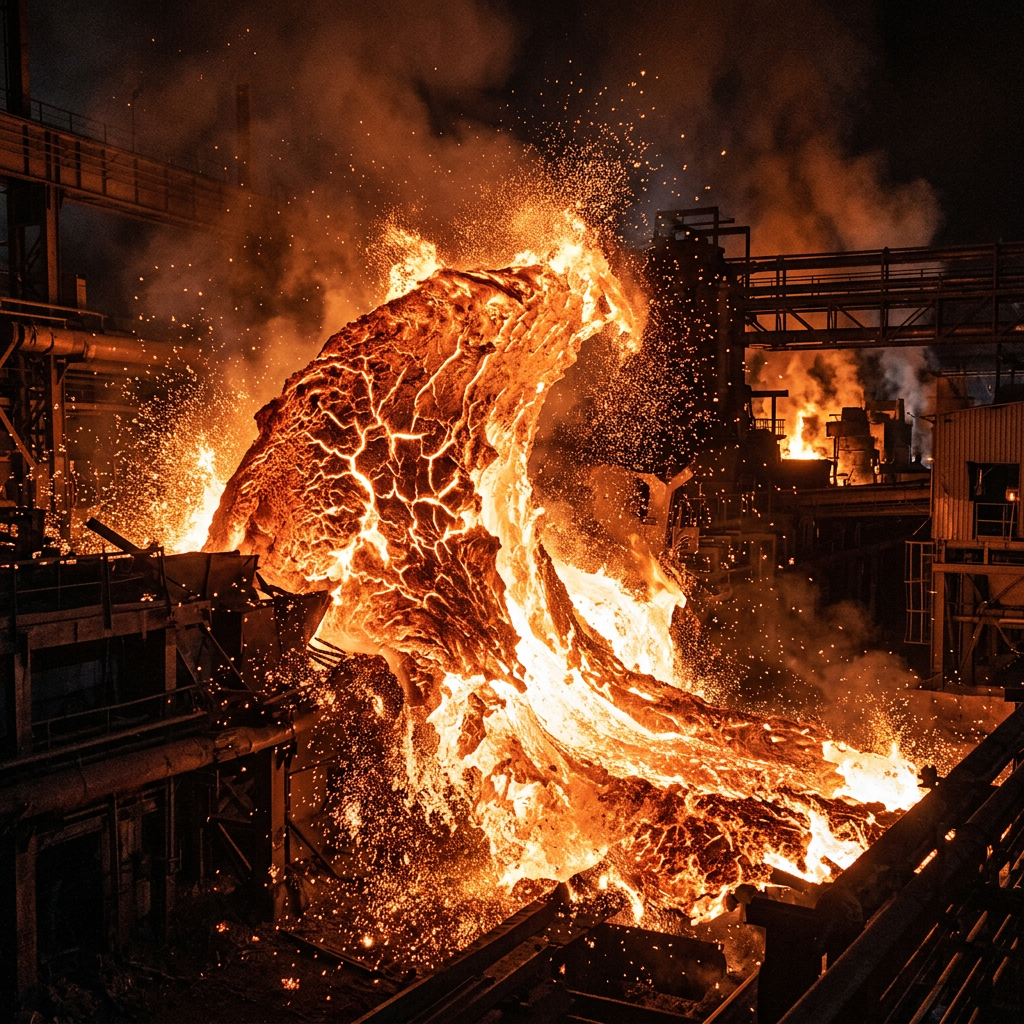
The “Marche of the Unbound Dawn” is not a peaceful parade. It is a relentless, industrial advance. The metaphor is literal: columns of molten steel, flowing like rivers from the heart of the horizon, begin to walk. This is the tide of glowing metal, a force that does not destroy so much as it reforges.
The march targets the geographies of the soul and the state. It pushes against the iron walls of addiction—not just to substances, but to power, to stagnation, to the comfortable numbness of the fading night. Key aspects of this march include:
- The Rejection of Ash: The old world was built on fuel and decay. The new dawn burns clean, using the kinetic energy of its own movement.
- The Armor of Focus: Those who march are not soldiers, but craftsmen. They carry hammers, tongs, and molds. Their weapon is relentless creation.
- The Trail of Sparks: Wherever the march passes, it leaves behind structures of crystalline iron—schools, bridges, and forges—built from the heat of the advance.
This is a dawn of industry without exploitation, a paradox only possible when the trumpet sounds.
The Tide of Glowing Metal That Pushes Back Addiction
The core struggle of the narrative is internal. The “addiction” is the human longing for the easy, the unchanging—the comfort of a horizon that never moves. The tide of glowing metal acts as a physical antidote. It is a hypnotic, terrifying beauty. To touch this tide is to feel one’s own weaknesses burned away.
- The Addictive Hush: The old world lulls its inhabitants with a false silence. The trumpet breaks this hush.
- The Molten Mirror: The steel reflects not your face, but your intentions. It shows you what you truly want, stripping away denial.
- The Forge of Freedom: Once you march, you cannot stop. The addiction to inertia is replaced by the addiction to action. The steel becomes your blood.
> “Do not fear the burn. The metal only keeps what you are willing to let go of.” — Idris of Gao, from the Iron Scrolls
Marching Across the Edge: The Trumpet’s Final Call
The narrative concludes at the edge of the Abyssal Dunes, where the Iron Horizon drops into an unknown void. Here, the trumpet plays its final, sustained note. This is not an end, but a transcendence. The march does not stop; it steps off the edge.
- The Unbound Dawn Revealed: The light on the other side is not yellow or white, but a color that the old eyes cannot name. It is the color of potential.
- The Trumpet Falls Silent: The instrument has served its purpose. The dawn is no longer a distant promise; it is a part of every marcher.
- The Final Lesson: The march was never about reaching a destination. It was about becoming the dawn.
In this final moment, Idris of Gao is said to have turned his own heart into the last piece of steel, hammering it into a key that opened the gate of the horizon.
Conclusion
“The Iron Horizon Trumpet: March of the Unbound Dawn” is more than a story of a mythical landscape. It is a parable for anyone who has felt the pull of a new day that refuses to be gentle. It reminds us that some dawns must be earned through heat, pressure, and the courage to leave the comfortable shadow. The trumpet still sounds, faintly, on the wind. It asks a simple question: Will you stand still, or will you march?
Leave a Reply