The Iron Canopy’s First Tremor Over Río Grande
The people of Río Grande had long grown used to the hum. It was a low, steady vibration that seemed to come from the sky itself—a constant reminder of the Iron Canopy, the massive lattice of steel and alloy that had been suspended over their valley for generations. No one alive remembered its construction; it was simply a fact of life, a roof over the world that kept the sun’s harshest glare at bay and regulated the weather below. But on that fateful morning, the hum changed. It deepened into a groan, then into a shudder that rattled windows and sent birds scattering in panicked confusion. The first tremor was not an earthquake from the ground, but a wobble from above.
Residents poured into the streets, staring upward. The canopy, once a uniform gray-blue sheet stretching from horizon to horizon, now seemed to ripple like a pond disturbed by a stone. A low, metallic screech pierced the air—a sound unlike any industrial noise they had ever heard. The age of the Iron Canopy was finally catching up to it, and Río Grande was about to witness the sky’s slow, terrible sag.
A Scroll of Rust-Fire Descends with Judgment
As the morning wore on, the sun began to paint an impossible picture. Rust, once merely a creeping menace along the canopy’s unseen underbelly, now flaked off in great clouds of orange and brown. But these were no ordinary flakes of oxidation. They ignited as they fell, turning into what the elders would later call scrolls of rust-fire—long, curling sheets of flame that tumbled through the air like pages torn from a burning book.
> “The sky was writing our end in fire,” whispered an old woman named Alma, who watched from her doorstep. “Each scroll a line of judgment.”
These fiery scrolls did not crash to the ground. Instead, they hovered, spinning slowly, as if reading the land below before descending. Some struck power lines, turning the electrical grid into a screaming web of sparks. Others wrapped around trees, incinerating them in instant pillars of ash. The judgment was not swift; it was a slow, deliberate unfurling of destruction, each scroll a deliberate sentence passed upon the earth.
When the Wager-Sky Began to Overflow with Molten Metal
By midday, the canopy was no longer a solid structure but a leaking sieve of red-hot alloy. The Wager-Sky—the name the locals had given to the canopy in more hopeful times, when it was a bet against nature’s cruelty—began to overflow. Melted bronze and steel dripped like honey from a broken comb, only at temperatures that could turn concrete to glass.
The streets became rivers of silver and copper. Those who had not fled sought shelter in basements and underground tunnels, listening to the relentless drip-drip-drip of liquid metal hitting rooftops. It was a sound that mixed the mundane with the apocalyptic. A child later described it as “a thousand teakettles boiling at once, but the water was fire.”
- Key signs of the overflow:
- Drops that sizzled before they landed, creating steam clouds of toxic fumes.
- Puddles of molten metal that reflected the burning canopy above, creating a hellish mirror world.
- Secondary fires erupting wherever these glowing streams touched wood, plastic, or even stone.
The canopy was not falling apart; it was melting down, returning to its primal elements in a final, violent act of submission to gravity.
The Collapse: Canopy Falling in Sheets of Flame
Then came the sound that would echo in nightmares for decades. A deep, resonant crack split the air, followed by a prolonged rumble like distant thunder trapped inside a metal box. The central supports, weakened by centuries of stresses and now glowing with their own heat, gave way. The collapse did not happen all at once. It came in stages, as though the canopy was fighting to hold its shape even as it disintegrated.
First, a hundred-meter-wide section near the old market square simply folded downward, a curtain of flame and iron descending in slow motion. It landed with a deafening crash that sent shockwaves through the ground—a seismic event of 4.2 magnitude recorded miles away. Then, like dominoes, adjacent sections followed, each one pulling its neighbors into the abyss.
> “It wasn’t falling,” wrote a survivor in a later memoir. “It was surrendering. The sky gave itself back to the earth.”
Sheets of flame—literal sheets of burning alloy, still rippling like fabric—rained down for hours. Some remained intact as they hit the ground, burying entire city blocks under twisted, molten shrouds. The Iron Canopy’s judgment was complete, but the verdict was still being delivered in fire and steel.
Melting Into Earth That It Once Overshadowed
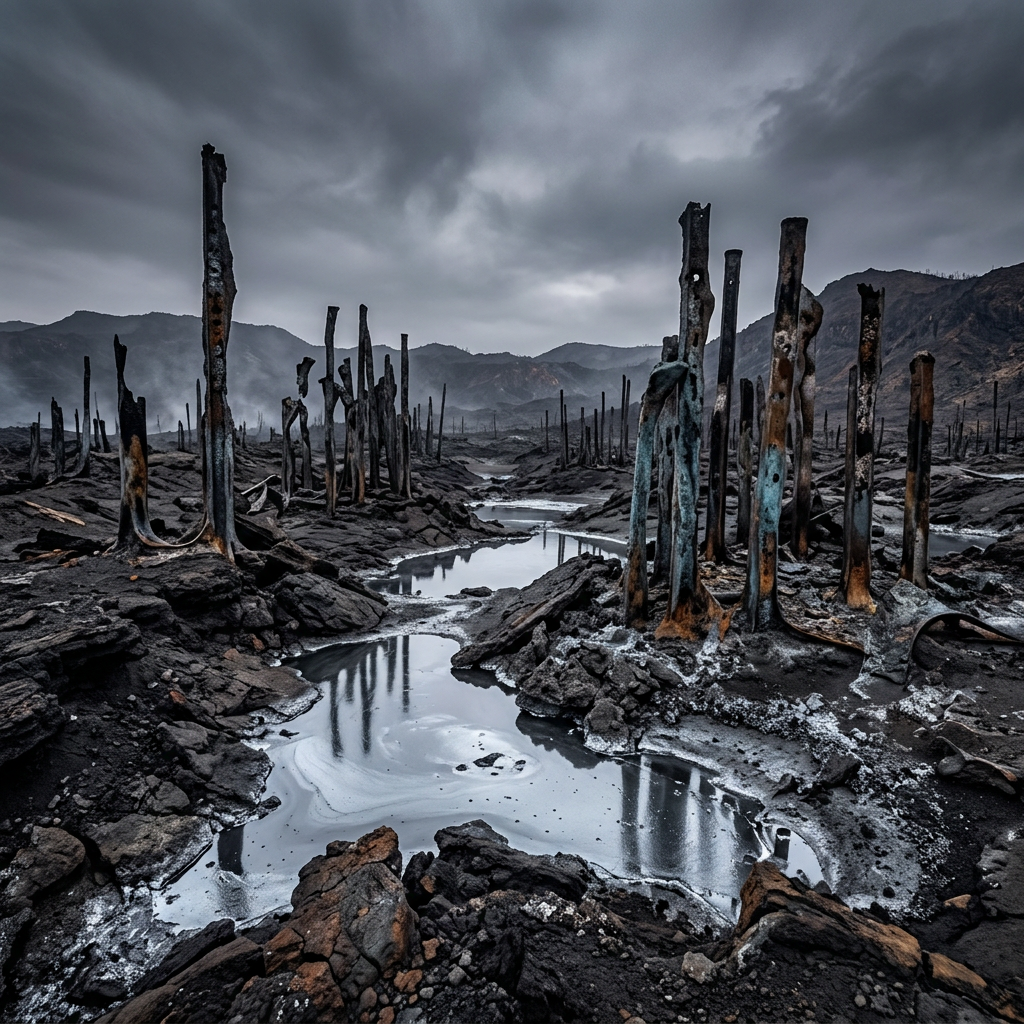
In the aftermath, the landscape of Río Grande was unrecognizable. The canopy had not merely fallen; it had merged with the ground. Sections of the structure, still glowing orange, sank into the soil like hot knives into butter. The earth, once overshadowed and kept cool by the artificial sky, now drank the metal as if quenching a millennia-long thirst.
What remained was a surreal terrain of blackened glass and twisted ruins, littered with puddles that hardened into sheets of bronze and steel. Birds returned cautiously, landing on metal branches that had once been parts of supports. The Wager-Sky, for all its hubris, had finally kept its oldest promise: it would never let the sun burn the people below. Now, it had become the very earth they walked on.
- Lasting effects:
- Soil contaminated with trace metals, creating a new ecosystem of hardy, metallic-hued plants.
- A permanent horizon of stumps and pillars—the broken teeth of the canopy.
- The phrase “under the Iron Canopy” became slang for any impossible, outdated system that eventually collapses under its own weight.
The judgment was harsh, but perhaps it was necessary. The Iron Canopy had sheltered Río Grande for too long, shielding its people not just from the sun, but from the sky itself—from the sight of stars, clouds, and the raw, unmediated weather of the world above. Now, the sky was open again, raw and beautiful and terrifying.
Conclusion
The falling of the Wager-Sky was not an ending, but a beginning—a forced return to a world without an artificial lid. The Iron Canopy’s judgment was a final act of mercy, clearing away a relic that had long outlived its purpose. In its place, the people of Río Grande inherited a naked horizon, a land made strange and new by fire and metal, and a painful lesson about the cost of trying to control the heavens. The canopy had fallen, but from its ruins, something else was already rising: a determination to live under the open sky, come what may.
Leave a Reply