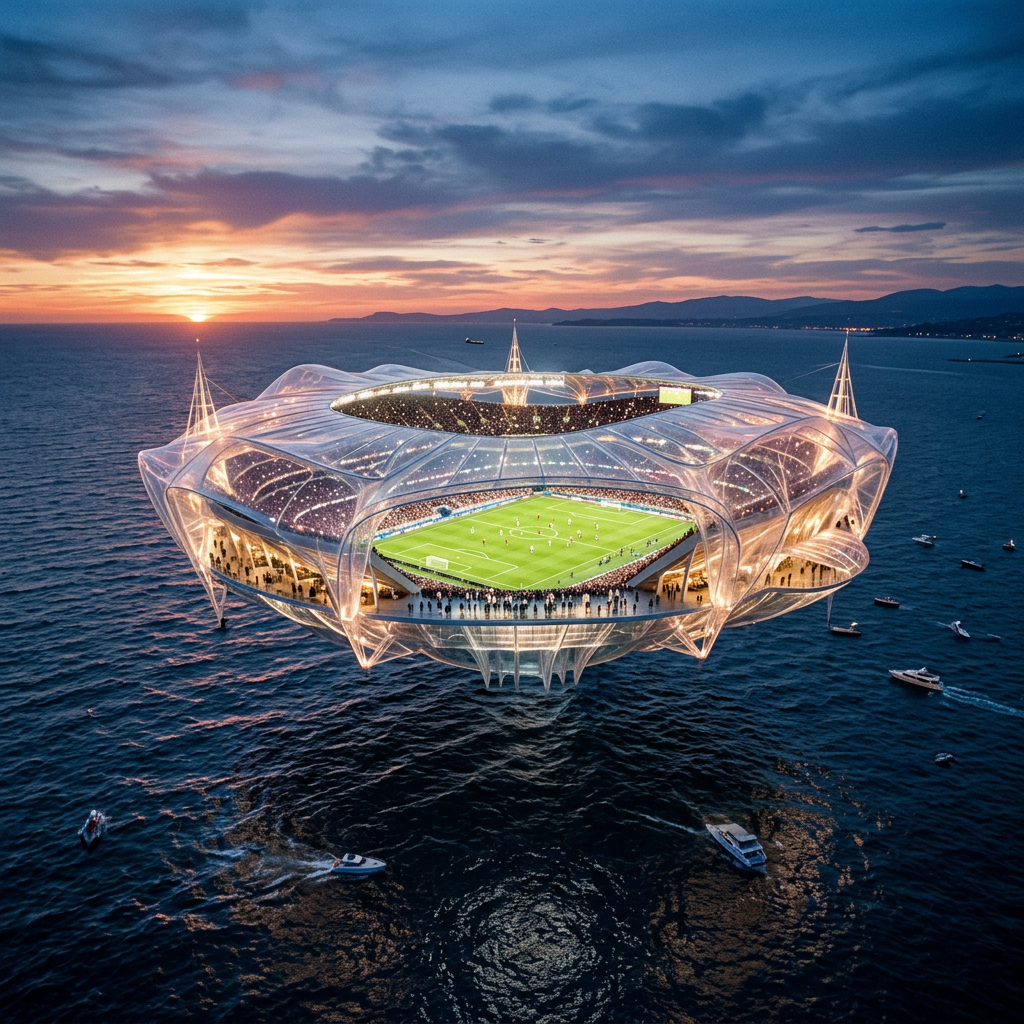
Every morning, as the city stirs to life, Mei Lin wheels her street cart to the corner of Jalan Pinang. She sells mie goreng with a secret spice blend, and she dreams of something the city has never seen. Not just a bigger cart or a permanent stall. Mei dreams of a floating stadium, a vast arena that hovers above the bay, lit by solar panels and powered by the tides. She sketches it on napkins between orders. It’s a ridiculous, beautiful vision—and no one takes it seriously. Until she overhears a conversation that changes everything.
The Dream: A Stadium Floating on Light
Mei’s dream isn’t just about architecture. It’s about fairness. In her vision, the Floating Light Stadium would host sports for everyone—kids from the slums, street vendors, factory workers—not just the wealthy elite. She pictures:
- A translucent dome that glows at dusk
- Seating made from recycled ocean plastic
- Ticket prices that cost less than a plate of noodles
- Energy harvested from the waves below
> “If you can sell noodles on a cart,” Mei often tells her regulars, “you can build a stadium on water. It’s just a bigger cart.”
But dreams, as she’s about to learn, have enemies.
Morning After: Eavesdropping on a Dark Plot
One Tuesday, Mei arrives early to find her usual spot occupied by a black sedan. Annoyed, she sets up nearby, hidden behind a stack of crates. Two men step out, speaking low. They don’t notice her. She hears fragments: “fair-sports quota,” “manipulate the next draw,” and “bury that floating idea before it floats.”
Her blood runs cold. These aren’t city officials or investors. They’re agents—and they’re plotting against the very system that could make her dream real. Mei scribbles what she hears on a napkin:
- Names: “Mr. Keppel” and “Agent Surya”
- Code words: “Project Anchor” and “Weighted Draw”
- A date: the upcoming International Youth Games
She realizes: the floating stadium isn’t just a pipe dream. To these men, it’s a threat.
Agents of Chaos: Targeting the Fair-Sports System
The fair-sports system is the backbone of the city’s athletic programs. It uses a transparent, algorithm-based selection process to give underprivileged kids a shot at scholarships and training. Mei’s stadium was designed to be its showpiece—a place where talent, not money, determined who played.
The agents, she later learns, work for a shadow network that profits from rigging these draws. They bet on outcomes, sell access, and pocket grants meant for poor neighborhoods. A transparent floating stadium, open to all, would expose their schemes. Their plan:
> Undermine public trust in the selection algorithm by planting false data. > Delay construction permits indefinitely using bureaucratic loopholes. > Discredit Mei as a “delusional vendor” to media outlets.
They even plot to bribe the architect Mei had contacted. For them, the stadium isn’t a dream—it’s a liability.
From Street Cart to World-Changing Vision
Mei faces a choice: stay silent and keep frying noodles, or fight. She chooses to fight—not with money or power, but with truth. She starts recording conversations on her phone, hiding it in her spice jar. She copies the napkin notes into a worn notebook. She talks to journalists, sports officials, and the very kids who would use the stadium.
Her street cart becomes a command center. Regular customers become informants. A retired engineer helps her refine the stadium blueprints. A young athlete shares her story of being cheated out of a tryout. Word spreads.
> “A street vendor,” one newspaper writes, “holds the key to cleaning up sports.”
Mei’s dream is no longer just about a building—it’s a movement.
Can One Woman’s Dream Save the System?
The climax arrives at the city council hearing on the stadium proposal. The agents are there, slick in suits. Mei is there too, in her apron, with a folder of evidence. The room is packed. The council chair calls for order.
Mein stands up. She doesn’t yell. She reads from her napkin notes. She plays the recordings. She names names. The council members shift uncomfortably. The agents try to leave, but security holds the doors.
In the end, the floating stadium is approved—with added transparency measures. An investigation into sports corruption is launched. Mei’s cart becomes a landmark. She still sells noodles, but now she also sells hope.
The lesson? Dreams don’t need funding first. They need courage. And sometimes, the best weapon against chaos is a street vendor with a notebook and a dream that glows.
Conclusion
Mei Lin didn’t set out to save the system. She just wanted a floating stadium where every kid could play. But in fighting for her light, she exposed the darkness hiding in plain sight. Her story reminds us that the most powerful agents of change aren’t always in boardrooms—sometimes they’re on street corners, serving noodles and sketching impossible things. The Floating Light Stadium may still be years away, but its first victory was already won: the belief that fairness is worth fighting for.
Leave a Reply