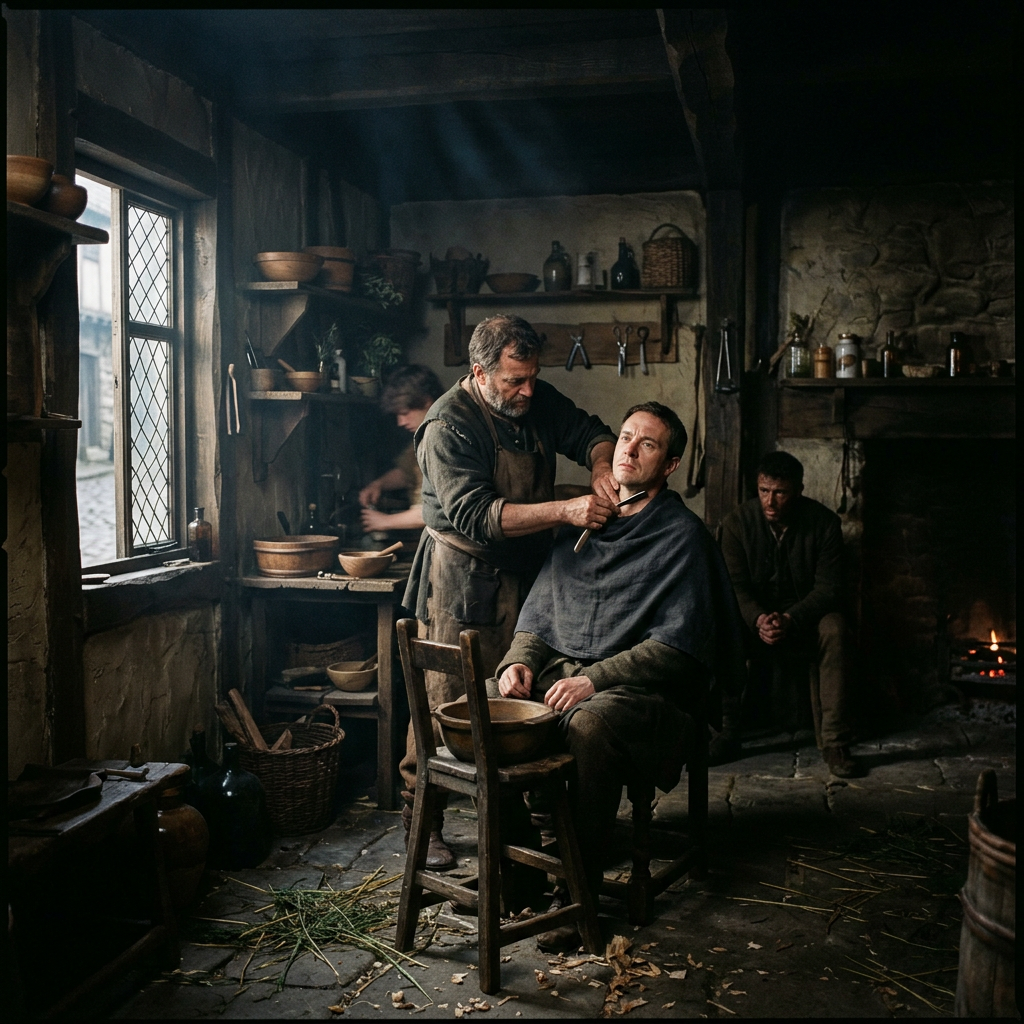
The Silent Tray of Secrets
In the bustling heart of a medieval European kingdom, a man named Eldric lived an unremarkable life. He was a barber—steady hands, quiet demeanor, and a shop tucked away on a cobbled street where the smell of lye soap and sharpened steel hung in the air. Eldric’s clients trusted him with their lives, not just because of his skill with a razor, but because he was known for one thing above all: absolute discretion. He never repeated a rumor, never traded a secret for gossip. His chair was a sanctuary, and his silence was a contract. But some secrets, once heard, are not meant to be kept. And some prices are too heavy for any man to pay.
When Foam and Blades Uncover Plots
It began on a foggy autumn afternoon. A nobleman named Lord Vesper—a man whose beard had been trimmed by Eldric for years—sat stiffly in the leather chair. The scrape of the straight razor against his jaw was the only sound. Then, in a low murmur, Lord Vesper spoke of a secret alliance forming against the king. He spoke of midnight meetings in a forgotten abbey, of letters sealed with green wax, and of a plan to place a distant cousin on the throne. Eldric’s hand did not waver, but his heart pounded. He lathered the foam, careful to show nothing on his face. The nobleman, perhaps emboldened by the shaving foam and the soothing rhythm of the blade, continued:
> “A barber’s ears are his master’s property, but I entrust my throat to you. I know you will speak of this to no one.”
Eldric nodded, wiping the blade on a linen cloth. But the secret had already infected him like a slow poison. Over the following weeks, pieces of the plot fell into place. A merchant whispered about “a shipment of arms to the northern border.” A priest confessed “fears of the coming storm” while getting his tonsure trimmed. Each snippet added weight to a truth that was growing too large for one man to carry.
A Whisper That Shook the Kingdom
Eldric had a choice. He was a simple barber—he had no army, no titles, no influence. But he had duty. Late one night, he penned an anonymous letter to the king’s royal steward, detailing the names and locations he had heard. The parchment was sealed with wax, and he slipped it under the castle gate like a thief. What happened next was a storm: soldiers raided the abbey, letters were seized, and Lord Vesper was arrested in his own chambers, still wearing his nightcap. The king’s throne was saved. But the realm did not celebrate the anonymous informant. Instead, whispers began: “Who among us is a spy?” The court became a nest of suspicion. And Lord Vesper, from his dungeon cell, swore vengeance.
The Price of an Unheard Truth
Eldric’s shop remained open, but the air changed. Clients who once laughed and shared stories now sat in silence, watching him with narrowed eyes. A man’s throat is vulnerable under a blade, and trust is fragile. Then, one evening, a knock came at his door. A royal guard stood outside, holding a sealed decree. Eldric was accused of high treason—a charge that stemmed from whispers that he had “overheard and repeated” secrets that endangered the realm. The irony was brutal: by saving the kingdom, he had condemned himself. He was brought to the town square, where the crowd gathered. They had loved him once for his discretion; now they despised him for breaking it.
> “The truth is a blade that cuts both ways. He who speaks it becomes a target.”
From Barber Chair to Battlefield
Eldric did not face the executioner’s ax. Instead, the king—perhaps out of a grudging respect—offered him a choice: execution or exile to the frontier. He chose the latter. He became a field medic, tending to soldiers’ wounds with the same steady hands that once trimmed noble beards. On the battlefield, he was known as “the silent healer,” a man who never asked questions and never answered them. He had learned a terrible lesson: some truths are not meant to be traded, even for the good of the realm. The price of speaking is often one’s place in the world. And in the end, a barber’s greatest strength is not just in listening, but in knowing when the heard truth becomes a burden too heavy for any chair to hold.
Conclusion
Eldric’s story lingers like the smell of soap in an empty shop. It reminds us that the line between silence and speaking is not always clear. In a world of plots and power, the simple act of listening can become an act of war. And sometimes, the heaviest price is not paid by the one who hears a secret, but by the one who chooses to repeat it—even for the right reasons. In the end, the barber who heard too much paid with everything but his life. And that, perhaps, is the most haunting lesson of all.
Leave a Reply