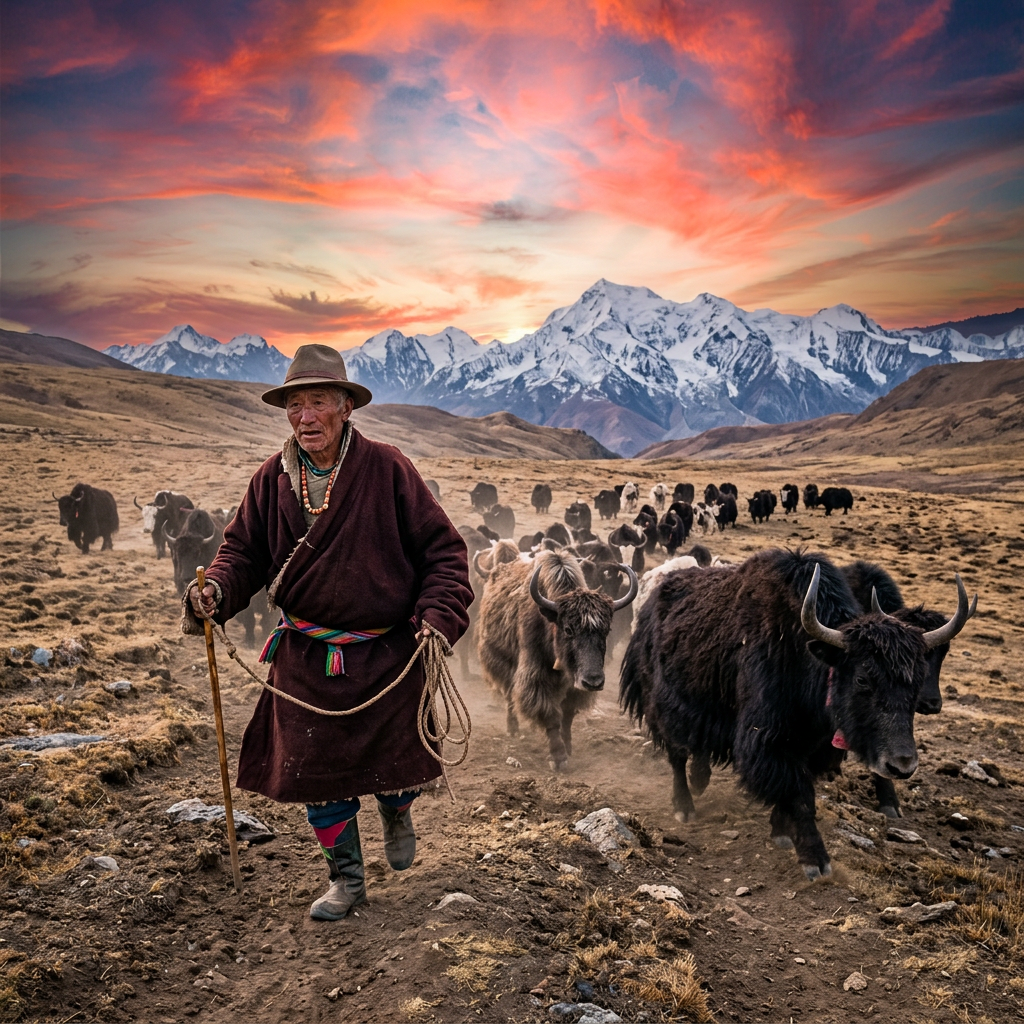
High on the windswept plateaus of Central Asia, where the sky scrapes the earth and the grass whispers in a language older than empires, lived a man whose name has been forgotten by the maps but whose vision is now scribbling itself across the ledgers of time. He was a yak herder. Not a financier, not a tech mogul, not a politician. He was a man who moved with the seasons, who read the stars for weather and the soil for sustenance. And one night, after a long day of tracking a stray calf through a blizzard, he dreamed a dream that did not end.
That dream, as he told it to his grandchildren, was a new economy.
The Vision on the Plateau
The herder’s world operated on a logic foreign to our own. In his economy, value was not a number on a screen. Value was the thickness of a yak’s coat before winter, the resilience of a horse to cover thirty miles in a day, the knowledge of which herbs could heal a fever. It was an economy of reciprocity and intrinsic worth. The herder did not “sell” his milk; he shared it with the neighbor whose flock was lean, knowing that next year, the favor would return as wool or labor or stories.
In his dream, he saw the modern world. He saw vast cities of glass and steel, where people rushed past each other without seeing, where value was a phantom that grew or vanished with the whim of a trader. He saw rivers of money flowing uphill, concentrating in pools that never touched the parched earth. And he wept in his sleep. But then, the dream shifted. He saw a thread of gold connecting every exchange, every act of care, every shared resource. That thread was not money. It was trust, verified not by a bank, but by the community itself.
> “The mountain does not ask the river for interest. The river gives, and the mountain holds the rain for the river’s return. This is the original balance.”
He woke with a start. The vision was not a rejection of progress; it was a blueprint for its redemption.
Signals from the Dreaming
The herder began to “translate” his dream into signals the modern world could understand. He started calling his grandchildren—one who had gone to the city to study engineering. He would send them peculiar drawings on birch bark. A circle with a yak at the center. A scale with a healthy meadow on one side and a profit margin on the other.
He identified three key signals from the modern chaos that matched his dream:
- The Decay of Trust: He saw that people no longer trusted institutions but did trust each other in small, digital groups. This was the “herd instinct” he knew so well.
- The Paradox of Abundance: In the city, food was thrown away while people starved. On the plateau, a bumper crop of berries was a reason for a community feast. The signal was that our systems for allocating abundance were broken.
- The Silence of Nature: He noted that no market price ever accounted for the cost of a polluted river or a silent forest. In his dream, the forest had a vote, cast through the health of the stream.
He taught his grandchildren to stop looking for solutions in the headlines and instead to look for the anomalies—the small, strange places where the old logic was already being reborn.
Hunters of the Anomaly
These grandchildren became the first “anomaly hunters.” They did not invent new systems; they discovered them. They traveled the world with their grandfather’s lens, looking for the same principles he lived by.
What did they find? They found:
- Time Banking: Communities where one hour of your labor (childcare, plumbing, teaching) was worth one hour of another’s, regardless of skill level. A direct translation of the herder’s “shared flock” principle.
- Regenerative Agriculture: Farmers who saw their land not as a factory for calories but as a living system. They measured success by soil depth and water retention, not yield per acre. This was the yak herder’s calculus: the health of the whole.
- Local Mutual Credit: Artisans and grocers in a village creating their own currency to trade with each other, bypassing the global fiat system. They were building a new “plateau” economy in a city borough.
> To hunt an anomaly, you must first stop fearing what looks like inefficiency. The grass grows slowly, but it feeds the world.
The herder’s vision was not a return to a romantic past. It was a hunting expedition for a future that already existed, scattered in fragments, waiting to be re-assembled.
The Technology of Balance
The most profound part of the herder’s dream was the tool he imagined to connect these fragments. He did not see a blockchain (he had never heard of it), but he saw its soul: a distributed ledger of gratitude and impact.
He called it “the Technology of Balance.” It was not a software; it was a protocol for human behavior. It had three immutable laws:
- Every Contribution Counts: From the grandmother sewing a coat to the engineer fixing a solar panel. Value is multi-dimensional.
- Feedback is Immediate and Local: You see where your surplus goes. You see the child who wears the coat you mended. The loop is closed.
- The Common Good is a Co-Inventor: The forest, the river, the soil—they are stakeholders. Their “proxy votes” are casts by the collective health of the ecosystem.
The herder’s technology is now being prototyped. Not by a corporation, but by a consortium of co-ops, indigenous communities, and open-source developers. They are building tools that measure a farmer’s carbon sequestration with the same precision that Wall Street measures a stock’s P/E ratio. They are creating “holochains” of value that track a product’s journey and give a “voice” to every hand that touched it.
A New Economy Awakens
The yak herder’s dream is not yet reality, but it is no longer a secret. A new vocabulary is emerging from the plateau to the boardroom. Terms like “regenerative economics,” “doughnut economics,” and “prosperity without growth” are gaining traction.
This new economy does not have a single flag. It is polycentric, like the herder’s scattered camps. It is waking up in thousands of places:
- In community land trusts that remove housing from the speculative market.
- In “low-profit” companies that cap their returns to reinvest in mission.
- In seed libraries that treat genetic diversity as a sacred public good.
The herder was not a prophet. He was a human being who paid attention. He saw that the economy is not an external machine we must feed; it is a conversation we are having with each other and with the earth. He taught his grandchildren that poverty is not a lack of money but a severing of relationships.
Conclusion
The story of the yak herder who dreamed the world a new economy is not a fairy tale. It is a compass. It reminds us that the solutions to our most complex problems are already encoded in the simple, resilient systems that have survived for millennia. The herder’s greatest gift was not a plan, but a permission—permission to imagine an economy where value flows from care, where growth is measured in health, and where the poorest neighbor still has a seat at the table of the world’s wealth.
He passed away peacefully, under the same stars he had always followed. But as he closed his eyes for the last time, he smiled. Because in the flickering campfires of a thousand villages and the glowing screens of a thousand co-ops, his dream was still dreaming itself awake.
Leave a Reply