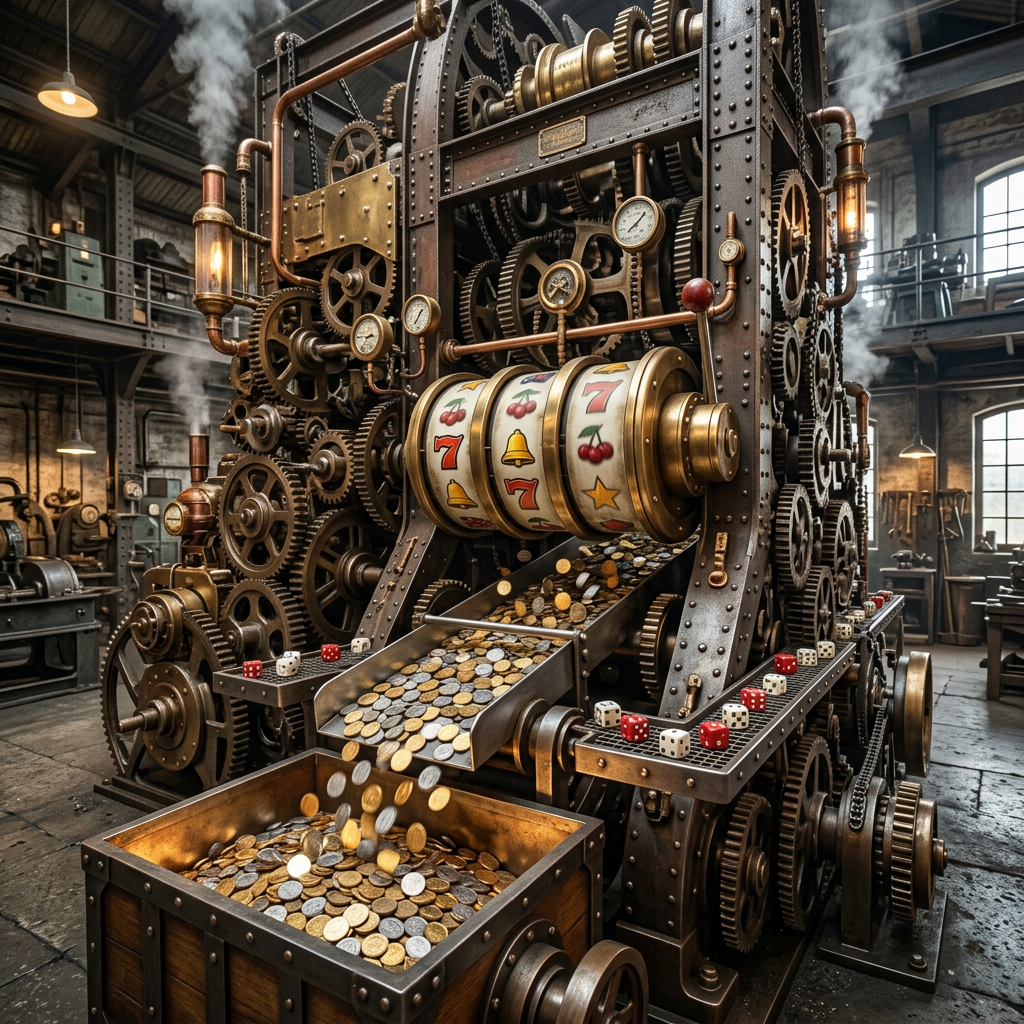
The Gambling Engine: A Secret History of Control
It begins not with dice, but with a coin toss. A glint of bronze, a thumb flick, and the fate of a Roman soldier was sealed—heads we advance, tails we retreat. For millennia, humanity has used randomness as a decision-making tool, a way to offload responsibility to the capricious gods of chance. But what if the relationship was always inverted? What if randomness wasn’t a tool we wielded, but a chain we forged for ourselves? From the first temple oracle casting lots to the modern algorithm curating your newsfeed, a hidden engine has been humming. This is the story of how a simple principle—uncertainty—became the most effective leash ever designed for the human will.
How Randomness Became Humanity’s Invisible Leash
The leash is invisible because it is woven into the fabric of our daily rewards. Consider the core mechanics:
- Intermittent Reinforcement: The slot machine doesn’t pay out every time. It pays out sometimes. Our brains are wired to crave this unpredictable reward, releasing dopamine more powerfully than for predictable outcomes.
- The Illusion of Agency: Choosing a “lucky” number or a specific card sequence makes us feel in control, even when the outcome is purely random. This keeps us engaged, pulling the leash tighter.
- Social Scalability: Gambling isn’t just about casinos. It’s in surprise mechanics in video games, random loot boxes, and mystery discount offers. Every click on a “spin to win” button is a tug on the chain.
> “The house doesn’t need to cheat. The game itself is the trap. The randomness isn’t the bug; it’s the feature that keeps you coming back.”
The true power of this leash is that it reconditions our expectations. A life governed by the principle of “one more spin” is a life that tolerates stagnation, hoping the next random event will be the jackpot. It replaces strategic planning with impulsive reaction.
The Ledger vs. The Continuum: Order or Chaos
Two forces have always competed for the soul of humanity. On one side stands The Ledger—a symbol of linear, predictable, cause-and-effect order. It represents the farmer who plants a seed knowing harvest will come, the builder who lays bricks in a straight line, the scientist who trusts a replicable experiment.
On the other side flows The Continuum—the chaotic, entropic river of pure randomness. This is the gambler’s universe, where outcomes are fully decoupled from effort. In The Continuum, a sudden windfall matters more than a lifetime of steady work.
| The Ledger | The Continuum |
|---|---|
| Long-term planning | Short-term spikes |
| Effort equals reward | Luck equals reward |
| Predictable stability | Chaotic volatility |
| Creates sustainable systems | Creates addicts |
The modern world, driven by algorithmic capitalism, has deliberately blurred the line between the two. We are told to work hard (Ledger logic) but trained to expect sudden, random success (Continuum logic). The result is a population that is always waiting for a miracle rather than building a foundation. Our attention is the stake on the table, and the house always wins.
Inside the Vault: The Revelation of the True Enemy
Who designed this engine? It is not a single villain, but a system that evolved organically across centuries. The true enemy is the architecture of dependence itself. The first enemy was the fear of uncertainty—we gambled to invite fate’s favor. The second enemy was our own biology—our dopamine reward system hijacked. The third and final enemy is social inertia.
The Gambling Engine thrived because it aligned perfectly with power structures:
- Governments love lotteries because they are voluntary taxation.
- Tech platforms love algorithmic feeds because they maximize engagement through unpredictable rewards.
- Financial markets love volatility because it creates liquidity and profit from anxiety.
The enemy is not “gambling” as a vice. The enemy is the normalization of randomness as a governing principle for human life. When society prioritizes the jackpot over the job, the viral hit over the masterwork, the lucky break over the learned skill, it has placed its faith in the Gambling Engine. And the engine has no mercy.
> “A society that worships randomness will inevitably reward the fool who stumbles over the sage who walks.”
The Entropy Engine: The Final Weapon Against Freedom
If the Gambling Engine is the leash, The Entropy Engine is the antidote—the reclamation of self-determined direction. Entropy is not just chaos; it is the natural tendency toward disorder. But in a human context, we can use it as a force of creative destruction.
To break the leash, we must flip the principle on its head:
- Embrace deliberate uncertainty. Do not let randomness choose for you. Instead, introduce controlled randomness into your own life—take a different route, learn a skill outside your comfort zone, disrupt your own patterns before the algorithm does.
- Build your own Ledger. Keep a personal record of effort-to-outcome. When you experience a loss (a bad spin, a failed investment), do not chase it. Close the ledger and walk away. Accept the cost of randomness.
- Reclaim boredom. The Gambling Engine needs constant novelty to stay powerful. Boredom is its kryptonite. Let yourself sit with emptiness. The urge to pull a lever will fade.
- Invest in compound returns. Seek activities where effort accumulates predictably over time: learning a language, building a relationship, writing a book. These are anti-random.
- Resist the narrative of the big win. The lottery winner is statistically likely to be bankrupt in five years. Recognize that the story of the lucky breakthrough is a lure, not a lesson.
The Entropy Engine is not about eliminating luck—that is impossible. It is about claiming sovereignty over where you place your focus. Randomness will always exist; the question is whether you dance for it or let it dance around you. The final weapon against the leash is the conscious decision to value the process over the prize, the path over the chance.
Conclusion
The Gambling Engine did not emerge from a shadowy cabal; it grew from a billion tiny decisions to outsource our agency. From the first carved die to the last swipe on a screen, randomness has been both a tool for decision-making and a gilded cage for the soul. The leash is real, but it is self-imposed. It tightens every time we hope for a miracle instead of building a ladder.
To remove the leash is not to reject fun or spontaneity. It is to understand where the control resides. The continuum of chaos can never be abolished, but it can be compartmentalized. We can enjoy a roll of the dice without letting it govern our destiny. The choice remains ours: live as a gambler waiting for the next spin, or as a creator shaping a world where the ledger of our own effort is the only balance that truly matters. The engine runs on your attention. Starve it, and the leash falls away.
Leave a Reply