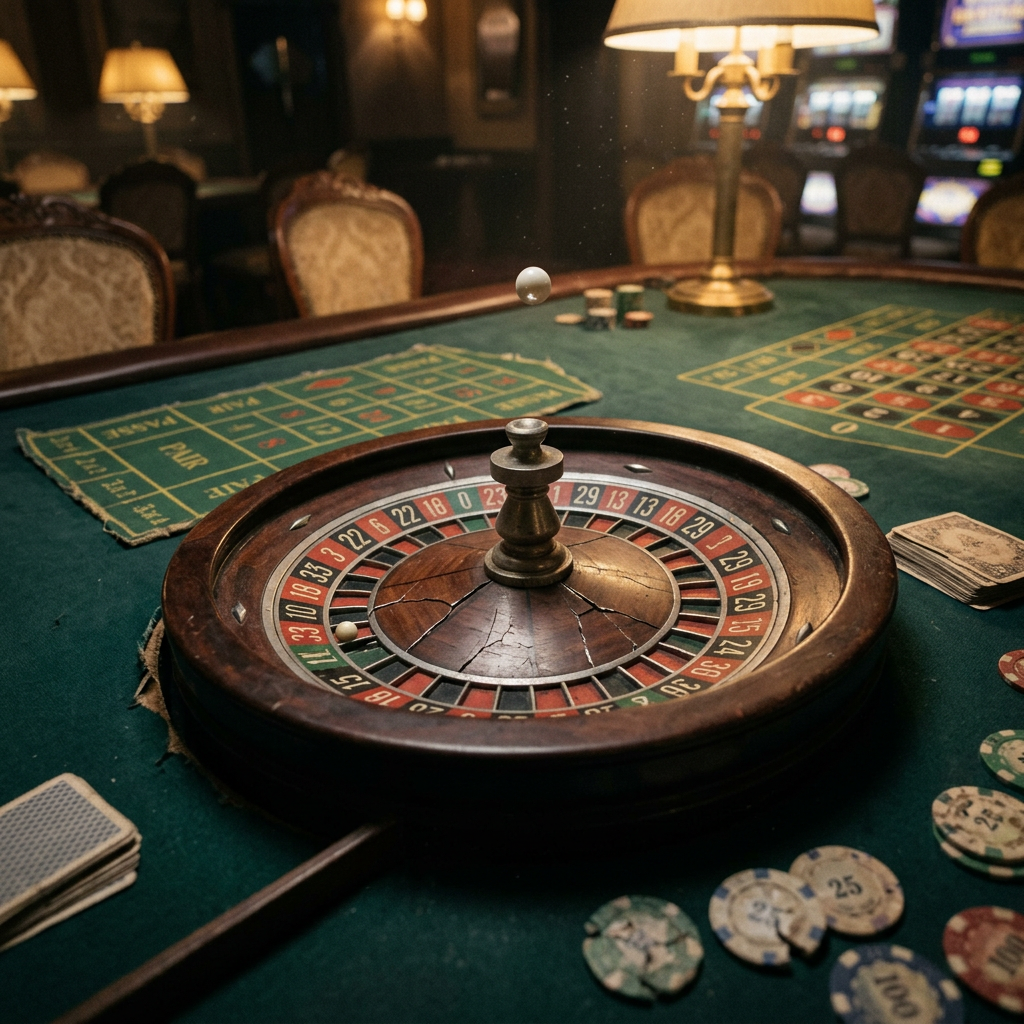
It began not with a bang, but with a whisper—a phantom shift in the algorithms that governed every spin, every shuffle, every roll of the dice. For centuries, humanity had danced with chance, lured by the promise of fortune against the house’s immutable edge. But on that singular night, the ancient compact was broken. The odds, once the bedrock of probability, simply died. And when they did, the world shuddered.
The Ledger Unleashed: Gambling’s Final Hour
The first sign came in Monte Carlo. A roulette wheel landed on double-zero seven times in a row. The pit boss laughed it off as a statistical fluke—until the same sequence repeated in Macau, then Las Vegas, then a floating casino on the Danube. Systemic anomaly wasn’t in the lexicon; chaos was.
- Tables that once paid out at 35:1 for a single number began paying random amounts—sometimes 1,000:1, sometimes nothing.
- Slot machines displayed reels of pure nonsense: tulips, mathematical symbols, and laughing skulls.
- Blackjack dealers drew to 21 without rules; the deck seemed to rearrange itself mid-hand.
Tip for survivors of that night: > Never trust a dealer’s smile when the house edge evaporates. The casino isn’t losing—the universe is rewriting its own math.
Punters who had bet their life savings staggered out, not richer or poorer, but unsettled. One man won the lottery jackpot three times in two hours; another flipped a coin that landed on its edge for an entire minute before dissolving into dust. The old mechanisms of risk and reward had been unplugged.
Casinos Fall Silent as the House Edge Vanishes
By midnight, every major gambling hub on Earth had gone dark. Not because of power failure—because the games no longer made sense. In Singapore, a baccarat shoe produced nothing but aces. In London, a poker table dealt a royal flush to every player simultaneously. The house edge—that sacred 1–5% advantage the casino always held—had vanished like morning fog.
What replaced it was pure uncertainty. The casinos tried to shutter their doors, but crowds demanded answers. They weren’t angry; they were fascinated. Some saw it as divine intervention; others, a glitch in reality’s operating system.
- Poker rooms became forums for philosophical debate about free will.
- Sportsbooks displayed odds of 1:1 for everything—a horse, the weather, the next sunrise.
- Slot machine attendants wept as coins spilled from machines that had no programmed payouts.
A famous quote from the historian Dr. Elara Vance: > “We spent millennia trying to beat the house. We never imagined the house could simply quit. The game didn’t end in a win or loss—it ended in a sigh.”
A World Without Odds: Systems Crash in Chaos
The chaos didn’t stay confined to casinos. Insurance companies, stock markets, and weather prediction models all relied on the same underlying mathematics of probability. With the odds dead, the pillars of modern civilization began to crack.
- Stock exchanges saw algorithms go haywire: shares of companies like “Toothpick Manufacturing Ltd.” suddenly valued at trillions.
- Weather forecasts became useless; every report now said “maybe rain, maybe not, with 15% chance of existential dread.”
- Insurance policies were voided overnight—actuarial tables were now historical fiction.
Key observation: > When risk becomes unpredictable, safety becomes a memory. The world had bet on certainty, and the odds had folded.
Human behavior mirrored the madness. People began making decisions based on whims, not calculations. Rock-paper-scissors ended in ties for hours. Coin tosses were replaced by “I feel lucky” and “I feel unlucky.” The concept of a sure thing became an oxymoron.
Protocol Black Sun: The Continuum’s Last Gambit
Amidst the global confusion, a group known only as The Continuum activated a long-dormant protocol called Black Sun. Their mission: to restore the concept of odds before the universe collapsed into pure, meaningless chance. They believed the death of probability was not a bug but a feature—a reset button pressed by the universe itself.
Their plan was audacious:
- Isolate a single casino in the Nevada desert, shielded from the anomaly by quantum decoupling.
- Reboot the house edge using a black hole’s event horizon as a random number generator.
- Convince fate to play one last hand—poker, no limit, against the void itself.
A line from the Continuum’s manifesto: > “We are not gamblers. We are the croupiers of reality. The odds didn’t die—they were waiting for a better game.”
The world held its breath as the first cards were dealt. The deck didn’t shuffle itself; it waited, patient, as if the universe wanted to see if humanity still knew how to bet.
No Randomness Left: The System Shakes to Its Core
The final spin came at dawn. In the Nevada blackout, a single roulette wheel began turning. No one watched the ball—they watched the wheel. It wobbled, hummed, then clicked into place. Zero. The house had won. In that moment, the odds flickered back to life, like a light in a dark room.
But the world was never the same. The system had been shaken to its core:
- Randomness now had a personality: sometimes generous, sometimes cruel, always aware.
- Probability carried a whisper of sentience, as if numbers had learned to dream.
- Humanity now gambled with the knowledge that the house might, at any moment, change the rules.
Advice for the new world: > Never assume the odds are fixed. The universe is a game that loves to surprise itself. Place your bets with humility, and be ready to laugh at the results.
Conclusion
The night the odds died was a mirror held up to human fragility. We had built empires on the illusion of control, on the assumption that chance was mute and pliable. But when the randomness stopped being random—or became too random—we saw the lie beneath. The world shook, not because it broke, but because it realized that every roll of the dice is a conversation with the infinite.
Today, casinos still run, but the slot machines have a new button: “Surprise Me.” Insurance policies include a clause for “Acts of Cosmic Whim.” And every poker player knows that the deck might, just might, deal itself a hand that tells a story.
The odds didn’t die. They just decided to speak.
Leave a Reply