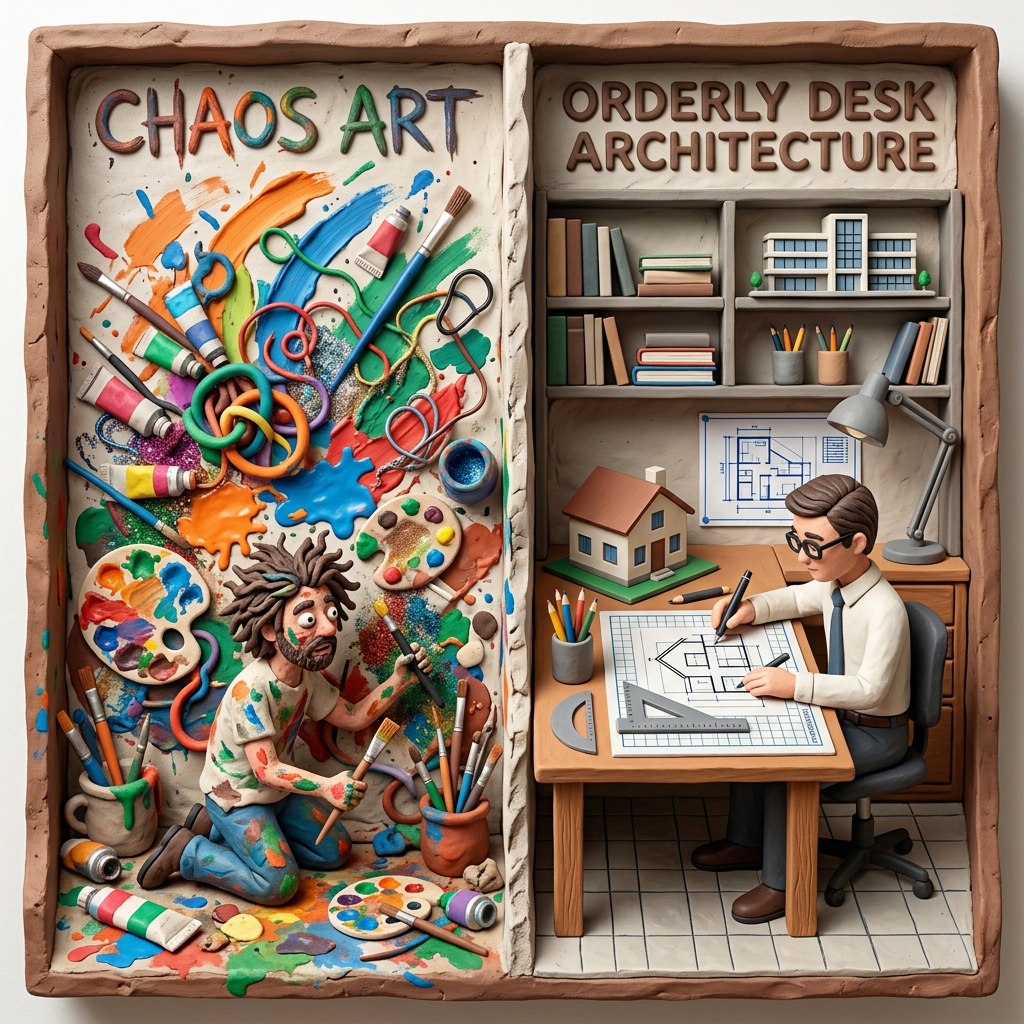
There exists a curious paradox in how we treat the concepts of balance and chaos. We are taught that balance is good—a ledger neatly zeroed out, a life free of turbulence, an economy that grows in predictable increments. Yet, we secretly crave the opposite. We pay for horror movies, we stare at abstract art that looks like a tantrum on canvas, and we applaud the dancer who nearly falls but does not. The truth is, we have swapped the domains. We have applied rigid order to the very place where it suffocates us—our economies—while trying to sterilize the one place chaos must live: our art.
This misunderstanding has led to a world where financial systems are treated as sacred texts, while creative expression is sanitized for mass appeal. It is time to forge a new covenant: Chaos in Art, Never in Economics. Let us explore why.
The Chaos Seed and the Balanced Ledger
Every great act of creation begins with a disruption—a “chaos seed.” Think of a musician dropping a wrong note that becomes a signature riff, or a painter flicking a brush in frustration, creating an unexpected galaxy of color. This is not an accident; it is the voluntary embrace of entropy.
- Art needs risk: The most memorable works are those that teeter on the edge of failure.
- Creativity feeds on uncertainty: A blank page is terrifying, but the terror is fuel.
- The “happy accident” is a myth: Great artists learn to surf the waves of chance, not control the ocean.
Conversely, a balanced ledger is the foundation of survival. Your household budget cannot have a “chaos seed.” A company’s cash flow cannot rely on dramatic, unpredictable swings to remain solvent. The ledger must be boring. It must be stable. When we mistake the economy for a canvas, we catastrophize it. We treat market dips like artistic critiques, and we demand that our financial systems be “inspired” rather than reliable.
Why Order Must Fall for Art to Thrive
Order is the enemy of expression. When a creative pursuit becomes too predictable—too “balanced”—it decays into decoration. It becomes wallpaper. This is why genres die and are reborn only when someone breaks the rules.
Consider the constraints of form:
- Haiku poetry: 5-7-5 syllables. Rigid. Yet the power lies in the tension between that order and the chaotic emotion stuffed inside.
- Jazz music: A structured chord progression (order) is used as a trampoline for improvisation (chaos).
- Abstract expressionism: The canvas is a battlefield where order is deliberately shattered.
> Important: Art that exists only to please an algorithm or a focus group has traded its soul for safety. True art requires the courage to make the viewer uncomfortable, to break the symmetry, to let the glaze crack.
The reason order must fall is simple: predictability creates boredom, and boredom is the death of the human spirit.
Unpredictability in Life, Not in Economics
Here is where the covenant becomes binding. We are creatures of narrative. We love a plot twist—in a book. We hate a plot twist when it arrives as a surprise hospital bill or a sudden layoff.
- In life (art, relationships, hobbies): Welcome unpredictability. Take a different route to work. Learn to paint with your non-dominant hand. Say yes to a strange invitation. Here, chaos enriches your soul.
- In economics (survival, infrastructure, policy): Build for stability. Predictable interest rates. Transparent tax codes. Reliable supply chains. Here, chaos destroys lives.
The modern tragedy is that we have reversed these roles. We try to make our love lives as predictable as a spreadsheet, while encouraging our economies to be “disruptive” (a euphemism for “unstable”). The result? Boring romance and terrifying recessions.
> Covenant Rule #1: Let your weekends be unpredictable. Let your retirement fund be boring.
The Birth of the Second Age of Performance
We are currently witnessing a shift. An emerging generation of artists is rejecting the polished, sterile perfection of the “First Age”—where digital tools could erase every flaw and algorithms optimized every story. We are entering the Second Age of Performance, where authenticity trumps perfection.
This age is defined by:
- The raw take: Unedited YouTube videos, live podcasts with mistakes, and “lo-fi” aesthetics.
- The intentional flaw: A visible brushstroke, a crack in the glaze, a voice crack in a song.
- Performance as a shared risk: The audience knows the tightrope walker could fall. The tension is the art.
> Tip for Creators: Do not polish until the soul is gone. Leave the mark of human error. That is where the connection lives.
This age recognizes that a perfectly balanced work is a dead work. The performance—whether on stage, on canvas, or in code—requires the element of danger. Without chaos, it is just a demonstration.
A Covenant: Chaos in Art, Never in Survival
We must make a pact with ourselves. This is the Covenant of Balance—not a balance between day and night, but a balance of domain.
- Domain A: Art, Spirit, and Experience. Here, chaos is king. Invite the storm. Break the symmetry. Be messy.
- Domain B: Economy, Safety, and Survival. Here, order is necessary. Build the shelter. Pay the bills. Plan for ten years.
The danger is cross-contamination. When we treat our economy like an art project (e.g., “creative destruction” without a safety net), we create suffering. When we treat our art like a business projection (e.g., making films based on market data), we create soulless products.
How to apply the covenant daily:
- In your workspace: Structure your hours (order) so that you can be chaotic in your thinking (art).
- In your finances: Maintain a stable, boring budget (survival) to fund your wild, expensive hobby (art).
- In your relationships: Be reliable in your commitments (survival), but spontaneous in your affection (art).
The covenant is not about rejecting order or worshiping chaos. It is about giving each its proper throne.
Conclusion
We are not meant to live in a perfectly balanced machine. The human spirit needs a place to scream, to paint, to write a bad poem. That place is art. But we also need a floor beneath our feet—a stable foundation of economics that does not collapse on a whim.
The covenant is simple: Keep the chaos in the gallery, the order in the ledger. Let the unpredictable storms rage only in the creative mind, where they can birth new galaxies, not in the bank account, where they birth ruin.
If we can honor this distinction, we will live richer lives—full of beautiful, broken, brilliant art, and sustained by systems that are quiet, calm, and safe.
Leave a Reply