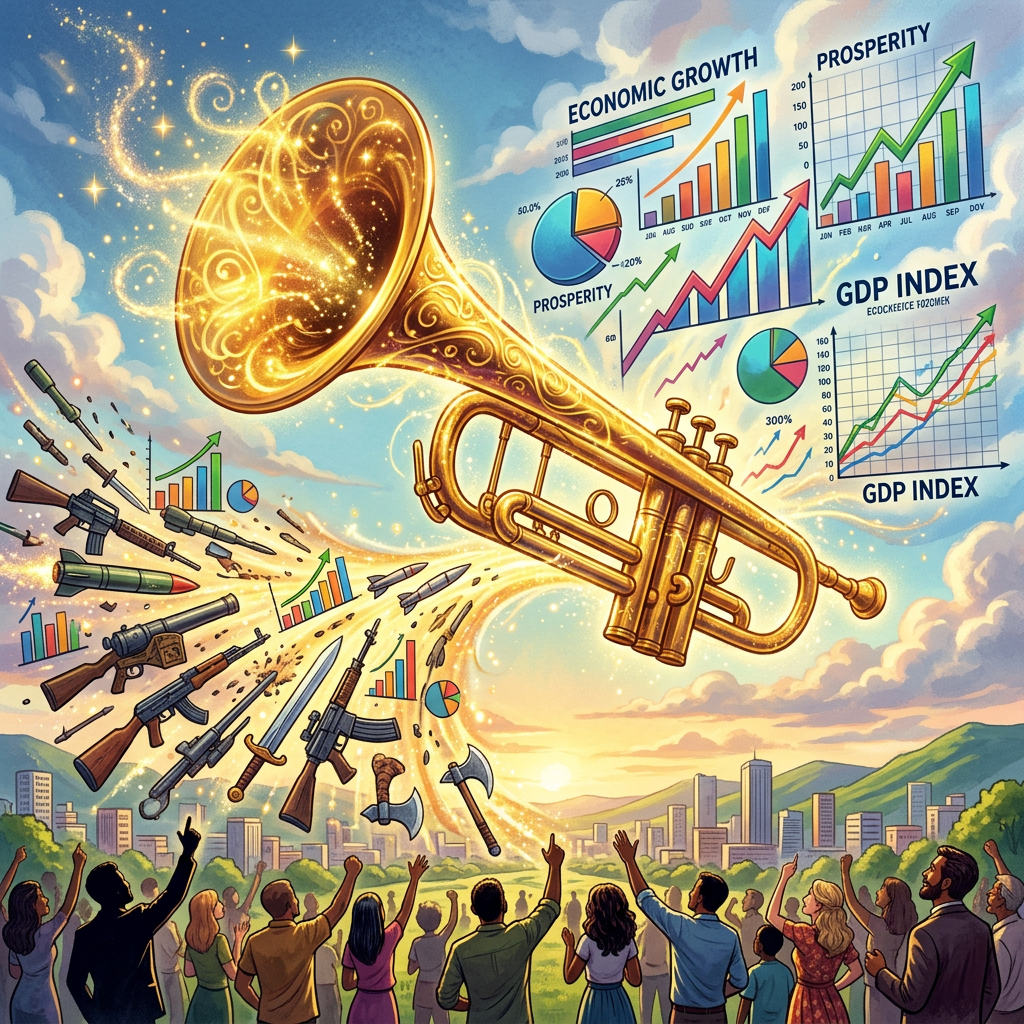
When the last cannon falls silent, it is not always because a treaty has been signed or a dictator toppled. Sometimes, the most powerful armies retreat because the cost of conflict simply no longer makes sense. This is the story of how economic performance began to outshine military aggression, and how a single, subtle sound—the trumpet of shifting priorities—ushered in a new era.
The Ledger That Silenced the War Machines
For centuries, nations measured their power by the size of their armies and the reach of their navies. War was the ultimate tool for expansion. But in the modern world, a new ledger emerged. This ledger didn’t count soldiers or tanks; it counted patents, productivity, and human capital.
Consider the shift:
- GDP per capita replaced territorial conquest as a status symbol.
- Innovation cycles became more valuable than territorial buffer zones.
- Global supply chains made economic interdependence a stronger deterrent than nuclear stockpiles.
When a country’s tech startups generate more revenue than its entire defense budget, the logic of war begins to crumble. Why risk destroying a $10 billion semiconductor factory for a patch of disputed land worth $10 million? The numbers simply no longer add up.
> “The strongest economy doesn’t need the biggest army; it needs the most resilient talent.”
Generals Raged as Wealth Shifted to Human Performance
This transition was not peaceful. Military establishments, which had enjoyed decades of unquestioned funding and political clout, fought back. Generals raged in closed-door meetings, arguing that national security required a constant state of readiness and hardware supremacy.
But the wealth was moving elsewhere. Private companies, not armies, became the primary drivers of national influence. The key metrics of power evolved:
- Human performance (education, health, creativity)
- Technological agility (speed of adaptation)
- Economic efficiency (how much value is created per citizen)
The old guard watched as their budgets were slashed to fund schools, research labs, and universal healthcare. The general who once commanded a thousand tanks now commanded a desk in a forgotten ministry.
When Contractors Plot but Armies Starve
Perhaps the most ironic twist came from the very industry that profits from war: defense contractors. These companies, accustomed to fat, no-bid contracts, found themselves in a strange position. They could still plot new weapons systems, but their customers—national armies—were starving for relevance.
The result was a bizarre paradox:
- Defense contractors lobbied harder than ever for “new threats.”
- Military recruitment plummeted as young talent preferred tech and finance.
- National armies faced budget cuts that forced them to sell equipment and downsize.
Meanwhile, the real power players sat in Silicon Valley, Shanghai, and Berlin, trading algorithms and engineering talent. The sound of the stock market bell became louder than the sound of any bugle.
> “When a country spends more on video games than on fighter jets, the general has lost the culture war.”
The Trumpet’s Proclamation: Value Performance, Not War
Then came the pivotal moment, subtle yet irreversible. It was a trumpet sound—the signal that the era of performance had officially overtaken the era of conflict. This proclamation was not written in blood, but in spreadsheets.
What does this new value system look like?
- Investment shifts: Capital moves from military hardware to human capital development.
- Diplomacy evolves: Trade agreements and cultural exchanges replace threats of invasion.
- National pride redefined: Countries boast about their marathon times, coding competitions, and literacy rates, not their aircraft carrier numbers.
- Conflict resolution: Disputes are settled with economic sanctions or arbitration, not boots on the ground.
The trumpet announces that a country’s worth is now measured by the vitality of its people, not the deadliness of its weapons. The winner is not the one who destroys the most, but the one who builds the best.
A World Shaken by the Economics of Peace
The world is still adjusting to this new reality. Old habits die hard, and there are still conflicts fueled by ideology, resource scarcity, and historical grievances. But the economic tide is undeniable.
Risks remain:
- Black swan events: A sudden resource crunch could resurrect war logic.
- Asymmetric threats: Non-state actors may still prefer violence over performance.
- Nationalist backlash: Some populations resist the globalized, performance-driven order.
Yet the long-term trend is clear. Nations that invest in human performance—health, education, innovation—are outpacing those that cling to military might. The trumpet of this economic peace is a quiet hum of productive activity, a rhythm far more sustainable than the drumbeat of war.
Conclusion
The sound of the trumpet is not a call to arms, but a call to action. It reminds us that the truest strength of any civilization lies in its ability to create, nurture, and perform. When the ledger of human achievement outweighs the ledger of destruction, war becomes a bad investment.
We may never see a world entirely without conflict, but we can see a future where performance triumphs over aggression. And when that happens, the trumpet sounds not to announce victory, but to celebrate a better way of being human.
Leave a Reply