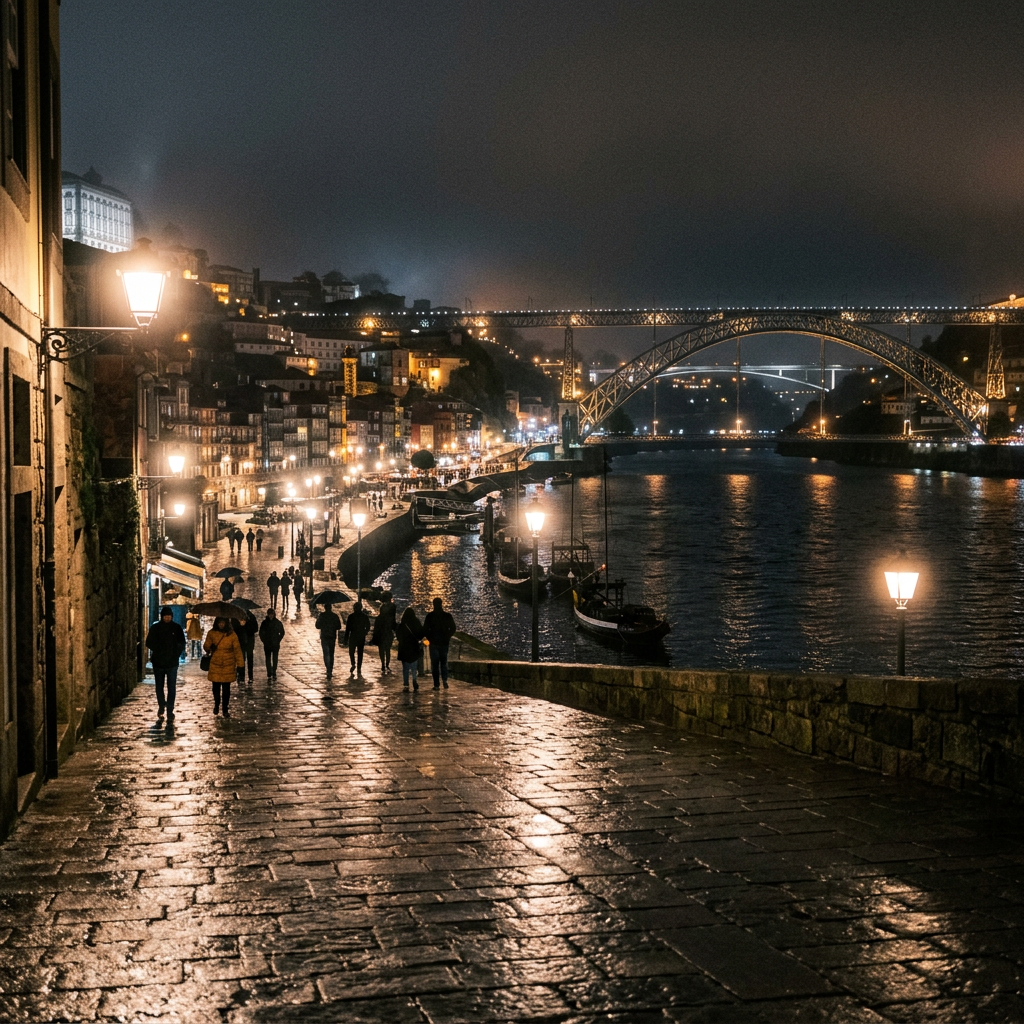
The Night the Cobblestones Wept Silver
There are some tales that refuse to be buried by time, and the legend of The Bowl of Weeping Stones is one of them. On a wind-scoured night in Porto’s historic Ribeira district, the ancient cobblestones are said to have glistened not with rain, but with something far more sorrowful: molten silver that dripped like tears from a cursed gambling bowl. This is not a ghost story for the faint of heart; it is a judgment tale passed down through generations, a warning whispered by the Douro River winds. On that fateful evening, the city itself became a courtroom, and the stones, the weeping jury.
Judgment Falls on Porto’s Ribeira District
The Ribeira, with its narrow alleys and tiled rooftops, has always been a place of secrets. But on the night in question, the air thickened with an unnatural pressure. Locals speak of a strange silence that fell over the taverns—no laughter, no clinking glasses, only the distant sound of water lapping against the quay.
- The Omen: Fishermen claim the river ran black as ink, refusing to reflect the moon.
- The Silence: Street musicians packed their guitars, and even the feral cats retreated to the rooftops.
- The Presence: A heavy, almost metallic scent wafted from the sewers, mixing with the cheiro of port wine.
It was into this charged atmosphere that a solitary figure emerged—a gambler who had staked everything on a single roll of fate. He carried with him a bowl of silver, intricately carved with shapes that seemed to writhe when viewed sideways. This was no ordinary gaming vessel; it was a Weeping Stone, an artifact said to hold the tears of those who had lost their souls to luck.
> “The house always wins,” the old dock workers would mutter, “but on this night, the house was the city itself.”
A Platform Buried, a Bowl of Tears Unleashed
The gambler climbed the steps to the upper platform, a stone terrace that overlooked the river. The crowd that gathered was silent, their faces half-lit by flickering oil lamps. He placed the bowl on the ground, and then, with a trembling hand, he cast his dice. The result was not a number—it was a judgment.
- The First Roll: The dice landed, but stuck to the stone, as if held by an unseen hand.
- The Second Roll: The bowl began to hum, a low frequency that vibrated in the chests of all present.
- The Third Roll: Silver tears poured from the bowl’s rim, not hot, but cold as the river below.
The cobblestones absorbed the liquid, and in that instant, they began to weep. Some say the stones turned translucent, revealing the faces of past gamblers, their mouths open in silent curses. The platform itself seemed to sink, as if the weight of a century of sin had finally become too heavy to bear. The gambler fell to his knees, not from sorrow, but from a sudden, crushing awareness that he had been judged not for his bet, but for his hubris.
Reflections of Guilt in the Weeping Stones
The following morning, the Ribeira was unrecognizable. The stones that had wept silver were now cracked and discolored, marking the spot with a permanent stain. But the true horror wasn’t in the physical damage; it was in what the locals saw when they looked at those stones.
- Personal Visions: Each person who approached the site saw their own greatest shame reflected in the metallic residue.
- Collective Guilt: Merchants saw themselves cheating customers; lovers saw their infidelities; priests saw their misplaced faith.
- The Echo: A faint sound of weeping could be heard from the stones at midnight, but only by those who had wronged another.
The bowl itself was never found. Some claim it was swept away by the river, others that it was buried beneath the platform, its weeping silenced only by the weight of earth. But the Weeping Stones remained as a mirror, forcing every passerby to confront the debts they thought they had hidden.
> “You cannot bury a promise,” an old wine-seller once told me. “Just as you cannot bury a lie. The stones remember what the heart forgets.”
The Echo of Gambling’s Fallen Reign
Today, the Ribeira is a UNESCO World Heritage site, bustling with tourists and street performers. But those who know the whispers avoid a specific spot near the riverfront—a patch of cobblestones that seem oddly darker than the rest, perpetually damp even in summer.
The legend of The Bowl of Weeping Stones serves as Porto’s most poignant reminder: that every wager carries a consequence, and every judgment eventually finds its court. The gambler who brought the bowl was never seen again, but his lesson remains etched into the city’s stone veins. When you walk through Porto’s old quarter, listen closely. The stones still weep for those who dare to test fate without paying the price.
Final thought: In the game of life, the house always collects. Sometimes, it collects in silver tears.
Leave a Reply