The First Chime That Refused to Fade
It began, as most unsettling things do, with a small detail out of place. The old clock in the village square, a wrought-iron behemoth that had marked every passing hour for three centuries, struck five o’clock just as the sun dipped behind the jagged horizon. The chime was deep, resonant, and final—a sound that usually ushered in the peaceful purple of twilight. But this time, the last note lingered. It hung in the air not for a second, but for the span of a held breath, then a full minute, then an impossible eternity. People stopped in the cobblestone streets, glanced up at the motionless minute hand, and felt a faint, collective shiver. The chime had refused to fade. It was as though time itself had stuttered, and in that stutter, a crack appeared—a crack through which the rest of the world began to slip.
When Twilight Trapped the Village Clock
By the sixth chime, the sky had not darkened further. The sun, a half-disc of molten gold, stayed fixed on the horizon, casting long, identical shadows that did not shift. Birds froze mid-flight. A dog, caught in the act of yawning, remained with its mouth open. The village was not merely paused; it was trapped in a single, amber slice of evening. The clock’s hands quivered between five and six, a constant, vibrating motion that advanced nowhere. Every attempt to leave the square ended the same way: a walk of ten steps away, only to find oneself back at the clock’s base, the unfinished chime still ringing in one’s ears. The loop was not a metaphor. It was a cage made of twilight and brass, and everyone inside it was a prisoner of the hour that would not end.
A Thief’s Hour in the Farmhouse Attic
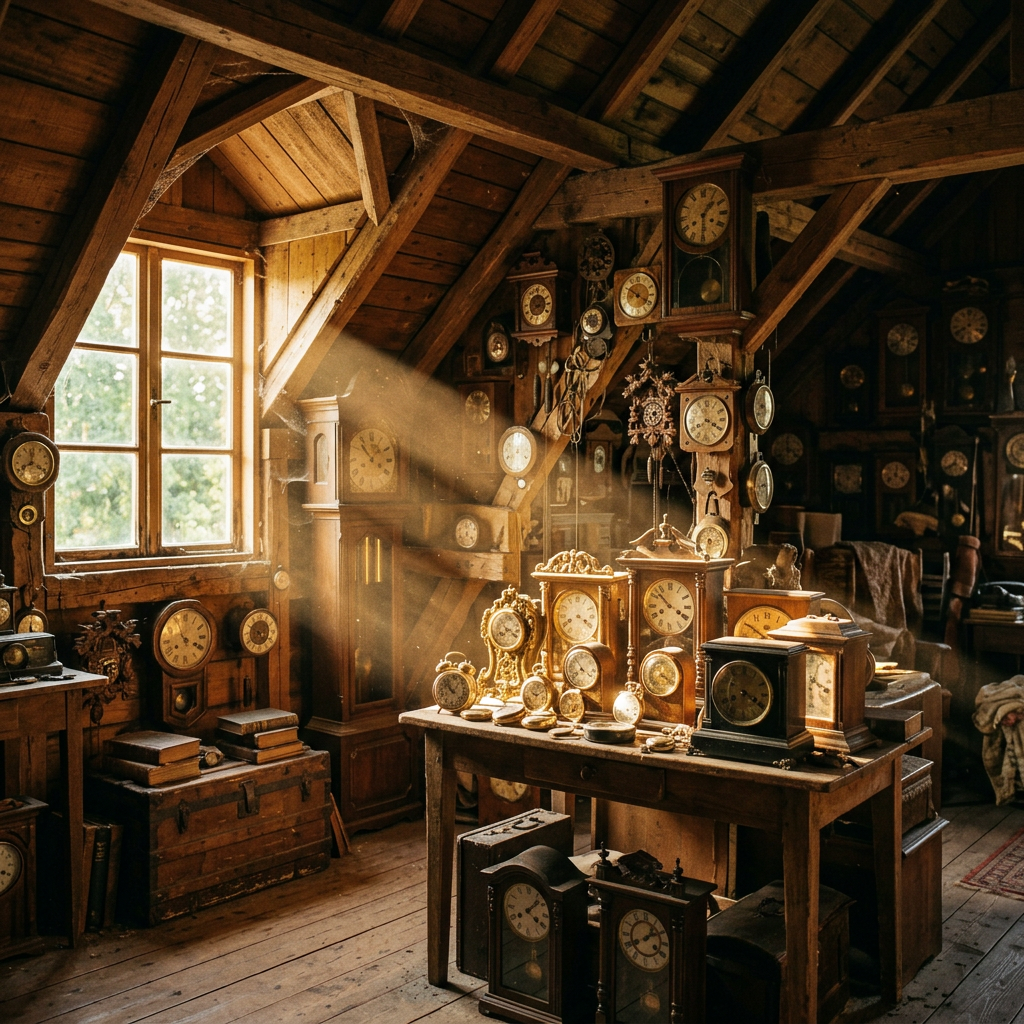
For Marta, a traveler known for her quick fingers and quicker lies, the loop was an opportunity. While others panicked, she slipped away from the crowded square into the old Drummond farmhouse, a place she had scouted weeks earlier. The attic was her target: a dusty chamber filled with porcelain dolls, moth-eaten quilts, and a silver jewelry box believed to hold a forgotten heirloom. She had exactly one hour—an hour that never ended. She picked the attic lock, sifted through silk-lined drawers, and found the box. Inside lay a simple, carved whistle. Disappointed, she almost tossed it aside, but then she heard it: a low hum emanating from the whistle, perfectly in tune with the stuck chime. In that endless hour, time was not broken—it was awaiting a key. The thief’s greed had led her to the very instrument that could either shatter the loop or lock it forever.
The Bowl’s Murmur Through Endless Rings
Down in the village’s oldest tavern, an earthenware singing bowl sat untouched on a dusty shelf. The bowl was a relic from a forgotten monastery, its surface etched with spirals that echoed the shape of a snail’s shell. As the clock chime repeated for the hundredth time, the bowl began to vibrate. It did not ring; it murmured, a sound like water flowing backward. The tavern keeper, a woman named Elara, pressed her ear to its rim and heard fragments of conversations that had not yet happened, and whispers of moments that had already passed. The loop was not a flat circle. It was a spiral, and the bowl’s murmur traced its curves. Each endless ring of the chime brought the bowl’s tone closer to a single, perfect pitch—a note that, if struck correctly, could align all the trapped threads of time. Elara realized she had a choice: let the murmur guide her, or let the silence of the spiral consume her.
Dawn That Never Broke the Loop’s Grip
And yet, dawn never came. The sun remained a frozen disc, the shadows never lengthened, and the clock’s hands danced their endless, frantic step. The villagers, who had first prayed, then wept, then argued, had now fallen into a quiet stupor. They learned to live in the endless twilight: eating when hungry, sleeping when exhausted, each action a repetition of the one before. The loop’s grip was not violent—it was seductive. It offered the comfort of predictability, the safety of a perfect, unchanging moment. Marta, with the carved whistle in her pocket, stood beside Elara, who held the murmuring bowl. The thief had the key, the keeper had the song, but neither could decide to use them. To end the hour would mean facing an uncertain future, a tomorrow they could no longer imagine. The loop had become their home, and they were its reluctant guardians, trapped not by magic, but by the fear of what lay beyond the chime.
> The nature of time is not a river but a vine. It can be pruned, knotted, or left to grow wild. The only thing more terrifying than being caught in a loop is realizing you might not want to leave.
Conclusion: The Echo After the Loop
The hour that would not end eventually did—not with a bang, or a shattered clock, or a triumphant sunrise. It ended with a choice so small it was almost invisible. Marta, standing in the square, finally raised the whistle to her lips. Elara, at the tavern door, struck the bowl with a single, gentle tap. The two notes combined, not in harmony, but in a dissonance that broke the universe’s hold on that perfect twilight. The clock chimed once more, and this time, the sound faded. The sun dipped below the horizon, the birds flew on, and the dog finished its yawn. The villagers blinked, as if waking from a shared dream, and returned to their lives. But they all carried within them a strange knowledge: that time is a fragile thing, easily bent, and that sometimes, the most profound moments are the ones we choose to release. The loop was gone, but its echo—a faint, lingering chime in the back of every mind—would never truly end.
Leave a Reply