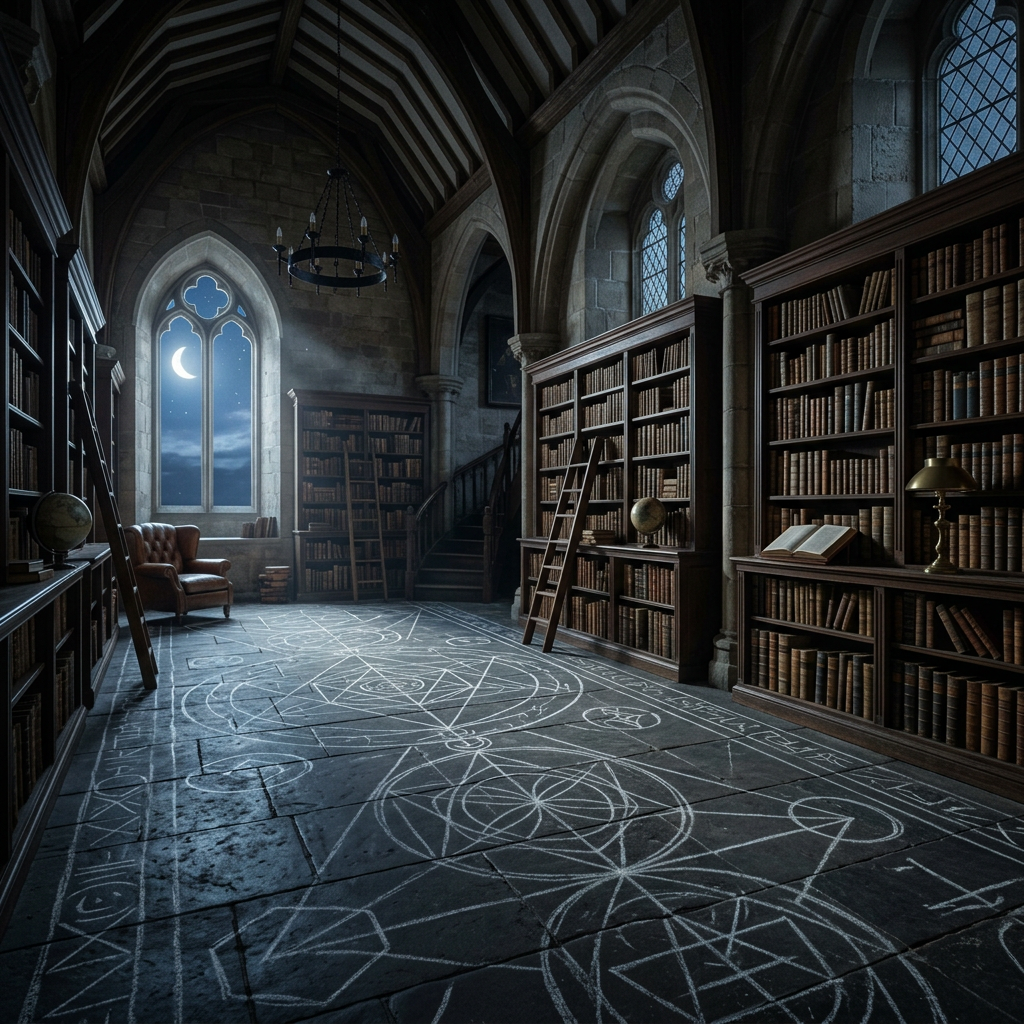
It begins, as all great disturbances do, not with a bang, but with a mop bucket. The story of the Seal of Unseen Hands is not one of wizards or warriors, but of a man whose truest weapon was a tattered ring of keys. He was the keeper of the night shift, a ghost in the fluorescent glow of a university’s oldest library. His name was Elian, and he saw what no faculty member ever bothered to notice: the dust, the silence, and the quiet geometry of forgotten things.
The Ledger Finds a Keeper in Dust
Elian’s world was one of classified fragments. His true ledger was not a book of financial records, but the pattern of wastebaskets knocked over, the specific tilt of a painting that always went askew, and the faint smudge of a handprint on a high, dusty window. He spent decades reading these signs, understanding the silent language of a building that was, in fact, breathing.
- The Dust Map: He knew which shelves were disturbed by students and which were left untouched for decades.
- The Broken Clock: He noted the precise minute the antique clock in the Rare Collections wing stopped ticking every third Thursday.
- The Echo: He could tell which floorboards were hollow by the weight of a footstep, identifying passages no architect had drawn.
This was his real ledger. It recorded the movements of the living, the dead, and the things that never were alive at all.
A Whisper in the Circuitry of Silence
Silence in a library is not a void; it is a container. One night, Elian noticed a change in the container. While cleaning the sub-basement, a room labeled “Cartography – Deferred,” he heard a whisper that was not a sound, but a pressure against the eardrum. It emanated from a locked cabinet covered in a patina of neglect.
He pressed his ear to the cold metal. The whisper was the sound of a tiny, mechanical circuitry—a pattern of clicks and ticks that mimicked the sounds of the building above. It was a shadow of the library. A sonic ghost.
> > “The most dangerous secrets are not those that are hidden,” Elian muttered to himself, “but those that are merely waiting for the right janitor to overhear them.”
Every night for a month, he charted the pattern. The clicks formed a map of disturbances: a door opened too fast here, a book dropped there. But the circuit was not just recording. It was reacting.
Beholding the First Pattern Beyond Chance
The breakthrough came when Elian poured his findings into a single, late-night observation. He realized the whispers were not random. They formed a constellation of tiny failures. When he mapped these failures against the library’s master floor plan, a shape emerged.
It was a pentagram of sorts, but organic. The points were not drawn with ink, but with the location of a dropped pencil, a slipped bookmark, a sudden draft from a crack in the foundation. This pattern was beyond chance. It was a signal. Someone—or something—had engineered the library’s very atmosphere to generate these signals.
- The First Node: The book De Motu Cordis by William Harvey (a study of circulation).
- The Second Node: A map of the London Underground (a study of movement).
- The Third Node: A misplaced globe (a study of orientation).
These were the Unseen Hands at work—not hands of flesh and blood, but of intention imprinted on objects.
Breaking the Seal in a Janitor’s Coat
To break the seal, Elian knew he could not use force. The lock on the cabinet was a fake; the real lock was the pattern. If he disturbed the pattern, the seal would collapse, but so would the information within. He had to be the janitor—the humble servant of order.
He gathered his tools: a single key that had no lock in the building, a length of string, and a container of industrial-grade ammonia cleaner. The ammonia was the key.
- Step One: He placed the key on the center of the circuit diagram he had drawn on his mop bucket.
- Step Two: He traced the string along the path of the “failed” whispered patterns, connecting the nodes once more.
- Step Three: He popped the seal on the ammonia, letting the fumes rise to the ventilation shaft. The ammonia interacted with the ancient varnishes in the room, creating a chemical reaction that shorted the latent electrical fields in the dust.
There was a pop. A flash of light that had no heat. The cabinet door swung open.
Inside was not a treasure, but a single black feather and a piece of paper. On the paper, written in ink that shifted colors when the light hit it, was a single phrase: “The seal was never meant to keep you out. It was meant to keep them from waking up.”
The Dawn That Overthrows Random Shadows
Elian did not become a celebrity. He did not publish a paper. He simply went back to his mop bucket. But something had changed. The random shadows in the library—the draft that never made sense, the book that fell off a shelf at 3:15 AM—ceased. The building stopped breathing its chaotic whisper.
> > “The janitor’s job is not to clean up after the chaos,” he wrote in his own small diary. “It is to recognize when the chaos is a message, and to answer the door when it knocks.”
The Dawn he experienced was not a rising sun, but a new understanding. The Seal of Unseen Hands was a warning system. The hands were not malevolent; they were guardians, asleep and waiting for a signal to return. By breaking the seal in the right way, Elian had not unleashed them. He had simply acknowledged their existence.
Conclusion
In the end, the greatest revolutions are not fought with fire and steel, but with a sharp eye, a steady hand, and the courage to ask why the dust lies a certain way. The janitor who broke the seal taught us a profound lesson: the universe is full of patterns that are too large for the scholars to see, but just the right size for a janitor’s coat. The shadows we fear are often just the backside of a light we have not yet learned to face. And sometimes, the most important key is the one that opens nothing but a question.
Leave a Reply