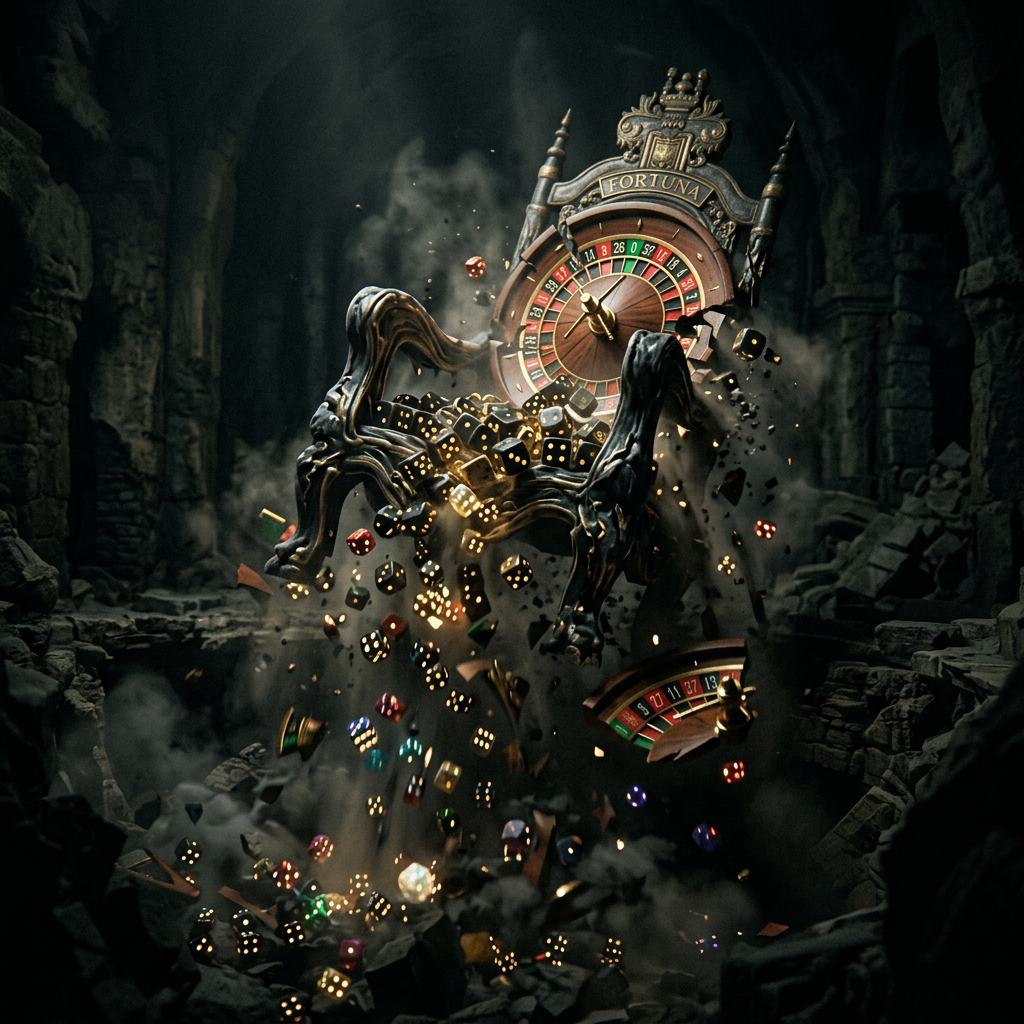
In the great theater of strategy, whether in markets, games of chance, or the high-stakes world of leadership, a quiet war is always being waged. One side revels in the chaotic thrill of probability, betting on luck and the fleeting windfall. The other side stands firm on the immutable laws of order and clarity. The story of the “Chance Lords” and their inevitable fall is not just a fable; it is a strategic reality. This article explores how a kingdom built on randomness collapses when faced with the unyielding pattern of the Ledger.
The Rise of the Probability Dominion
The Chance Lords did not seize power through strength of will or superior knowledge. They rose by exploiting the volatility of uncertainty. In an age of information overload and rapid market swings, they offered a seductive shortcut: a bet on the improbable. Their dominion was built on three pillars of chaos:
- The Gambler’s Fallacy: Believing that a losing streak must be followed by a win.
- Herd Momentum: Following the crowd into bubbles, fueled by nothing more than collective belief.
- Short-Term Miracles: Celebrating random spikes in fortune as “genius” rather than luck.
Their throne was a spin of the wheel, and their court celebrated the thrill of the unknown. They promised wealth without work, certainty without evidence, and power without discipline. For a time, it seemed the empire would never end.
Chaos Weapons and the War on Order
To maintain their reign, the Chance Lords deployed potent weapons designed to undermine long-term thinkers. These chaos weapons attacked the very fabric of clarity:
- Noise disguised as signal: They flooded the market or battlefield with irrelevant data, making clear decisions impossible.
- Emotional volatility: They triggered fear and greed in equal measure, ensuring that no rational plan could survive.
- The illusion of control: They offered complex, probabilistic models that felt scientific but were built on sand.
Their war was not against a physical army, but against the quiet, persistent work of the Ledger’s Keepers—those who tracked true value, recorded real outcomes, and ignored the noise. The Keepers were slow, boring, and unflashy. They were easy to mock.
The Ledger’s Unbroken Pattern Endures
The Ledger is not a physical book; it is a metaphor for systematic, unemotional record-keeping. It represents the principle that truth, over time, is revealed. The pattern it endures is simple:
> Clarity wins in the long run. Randomness is a loan that always comes due.
The Ledger’s unbroken pattern is built on these foundations:
- Consistency over time: A single lucky trade is meaningless; consistent profit or growth requires a real edge.
- Verifiable data: Every assumption is tested against reality, and every failure is recorded as a lesson.
- Discipline in execution: The pattern does not change based on mood or market noise.
The Keepers did not fight chaos with more chaos. They countered it with boredom, patience, and an unwavering commitment to the Ledger’s truth.
Fall of the Throne Built on Randomness
The fall of the Chance Lords is not dramatic—it is mathematically inevitable. A fortune built on randomness will eventually meet a streak of bad luck that destroys it. The throne crumbles under its own weight because:
- Variance catches up: Unlikely wins are always balanced by unlikely losses over a large enough sample.
- No sustainable edge: Without a real systemic advantage, the probability is set against the gambler.
- The crowd leaves: When luck runs out, followers abandon the Lords, leaving them isolated and exposed.
The moment of clarity is brutal. The leader who once seemed invincible is revealed as a charlatan. The empire that seemed eternal collapses in a single trade, a single election, or a single unexpected event.
> “The universe does not pay you for being lucky. It pays you for being right, over and over, without exception.”
Clarity’s Victory Over Chance’s Empire
In the aftermath, a new order arises—not one of flash, but of substance. Clarity does not defeat Chance in a single battle; it wins by outlasting every storm. The victory is established through:
- Transparent systems: Every action is traceable, every outcome is explained.
- Long-term metrics: Success is measured not by spikes, but by stable, upward trends.
- Resilience to chaos: The system is designed to absorb shocks without breaking.
The lesson of the Ledger is both simple and profound: You cannot build a legacy on luck. The Chance Lords fall because randomness is not a foundation—it is a trap. Clarity endures because it is built on truth, repeated over time.
In your own life, business, or strategy, ask yourself: Are you playing the Chance Lord’s game, hoping for a lucky spin? Or are you keeping the Ledger, recording every lesson, and building a fortress of unshakeable clarity? The choice is yours, but the outcome is already written in the numbers.
Leave a Reply