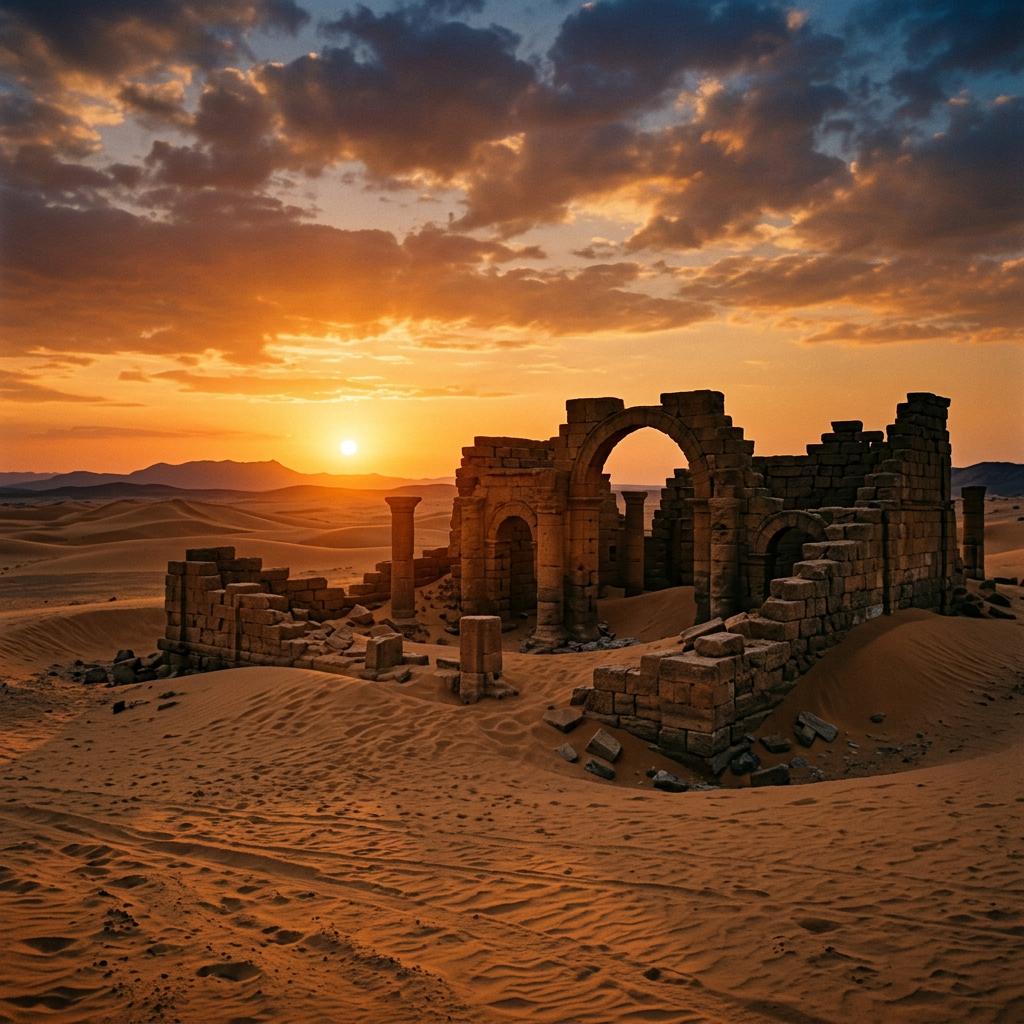
Beneath the scorching sun and shifting sands, the world’s great deserts hold more than heat and silence. They are vast libraries of stone and dust, preserving the bones of civilizations that once thrived where rain fell and rivers ran. From the Sahara to the Arabian Peninsula, these arid landscapes whisper a solemn truth: we are not the first to face collapse, and we will not be the last. This article explores what the desert remembers—and what it warns us about today.
The Desert’s Silent Archive: Empires Lost to Time
The desert is a relentless archivist. It buries cities, mummifies forests, and etches the outlines of long-vanished lakes into its bedrock. Consider these examples of empires preserved in sand:
- The Garamantes of Libya: A sophisticated civilization that built underground irrigation channels (foggaras) to farm the Sahara. Over-extraction of water led to their decline.
- The Nabataeans of Petra: Masters of water conservation in the Arabian desert, they carved entire cities from rock. Their empire fell after Roman conquest and shifting trade routes.
- The Ancestral Puebloans of the American Southwest: They built cliff dwellings and complex water systems, only to abandon them after a prolonged drought in the 13th century.
> Key insight: Each of these cultures left a physical record of their limits—a warning etched in stone, salt, and abandoned terraces. The desert does not forget.
When Prophecy Was Ignored: Echoes of Ancient Warnings
Ancient texts and oral traditions often spoke of the danger of overstepping nature’s boundaries. In Mesopotamia, the Epic of Gilgamesh describes a sacred cedar forest guarded by the god Enlil; cutting it down brought divine punishment. In Egypt, the Prophecy of Neferti warned of a time when “the river of Egypt is dry… and one crosses the water on foot.”
These were not mere superstitions. They were ecological observations wrapped in metaphor:
- Overgrazing and deforestation led to soil erosion and desertification in the Fertile Crescent.
- Salinization from poor irrigation turned once-fertile fields into salt flats.
- Climate shifts—often gradual, sometimes abrupt—made water sources vanish.
Yet, as the historian Ibn Khaldun observed in the 14th century, dynasties often collapsed because they forgot the practices that sustained them. The warnings were there; they were simply ignored.
The Wagered Kingdoms: Nations That Gambled With Fate
Some kingdoms made deliberate, high-stakes bets against their own environment:
- The Maya lowlands: They expanded agriculture into marginal rainforest soils. When megadroughts struck between 800 and 1000 CE, their food system failed. Cities were abandoned within a generation.
- The Khmer Empire at Angkor: A massive hydraulic network of reservoirs and canals allowed for dense urban life—until the system broke under the strain of deforestation and extreme monsoons.
- The Aksumite Empire in East Africa: A powerful trading state that exhausted its soils through intensive farming and deforestation, leading to famine and political collapse.
> Lesson: These kingdoms did not lack knowledge—they had sophisticated understanding of their environments. They wagered that growth would outpace limits. It never does.
Rise and Ruin: The Pattern That Keeps Repeating
History shows a recurring cycle:
- Innovation unlocks new resources and growth.
- Expansion pushes against ecological limits.
- Warning signs appear (salty soil, drying wells, crop failures).
- Denial or short-term fixes delay action.
- Collapse comes fast—sometimes within decades.
This pattern is not limited to ancient times. Modern examples, from the Aral Sea’s disappearance to the Dust Bowl of the 1930s, show that we are still susceptible to the same hubris. The difference today is scale: our civilizations are global, and the limits we push are planetary.
Remembering the Threshold: Lessons the Desert Saves
The desert teaches us to respect thresholds. It shows that:
- Freshwater is finite: Ancient aquifers are still being depleted faster than they recharge.
- Soil is living tissue: Once lost to erosion, it takes centuries to rebuild.
- Climate is not static: The “normal” we assume is a snapshot, not a guarantee.
Practical steps we can take, informed by ancient wisdom:
- Monitor water tables like the Nabataeans did with their cisterns.
- Rotate crops and use polyculture to maintain soil health, as Andean and Asian farmers have done for millennia.
- Build with local, sustainable materials to reduce energy and transport costs.
- Plan for drought, not just abundance: Store reserves before shortages hit.
> Final reminder from the desert: What is buried can be excavated, but only if the warnings are heeded. The sand may cover the past, but it does not erase it.
Conclusion
The desert remembers what we often forget: that every civilization lives within a fragile envelope of water, soil, and climate. From the lost cities of the Sahara to the abandoned pueblos of the Southwest, the message is consistent and clear—abundance can blind us to limits. Today, as we face global warming and resource depletion, the ancient warnings are more relevant than ever. We can still choose to listen, before the sand shifts again.
Leave a Reply