The Hour When Truth Awakens
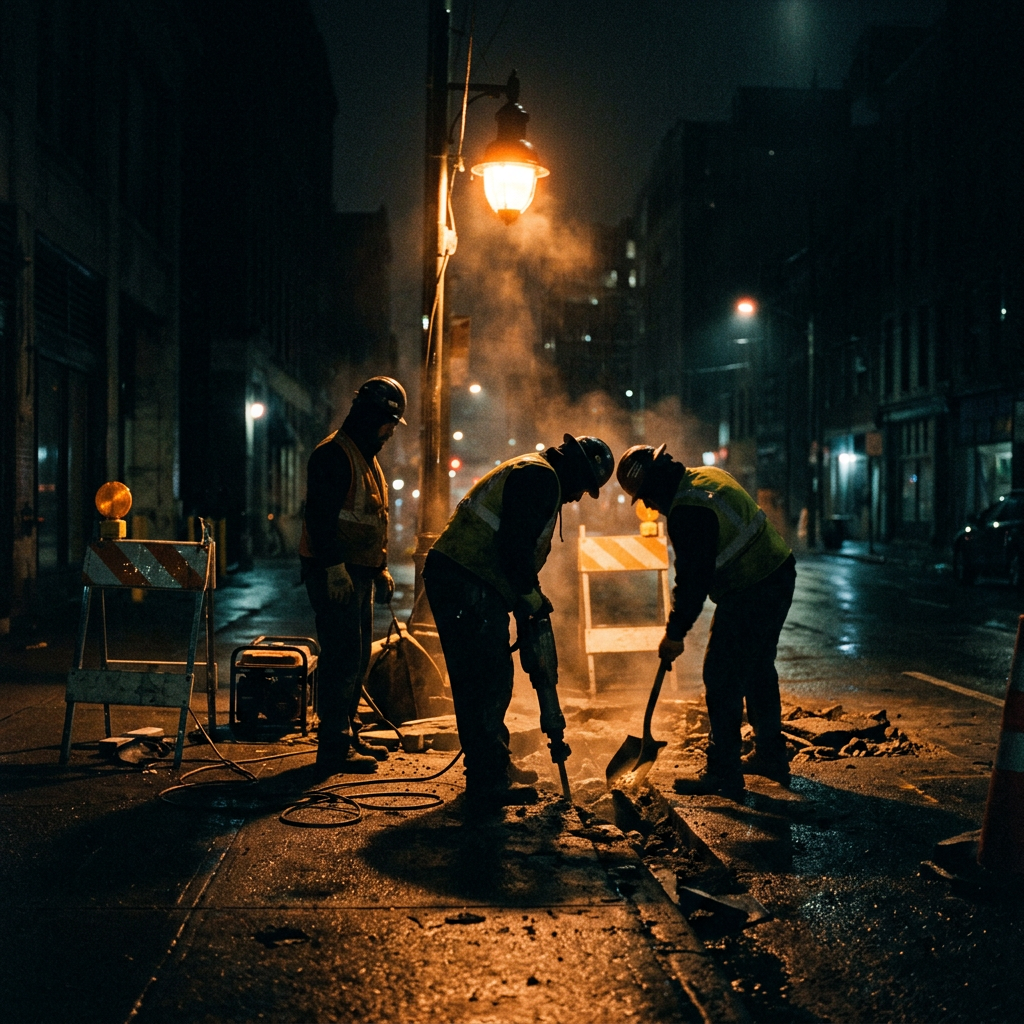
Between 2:00 AM and 4:00 AM, the world holds its breath. Streetlights hum a lonely frequency, and the silence is so thick you can almost taste it. This is the graveyard shift—a strange, suspended dimension where society’s daytime masks slip off and raw human truth rises to the surface. On these shifts, I became a collector of stories, not through interviews, but through the quiet ritual of observation. Night work isn’t about productivity; it’s about witnessing the unguarded moments that daylight erases. The graveyard shift has a seal: once you hear a story in those hours, you are bound to carry it.
Faces in the Neon Glow
The graveyard shift draws a specific cast of characters—people who exist in the margins by choice or by circumstance.
- The insomniac artist: Often found nursing a coffee at 3 AM, sketching on napkins, muttering about colors that don’t exist yet.
- The trucker on a break: Their eyes carry highway miles, and they speak in short, clipped sentences, as if words are fuel they can’t waste.
- The overnight cleaner: The true philosopher of the late hours; they see the mess everyone leaves behind, both literal and metaphorical.
- The security guard with a novel: They sit in a booth, pretending to read, but they’re actually watching shadows for movement that doesn’t belong.
- The lone musician: Strains of a guitar or a harmonica drift from a back alley, playing a tune that sounds like a question no one can answer.
> Key insight: The graveyard shift is the only time when strangers speak to each other without introduction. The darkness grants a peculiar intimacy—you don’t need names when the clock itself feels like a secret.
These faces aren’t desperate; they are awake by design. They have chosen to inhabit the hours when the rest of the world dreams. In their small rituals—a coffee cup turned just so, a cigarette lit at precisely 3:17 AM—there is a hidden order.
Soldier’s Ghost, Gambler’s Debt
I once met a man at a 24-hour diner who wore a faded military jacket. He sat in the corner booth, the same seat every night, nursing a single cup of coffee until it turned cold. He told me his name was Marcus, and he was a veteran of a war I had only read about in textbooks. Marcus didn’t sleep. He said the night was the only time his ghosts would let him rest—not from haunting, but from judgement.
“He never bet on me,” Marcus said, gesturing to an empty chair. “My brother. He was a gambler. Lost everything. House, car, family. Then one night, he bet on my life. Said I’d die in the desert. I survived. He didn’t.”
The debt Marcus carried wasn’t financial. It was a debt of survival—the guilt of outliving someone’s worst prediction. On the graveyard shift, debts like these are paid in silence. Marcus showed me a photograph: two boys, one in uniform, one in a cheap suit, grinning at a camera. The one in the suit was gone, but his bet lingered in the air like cigarette smoke.
- What the soldier taught me: Some debts can’t be paid with money. They can only be witnessed.
- What the gambler left behind: A curse that forces the survivor to live loudly enough for two.
Marcus stopped coming to the diner after a month. I never learned where he went. But on quiet nights, I still see that empty chair and wonder if his brother’s ghost finally let him go.
Ink on Skin, Stories Unseen
The graveyard shift has a particular fondness for tattoos. In daylight, body art is often an accessory, a fashion statement. At night, it becomes a confession. Late-shift workers at a small tattoo parlor near the depot told me that the most honest customers arrive after midnight.
| Time | Type of Story | Example |
|---|---|---|
| 1 AM – 2 AM | Regret tattoos | Names of ex-lovers, covered or altered |
| 2 AM – 3 AM | Memorial tattoos | Dates of death, abstract symbols for the departed |
| 3 AM – 4 AM | Freedom tattoos | Birds, open roads, broken chains |
| 4 AM – 5 AM | Confession tattoos | Single words like “Forgive” or “Sorry” |
I watched a woman in her 50s get a tiny anchor inked behind her ear at 3:45 AM. She said it was for her daughter, who had sailed away and never returned. The ink was small, but the weight it carried was oceanic.
> Practical tip: If you want to hear someone’s real story, ask them about their tattoo after midnight. The answer will come from a deeper place than their ID badge or their resume.
The Ledger Demands a Witness
Every graveyard shift worker knows about the Ledger. It’s not a physical book—it’s an unspoken agreement that the night’s events must be tallied. Someone must remember the small tragedies and tiny victories. The homeless man who found a warm grate. The nurse who cried in the parking lot after losing a patient. The cook who made a perfect omelet for someone who had lost their appetite months ago.
On my final night of graveyard shifts, an elderly woman handed me a folded piece of paper. Inside was a list—names, dates, and one-line descriptions. “John, 3/14, gave his coat to a shivering stranger. Maria, 7/22, sang to a dying cat. The boy with the red bike, 10/9, shared his last apple.”
“This is my ledger,” she whispered. “I’ve been keeping it for 40 years. Now you carry it.”
She vanished into the dark before I could refuse. The paper felt hot in my hand, like a living thing. The graveyard shift had marked me with its seal. Every quiet hour since, I add to the list. The ledger is never full, but it demands a witness—someone to say, “This happened. This mattered.”
The Last Hour
Dawn breaks slowly on the graveyard shift. The neon lights flicker, surrender, and go out. Birds begin a hesitant chorus. The streetlights, now useless, stand like tired sentinels. The characters disperse—the trucker hits the road, the artist folds her napkins, the cleaner pushes a mop for the last time.
> Final thought: The graveyard shift doesn’t end when the sun rises. It ends when you finally understand that the most ordinary night holds more poetry than a thousand days. The seal of the midnight witness is not a burden—it’s a privilege. To see the world when it’s not trying to be seen is to know it intimately, scars and all.
So if you ever find yourself awake at 3 AM, staring out a window, remember: you are not alone. Somewhere, another witness is keeping the ledger. And your story—whatever it is—has already been written in the ink of starlight and streetlamp glow.
Leave a Reply