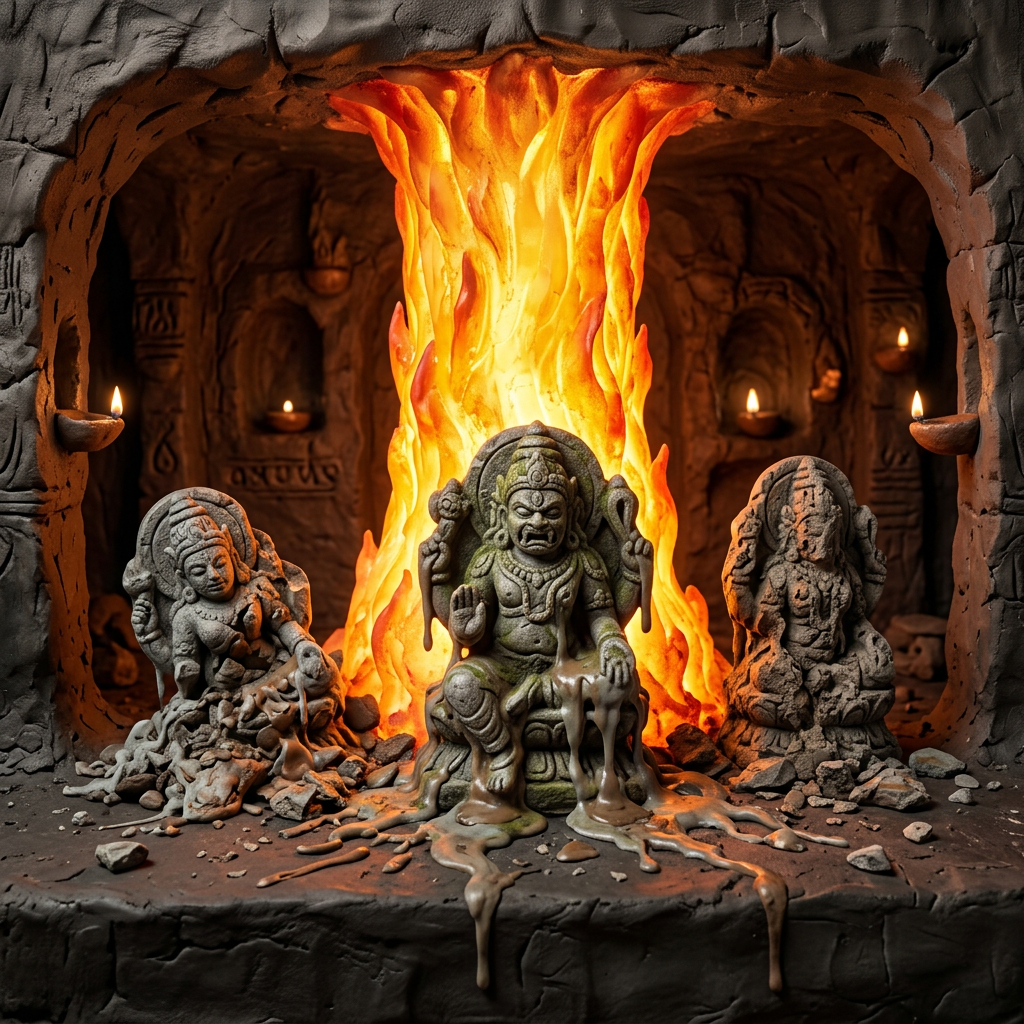
In a world where time was kept not by clocks but by the slow dying of ancient embers, there existed a story so old that even the stones had forgotten its beginning. It was not a tale of heroes or kings, but of a Throne of Flame—a seat of pure, sentient fire that did not destroy, but remembered. This is the account of how that throne rose from the ashes of a forgotten epoch and burned a truth into the fabric of existence.
The Shadowless Flame and the Forging of Memory
Unlike any fire in the mortal realm, this flame had no shadow. It cast no darkness, for it was born from the absolute light of pure intent. It was forged in the silence that preceded the first word, in the heat of a star that had never dimmed.
- Memory as Fuel: This fire did not feed on wood or oil. It fed on experience. Every sorrow, every triumph, every silent prayer—the throne absorbed them all.
- The Forging Process: It was not hammered by a smith, but woven by the collective consciousness of a dying civilization. They poured their entire history into the flame, hoping it would survive their end.
- A Silent Sentinel: The throne sat empty for eons, a repository of a world that was no more, patiently waiting for a soul willing to sit upon it.
The key to understanding this artifact is that it was not a weapon. It was a library with a pulse.
Witnessing the Throne Amid the Twenty-Ninth Bowl
The “Twenty-Ninth Bowl” is a reference in old scripture to the last and most obscure of the celestial vessels that carried the echoes of creation. It was inside this bowl—a metaphysical space of raw potential—that the throne was first glimpsed by a living being.
> “To look upon the Twenty-Ninth Bowl is to look upon the emptiness that existed before your own name was spoken. To see the throne within it is to see yourself as a memory you have not yet lived.”
The witness was a wanderer named Elara, a woman who had lost her past to a plague of forgetting. She entered the bowl seeking her own memories, but found the throne instead. She described the sight as overwhelming, yet gentle. The flames whispered in voices she almost recognized—the voices of a billion lives that had already ended. It was not a place of judgment, but of quiet revelation.
When the Idols of Chance Burned to Ash
For millennia, humanity worshiped the Idols of Chance—fickle deities of luck, fate, and random fortune. These idols demanded sacrifice and offered no guarantees. They were the scaffolding of a fearful world.
When the Throne of Flame was revealed, a transformation began:
- The Idols Crumbled: The flame did not attack them; it simply revealed their emptiness. Chance is a shadow; the throne was the light that cast it. One by one, the idols of luck and randomness turned to ash.
- People Stopped Gambling: Not just with coins, but with their lives. They realized that living by chance was a betrayal of the memory they carried. The throne taught them that every action was a record, not a roll of the dice.
- Fear of the Unknown Died: When the flame remembered everything, there was no “unknown” to fear. The past was present, and the future was simply a new page in the eternal book of fire.
This was a revolution of the soul. The chaos of probability was replaced by the order of remembrance.
A Throne of Revelation That Cast No Darkness
The most profound lesson of the throne was its lack of shadow. In our world, light creates darkness; every sun has its night. But this flame was different.
- Pure Illumination: It revealed truth without creating a hidden side. There was nothing lurking in the corners of its light.
- No Secrets: Sitting on the throne meant exposing every part of your being to yourself. It was terrifying and liberating.
- The Revelation of Unity: Elara, upon finally gathering the courage to sit, saw that her own lost memories were not gone—they were simply shared with the flame. Her pain was the world’s pain. Her joy was a universal note in a cosmic song.
> “The throne did not show me the future. It showed me that the future is just the past, wrapped in new skin. And that is enough.” — Elara’s final journal entry.
The Truth That Burns Without Consuming the World
In the end, the Throne of Flame did not change the world by force. It changed it by existing. It stood as a constant reminder that nothing is truly lost. The fire burns, but it does not consume the wood of time—it preserves it.
A list of what the throne taught a world that had forgotten itself:
- All pain is sacred: Your suffering is a thread in the tapestry. Do not burn it; weave with it.
- Memory is our duty: To forget is to let the world die a second time. The flame remembered, so we learned to remember too.
- There is no final darkness: Because the flame casts no shadow, there is no end to understanding. The truth is a journey, not a destination.
Conclusion
The Throne of Flame that Remembered the World is not a myth. It is a mirror. Every time we choose to honor our past instead of burying it, every time we share a story instead of letting it die, we build a small throne of our own. The flame lives in us now, not as a god to be worshiped, but as a duty to be carried. It asks only one thing: Remember. Remember everything. For in the fire of recollection, the world is reborn every single day.
Leave a Reply