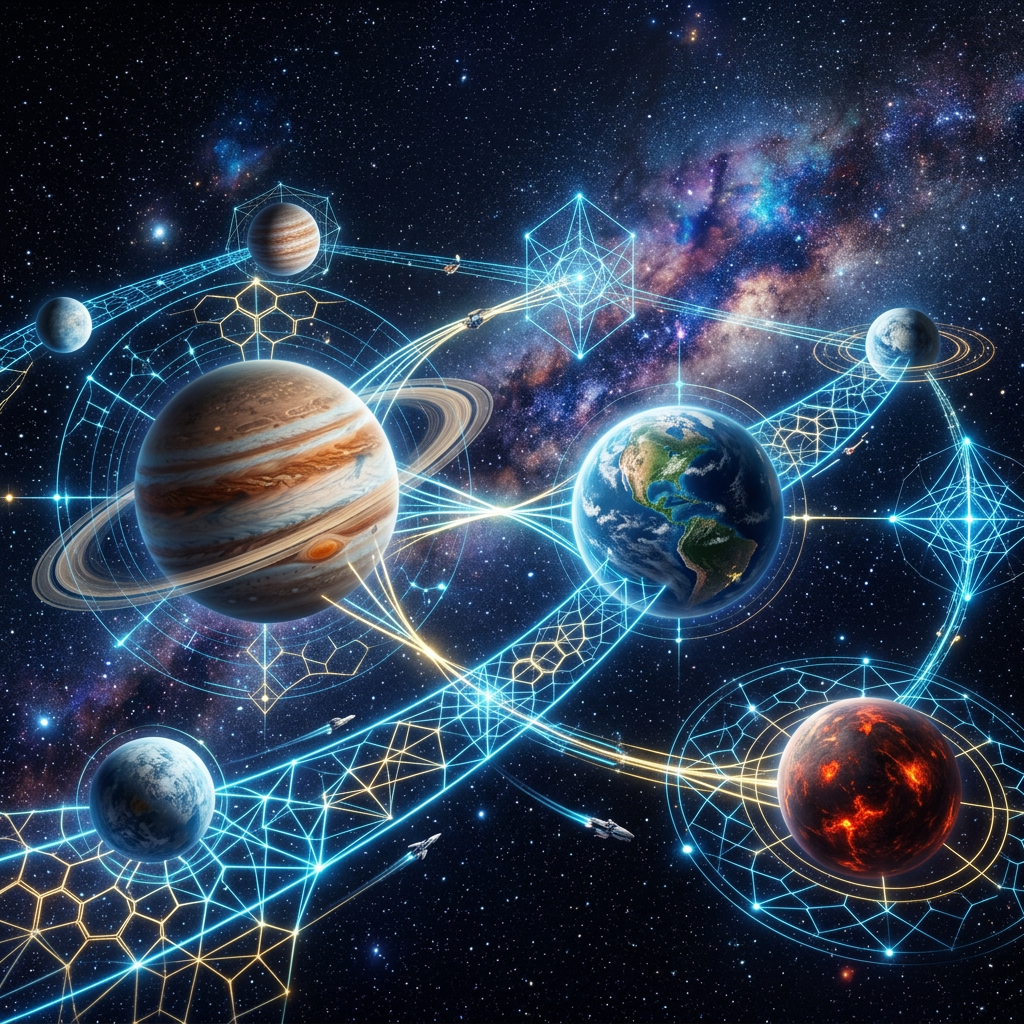
The Nocturnal Revelation: Inked Equations from the Dark
It began not in a lab, nor in a boardroom, but in the restless quiet of a sleepless night. The world was a muted hum—streetlights casting long shadows, the occasional car hissing through wet asphalt. In that solitude, something emerged not as a thought, but as an impression: a sense that beneath the random chaos of daily life, there was a hidden geometry. It felt less like inspiration and more like a mathematical covenant—a silent promise written in numbers, waiting to be read. The equations didn’t arrive as neat formulas; they came as sensations—rhythms, pulses, ratios—inking themselves onto the mind like persistent graffiti. This was no dream; it was a blueprint in the dark, a framework designed to bring order where none seemed to exist.
Beyond Prediction: The Covenant That Rejects Chance
At its core, this covenant challenges the very notion of randomness. We assume the world runs on probability—flipping coins, rolling dice, life as a series of unpredictable events. But what if that’s an illusion? The blueprint suggests a deeper structure, one where recurring patterns aren’t coincidences but signatures of a hidden contract. Consider:
- Natural cycles: from planetary orbits to heartbeats, everything oscillates.
- Human behavior: crowd movements, market flows, even social trends follow statistical rhythms.
- Unexpected synchronicities: moments that feel “too perfect” to be luck.
This covenant doesn’t claim to predict the future; it asserts that chance itself is a language—and we’ve been misreading it. The core principle is not control, but alignment. When you understand the pattern, you don’t force events; you move with them.
> “Randomness is the shadow of a system we haven’t learned to see.”
A Global Heartbeat: Sports as a Stabilizing Rhythm
One of the most compelling manifestations of this covenant appears in the world of professional sports. On the surface, games like football or basketball seem like chaos—sudden injuries, fluke goals, referees’ errors. Yet beneath this noise, there is a predictable pulse. Successful coaches and players don’t just react; they feel the game’s rhythm, knowing when to press and when to hold.
- Tempo control: Teams that win consistently often control the clock, not just the ball.
- Pattern exploitation: Great defenders aren’t faster; they anticipate—they’ve internalized the covenant of the opponent’s habits.
- Energy management: There’s a biological math to substitution—peak performance occurs in narrow windows.
Sports become a stabilizing rhythm for the world because they offer a microcosm of the covenant: a bounded system where the rules are known, and yet creativity thrives within them. When millions watch a game, they aren’t just spectators; they are participants in a global heartbeat, synchronizing their emotions to the same mathematical waves.
> “In play, the covenant is not a cage—it’s a dance floor.”
The Economic Mercy: Absorbing Volatility Before the Crack
Perhaps the covenant’s most urgent application lies in economics. Markets are often described as irrational—driven by fear and greed, prone to bubbles and crashes. But the blueprint suggests that volatility itself can be absorbed rather than amplified. How?
- Resilience frameworks: Instead of trying to predict every shock, build systems that flex—like a bamboo tree in a storm.
- Rhythmic investment: Wealth accumulation works best when aligned with natural cycles (e.g., seasonal spending, generational transfers).
- Distributed risk: The covenant favors many small bets over one big gamble—a form of economic mercy that prevents catastrophic failure.
This is not about eliminating risk, but about designing out panic. When volatility hits, the covenant acts as a shock absorber, turning potential cracks into mere ripples. It’s the difference between a brittle glass and a woven net: both handle pressure, but only one survives.
> “Mercy in economics is not charity—it is architecture that protects the unprepared.”
From Dream to Architecture: A Blueprint Not My Own
Looking back, I realize this blueprint was never mine to claim. It arrived fully formed, like a letter delivered to the wrong address, but meant for everyone. The equations I glimpsed in the dark are ancient—they predate human language, embedded in the crystalline structure of matter and the orbits of galaxies.
Building from that vision meant surrendering authorship. The covenant is not a patent; it is a shared inheritance. To live by it is to acknowledge that:
- You don’t control the current, but you can learn to swim.
- Patterns are not prisons; they are threads to weave with.
- The darkest moments often carry the clearest instructions.
So the blueprint is not a finished building—it’s an ever-unfolding architecture of possibility. It invites you to add your own room, your own rhythm, your own covenant with the unseen.
Conclusion
We are used to thinking of life as a gamble, a series of uncertain outcomes we must navigate alone. But the mathematical covenant whispers a different story: that beneath the noise, there is a silent score—a blueprint drafted in the dark but meant for light. Whether in sports, economics, or the quiet patterns of our daily existence, the invitation remains the same: listen for the rhythm, trust the geometry, and build with what you’ve been given. The dark only seems empty until you learn to read the equations inked within it.
Leave a Reply